


Taiwan ended its trip to the Asian Games with a bang yesterday, as fans were treated to three gold medal competitions in the space of several hours. While not all the results panned out as hoped, it was nevertheless a strong finish for Taiwan, which stands a good chance of finishing in the top 10 in the medal standings after holding sixth place for much of the week.
After winning a tough match against the China team earlier in the day, the Taiwan softball team didn't seem to have much left for its gold medal match against Japan. Japan starter Yukiko Ueno had command of the game from the outset, pitching five perfect innings for the complete game win and sending down six of the first nine Taiwan batters that she faced via strikeouts.
Meanwhile, Taiwan starter Han Hsin-lin got hammered for four runs on six hits in 2.1 innings of work. Reliever Lai Sheng-jung didn't fare much better, surrendering four runs on two hits in just one inning in the eventual 0-7 loss.
However, it took a gritty performance from the softball team earlier in the day just to get to the gold medal game. Facing China in the semi-final match, the Taiwan team quickly found itself in a 0-4 hole after the first inning when starter Wu Chia-yen clearly didn't have her best stuff.
Her teammates helped her out in the top of the second, scoring three runs to cut China's lead to just one, thanks in part to a two-out, two-run home run by Lai Meng-ting, who went three-for-three with four RBI in the game.
China came back again with another four runs in the bottom of the third to extend its lead to 7-3, but that's all it would get, as reliever Lin Su-hua would take the win by quieting the China offense, allowing just one run over the last 2.2 innings for the win.
The Taiwan bats woke up in the top of the fourth to rally for four runs and even the score. Taiwan took its first lead in the top of the sixth with three runs off China reliever Li Qi, who took the loss. The 10-7 win not only earned Taiwan a trip to the gold medal match, but also got some payback for their 5-2 loss to China on Tuesday.
The women's tennis doubles pair of Chan Yung-jan and Chuang Chia-jung took the silver medal after losing their final match in two sets.
They went into the gold medal round as underdogs, facing this year's Wimbledon and Australian Open champions, China's Zheng Jie and Yan Zi.
Despite losing quickly in the first set 6-1, Chan and Chuang made a strong start in the second set, pulling ahead for an early 3-0 lead.
However, it got more difficult from there as the Chinese duo dug in to fight their way back to a 6-6 tie before finally taking the second set and the gold 7-6.
Despite the strong showing from Chang and Chuang, their medal marks the end of a disappointing showing for the tennis team, which had been expected to win several golds but finishes with only one.
The women's basketball team was also scheduled to play China late yesterday in its first ever trip to the finals at the Asian Games. It was expected to be a difficult match against the top-ranked and undefeated China squad, which impressively demolished the Lebanese team 106-30 last week.
With only three players on the China team under 1.83m in height, Taiwan head coach Hung Ling-yao knew beating them would be a tall order, but said the team was ready for the challenge and would go all out.
also see stories:
Asian Games: Taiwan's athletes run out of steam
Asian Games: Indonesians upset about nation's tiny medal haul
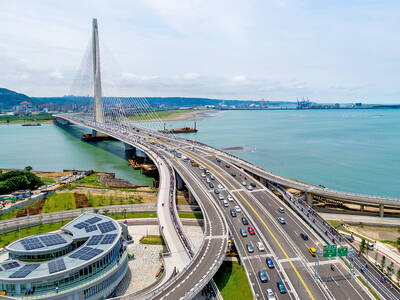
The Ministry of Transportation and Communications yesterday inaugurated the Danjiang Bridge across the Tamsui River in New Taipei City, saying that the structure would be an architectural icon and traffic artery for Taiwan. Feted as a major engineering achievement, the Danjiang Bridge is 920m long, 211m tall at the top of its pylon, and is the longest single-pylon asymmetric cable-stayed bridge in the world, the government’s Web site for the structure said. It was designed by late Iraqi-British architect Zaha Hadid. The structure, with a maximum deck of 70m, accommodates road and light rail traffic, and affords a 200m navigation channel for boats,
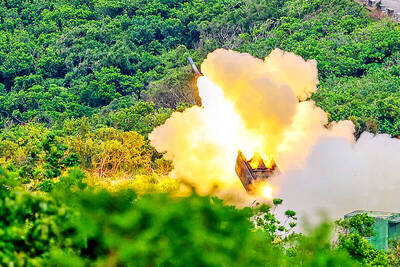
PRECISION STRIKES: The most significant reason to deploy HIMARS to outlying islands is to establish a ‘dead zone’ that the PLA would not dare enter, a source said A High Mobility Artillery Rocket System (HIMARS) would be deployed to Penghu County and Dongyin Island (東引) in Lienchiang County (Matsu) to force the Chinese military to retreat at least 100km from the coastline, a military source said yesterday. Taiwan has been procuring HIMARS and Army Tactical Missile Systems (ATACMS) from the US in batches. Once all batches have been delivered, Taiwan would possess 111 HIMARS units and 504 ATACMS, which have a range of 300km. Considering that “offense is the best defense,” the military plans to forward-deploy the systems to outlying islands such as Penghu and Dongyin so that

WHAT WAS ALL THAT FOR? Jaw Shaw-kong said that Cheng Li-wen had pushed for more drastic cuts and attacked him, just for the outcome to be nearly identical to his bill The legislature yesterday passed a supplementary budget bill to fund the purchase of separate packages of US military equipment, with the combined amount of spending capped at NT$780 billion (US$24.8 billion). The Chinese Nationalist Party (KMT) and Taiwan People’s Party (TPP) used their legislative majority to pass the bill, which runs until 2033 and has two main funding provisions. One was for NT$300 billion of arms sales already approved by the US for Taiwan on Dec. 17 last year, the other was for NT$480 billion for another arms package expected to be announced by Washington. The bill, which fell short of the NT$1.25

‘CLEAR MESSAGE’: The bill would set up an interagency ‘tiger team’ to review sanctions tools and other economic options to help deter any Chinese aggression toward Taiwan US Representative Young Kim has introduced a bill to deter Chinese aggression against Taiwan, calling for an interagency “tiger team” to preplan coordinated sanctions and economic measures in response to possible Chinese military or political action against Taiwan. “[Chinese President] Xi Jinping [習近平] has directed the People’s Liberation Army to be ready to invade Taiwan by 2027. China has a plan. America should have one too,” Kim said in a news release on Thursday last week. She introduced the “Deter PRC [People’s Republic of China] aggression against Taiwan act” to “ensure the US has a coordinated sanctions strategy ready should


 RSS
RSS