


Former minister of justice Chen Ding-nan (
Chen died of lung cancer in National Taiwan University Hospital.
His remains will be brought back to his hometown in Ilan County, where they are to be cremated.
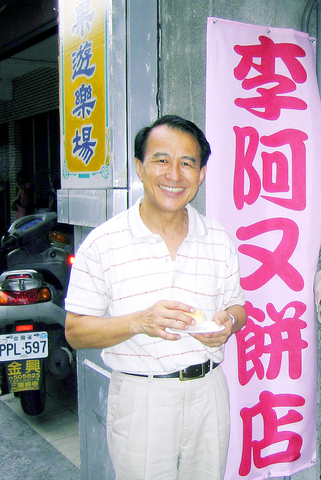
TAIPEI TIMES FILE PHOTO
After Chen was diagnosed with lung cancer in April, he started a blog titled "Good Morning, The Death God," in which he wrote about his experience of his illness.
Chiang Hui-ming (江惠民), head of the Taichung District Prosecutors' Office and a former top aide to Chen, yesterday told the Taipei Times that he could not believe it when Chen was diagnosed with cancer, because the former minister never smoked and had led a healthy life.
Dubbed "Mr Clean" by the media, Chen established the Black Gold Investigation Center under the Taiwan High Court Prosecutors' Office to fight serious corruption right after he assumed his post as minister in 2000.
Unlike his predecessors, Chiang said, Chen never intervened in prosecutors' investigations into sensitive cases.
"Chen gave prosecutors more room and more independence to fight corruption," Chiang said.
Chen also managed to resist pressure from government officials trying to avoid queries from investigators, Chiang added.
During his tenure as justice minister, Chen encouraged his staff to watch CNN daily as a way to improve their English.
He had also set up programs offering scholarships to prosecutors entering masters programs in law at prestigious universities around the world.
Chen had a reputation for strictness. He once told reporters that news agencies kept criticizing him because he always demanded perfection in every aspect of his life and work.
In 2001, Chen implemented a strict regulation stipulating that any gift worth more than NT$30 would be regarded as vote-buying, which sparked criticism from political parties.
Chen, an Ilan native, stepped down as justice minister in January last year to campaign for the Ilan County commissionership.
He officially began his political career when he was first elected Ilan County commissioner in 1981, an office he occupied for two terms, until 1989.
During his eight-year term in Ilan, he cracked down on factory pollution and spent the fines that were collected on cleaning up polluted areas.
Chen's political involvement goes back to his connections with the dangwai movement, the forerunner of the Democratic Progressive Party (DPP).
Many of those involved in the Kaohsiung Incident in 1979 were Chen's high school or college friends.
Murder
The murder of former DPP chairman Lin I-hsiung's (
Before that, as a successful businessman, he constantly donated and supported dangwai activists.
DPP Chairman Yu Shyi-kun yesterday paid a visit to Chen's family in the hospital and offered his condolences.
Funeral
Super Meng (
Chen's former assistant DPP Legislator Lee Kun-tse (李昆澤), said that Chen had been an earnest, honest man.
"A politician like him was exactly what Taiwan needed," Lee added.
Chinese Nationalist Party (KMT) Chairman Ma Ying-jeou (
`Sorry'
"I am very sorry to hear about his death. Minister Chen was a DPP official with integrity and virtue," Ma said while attending the KMT's anti-President Chen Shui-bian (
"Although not everyone agreed with his way of doing things, I think everyone identifies with his principles in maintaining his integrity," Ma said.
High quality
While lauding Chen Ding-nan's "high quality of administration during his term as Ilan County commissioner," the DPP's mayoral candidate for Kaohsiung, Chen Chu (
Additional reporting by Flora Wang, Mo Yan-chih and Jimmy Chuang

PROVOCATIVE: Chinese Deputy Ambassador to the UN Sun Lei accused Japan of sending military vessels to deliberately provoke tensions in the Taiwan Strait China denounced remarks by Japan and the EU about the South China Sea at a UN Security Council meeting on Monday, and accused Tokyo of provocative behavior in the Taiwan Strait and planning military expansion. Ayano Kunimitsu, a Japanese vice foreign minister, told the Council meeting on maritime security that Tokyo was seriously concerned about the situation in the East China and South China seas, and reiterated Japan’s opposition to any attempt to change the “status quo” by force, and obstruction of freedom of navigation and overflight. Stavros Lambrinidis, head of the EU delegation to the UN, also highlighted South China Sea

SILENCING CRITICS: In addition to blocking Taiwan, China aimed to prevent rights activists from speaking out against authoritarian states, a Cabinet department said The Ministry of Foreign Affairs (MOFA) yesterday condemned transnational repression by Beijing after RightsCon, a major digital human rights conference scheduled to be held in Zambia this week, was abruptly canceled due to Chinese pressure over Taiwanese participation. This year’s RightsCon, the world’s largest conference discussing issues “at the intersection of human rights and technology,” was scheduled to take place from tomorrow to Friday in Lusaka, and expected to draw 2,600 in-person attendees from 150 countries, along with 1,100 online participants. However, organizers were forced to cancel the event due to behind-the-scenes pressure from China, the ministry said, expressing its “strongest condemnation”

Taiwan Semiconductor Manufacturing Co (TSMC, 台積電), the world’s largest contract chipmaker, said it expects its 2-nanometer (2nm) chip capacity to grow at a compound annual rate of 70 percent from this year to 2028. The projection comes as five fabs begin volume production of 2-nanometer chips this year — two in Hsinchu and three in Kaohsiung — TSMC senior vice president and deputy cochief operating officer Cliff Hou (侯永清) said at the company’s annual technology symposium in Silicon Valley, California, last week. Output in the first year of 2-nanometer production, which began in the fourth quarter of last year, is expected to
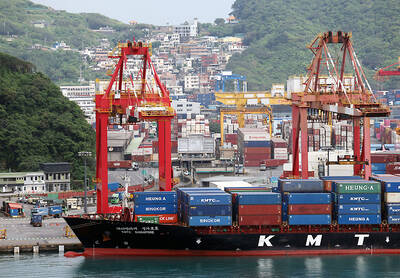
Taiwan’s economy grew far faster than expected in the first quarter, as booming demand for artificial intelligence (AI) applications drove a surge in exports, spilling over into investment and consumption, the Directorate-General of Budget, Accounting and Statistics (DGBAS) said yesterday. GDP growth was 13.69 percent year-on-year during the January-to-March period, beating the DGBAS’ February forecast by 2.23 percentage points and marking the most robust growth in nearly four decades, DGBAS senior official Chiang Hsin-yi (江心怡) told a news conference in Taipei. The result was powered by exports, which remain the backbone of Taiwan’s economy, Chiang said. Outbound shipments jumped 51.12 percent year-on-year to


 RSS
RSS