


Thailand's top junta-appointed anti-graft investigator threatened yesterday to confiscate the assets of overthrown billionaire prime minister Thaksin Shinawatra if he tried to move them overseas.
The warning came just hours after Thaksin's wife, Pojaman Shinawatra, left Thailand to be reunited with her husband in London, where he took refuge after last week's coup.
"As of now, there have been no assets confiscated," said Sawat Chotipanich, head of a high-powered committee set up by the military late on Sunday to probe the books and tax records of Thaksin Cabinet members and their relatives.
"But if there is evidence proving that the suspects are trying to move or transfer assets before a court ruling, we will seek court approval to seize their assets," he added.
"If my committee finds any corruption among former ministers, the committee will prosecute them immediately," he said.
Junta leader General Sonthi Boonyaratglin last week justified the nation's first coup in 15 years by accusing Thaksin of corruption and of insulting King Bhumibol Adulyadej.
Much of the billionaire politician's wealth is held by his wife and their three children.
Meanwhile officials denied he had left Thailand ahead of the coup with an "unusual" amount of baggage, after reports he may have whisked cash out.
Thaksin left for a series of foreign engagements 10 days before his ouster, while a later flight from Bangkok brought officials for a summit in Cuba that picked him up on the way.
Media reports had suggested the two aircraft carried more than 100 items of luggage, hinting Thaksin may have packed them with some of his vast fortune.
But a Royal Thai Air Force spokesman said that "both flights took off from the military airport and the amount of luggage was not unusual."
Three bodies are now probing corruption allegations against Thaksin; the new committee, the auditor general's office with widened powers and a revived nine-member National Counter-Corruption Commission.
Meanwhile, the coup leaders will yield power to a civilian prime minister once an interim constitution is in place later this week, General Winai Phattiyakul said yesterday.
"We are not the prime minister's boss and the prime minister is not our boss," he said.
"After the constitution is announced at the end of this week, the CDR [Council for Democratic Reform] will then transfer to be National Security Council," he said.
Winai said it would take about six months to complete the constitution, which would be subject to final approval by the military. It would then be put to a referendum before elections were held, a process which might take about eight months, he said, adding that the generals would return to barracks only after the election.
"We will assist the next government in looking after the country, to sustain the economic and social stability," he said.
Also see story:
King's siding with coup leaders seen as no surprise
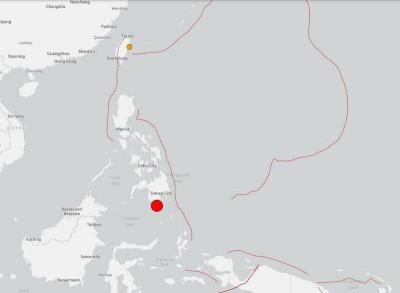
A magnitude 7.8 earthquake struck off the southern coast of Mindanao in the Philippines at 7:38am today, prompting the US Tsunami Warning System to issue an alert for neighboring countries, including Taiwan. The system issued a purple alert indicating a "tsunami threat." The potential threat zone includes Taiwan, the Philippines, Papua New Guinea, Yap and Palau. Philippine authorities were assessing the damage from the quake, with the office of civil defense seeking to verifying initial reports that 15 people had been killed and 129 injured in the region, mostly from falling debris. Arlene Hollero, disaster chief of Maasim town in the Philippines' Sarangani Province,
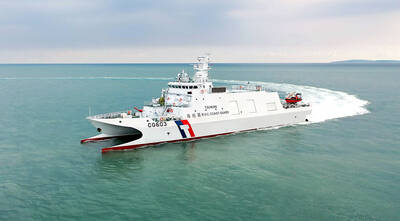
‘GRAY ZONE’ PRESSURE: Beijing’s activities are intended to create the deceitful impression that China has jurisdiction over the area around Taiwan, the CGA said Taiwan’s rights over its territorial waters and exclusive economic zone must not be violated by any country, the Mainland Affairs Council said yesterday, adding that it will not accept any unprovoked actions. The council issued the remarks in response to the China Coast Guard conducting maritime enforcement drills near eastern Taiwan and claiming to fully exercise China’s maritime administrative law enforcement authority. The Coast Guard Administration (CGA) has been closely monitoring the situation and is taking concrete steps to defend the nation’s sovereignty and secure its waters, the council said. China has no sovereign rights over the waters off eastern
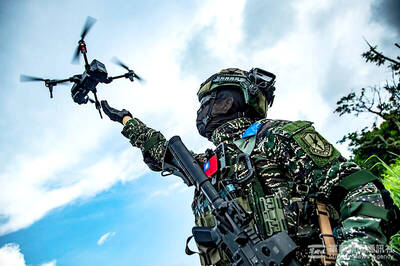
RESILIENCE: Taiwan plays a key role in semiconductors, energy, information infrastructure and advanced manufacturing, AIT Director Raymond Greene said Taiwan’s continued investment in deterrence and resilience remains vital, especially in uncrewed systems and other emerging technologies, American Institute in Taiwan (AIT) Director Raymond Greene said yesterday. Greene made the remarks at the annual National Strategic Summit on Supply Chain Resilience held by the Research Institute for Democracy, Society and Emerging Technology (DSET), a government-backed think tank. As Taiwan last year became the US’ fourth-largest trading partner and supply chain security is becoming more important, cooperation in emerging technologies continues to deepen between the two countries, he said. The US is committed to accelerating innovation, building key infrastructure, strengthening cooperation

RIGHT DIRECTION: Taiwan’s efforts to prevent forced labor include a proposal to ‘fully prohibit’ employers from withholding workers’ documents, an official said Taiwan is to establish a mechanism to restrict imports of goods linked to forced labor, the Executive Yuan said yesterday, after the US proposed imposing additional tariffs on Taiwanese goods over labor concerns. “The Ministry of Labor and the Ministry of Economic Affairs are to establish an interministerial review procedure,” Executive Yuan spokesperson Michelle Lee (李慧芝) said at a news briefing in Taipei. “The government is to use the Foreign Trade Act [貿易法] as the legal basis to restrict imports of goods produced with forced labor” and bring its supply chain governance more in line with international standards on human rights, resilience


 RSS
RSS