


Scientists have discovered a remarkably complete skeleton of a three-year-old female from the ape-man species represented by "Lucy."
The discovery should fuel a contentious debate about whether this species, which walked upright, also climbed and moved through trees easily like an ape.
The remains are 3.3 million years old, making them the oldest known skeleton of such a youthful human ancestor.
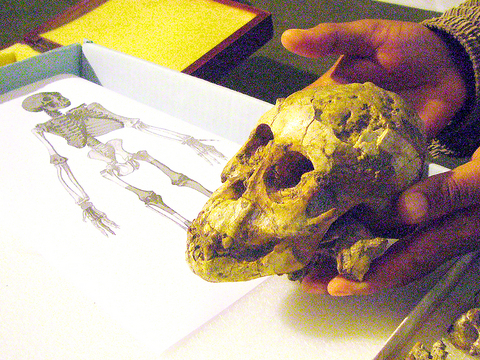
PHOTO: AFP
The fossil including an entire skull, torso, shoulder blade and various limbs was discovered at Dikaka, some 400km northeast of Addis Ababa near the Awash river in the Rift Valley.
"The finding is the most complete hominid skeleton ever found in the world," Zeresenay Alemseged of the Max Planck Institute for Evolutionary Anthropology in Leipzig, Germany, told a news conference.
He said the fossil was older than the 3.2-million-year-old remains of "Lucy" discovered in 1974, and described by scientists as one of the world's greatest archaeological finds.
"The new bones belong to a three-year-old girl who lived 3.3 million years ago -- 150,000 years before Lucy," Zeresenay said.
"Evidence indicates that she probably died in a flood from the nearby Awash River," he added.
The remarkable fossil has been named "Selam," which means "peace" in Ethiopia's official Amharic language.
"It's pretty unbelievable" to find such a complete fossil from that long ago, scientist Fred Spoor said. "It's a once-in-a-lifetime find."
Spoor, professor of evolutionary anatomy at University College London, describes the fossil in yesterday's issue of the journal Nature with Zeresenay and other scientists.
Zeresenay said the child belonged to the Australopithecus afarnesis species, which includes Lucy, and is thought to be an ancestor to modern humans.
"We now have for the first time the hard evidence for a clear picture of what early child human ancestors looked like," he added.

ROLLER-COASTER RIDE: More than five earthquakes ranging from magnitude 4.4 to 5.5 on the Richter scale shook eastern Taiwan in rapid succession yesterday afternoon Back-to-back weather fronts are forecast to hit Taiwan this week, resulting in rain across the nation in the coming days, the Central Weather Administration said yesterday, as it also warned residents in mountainous regions to be wary of landslides and rockfalls. As the first front approached, sporadic rainfall began in central and northern parts of Taiwan yesterday, the agency said, adding that rain is forecast to intensify in those regions today, while brief showers would also affect other parts of the nation. A second weather system is forecast to arrive on Thursday, bringing additional rain to the whole nation until Sunday, it

LANDSLIDES POSSIBLE: The agency advised the public to avoid visiting mountainous regions due to more expected aftershocks and rainfall from a series of weather fronts A series of earthquakes over the past few days were likely aftershocks of the April 3 earthquake in Hualien County, with further aftershocks to be expected for up to a year, the Central Weather Administration (CWA) said yesterday. Based on the nation’s experience after the quake on Sept. 21, 1999, more aftershocks are possible over the next six months to a year, the agency said. A total of 103 earthquakes of magnitude 4 on the local magnitude scale or higher hit Hualien County from 5:08pm on Monday to 10:27am yesterday, with 27 of them exceeding magnitude 5. They included two, of magnitude

CONDITIONAL: The PRC imposes secret requirements that the funding it provides cannot be spent in states with diplomatic relations with Taiwan, Emma Reilly said China has been bribing UN officials to obtain “special benefits” and to block funding from countries that have diplomatic ties with Taiwan, a former UN employee told the British House of Commons on Tuesday. At a House of Commons Foreign Affairs Committee hearing into “international relations within the multilateral system,” former Office of the UN High Commissioner for Human Rights (OHCHR) employee Emma Reilly said in a written statement that “Beijing paid bribes to the two successive Presidents of the [UN] General Assembly” during the two-year negotiation of the Sustainable Development Goals. Another way China exercises influence within the UN Secretariat is

Taiwan’s first drag queen to compete on the internationally acclaimed RuPaul’s Drag Race, Nymphia Wind (妮妃雅), was on Friday crowned the “Next Drag Superstar.” Dressed in a sparkling banana dress, Nymphia Wind swept onto the stage for the final, and stole the show. “Taiwan this is for you,” she said right after show host RuPaul announced her as the winner. “To those who feel like they don’t belong, just remember to live fearlessly and to live their truth,” she said on stage. One of the frontrunners for the past 15 episodes, the 28-year-old breezed through to the final after weeks of showcasing her unique


 RSS
RSS