

The head of the Tainan City Police Department yesterday offered to resign for failing to curb clashes on Tuesday night between President Chen Shui-bian's (陳水扁) supporters and opponents.
In response, National Police Agency (NPA) Director-General Hou You-yi (侯友宜) asked Tainan City Police Chief Wang Wen-chung (王文忠) to stay in his post. But Wang and Kaohsiung City Police Chief Tsai Yi-ren (
Five other high-ranking Kao-hsiung and Tainan police officers were also disciplined.
"I apologized to the public for the police being unable to carry out their duties during the protests in Kaohsiung and Tainan," an upset-looking Hou told a press conference yesterday.
"I vowed that there would be no tolerance for any illegal behavior at any protests," Hou said.
"I have asked police chiefs nationwide to handle the upcoming protests toughly. Anyone violating the law will be arrested," he added.
Wang told reporters he had turned in his resignation because of the clashes.
"The city police department thought it could control the situation, but obviously it was wrong," Wang said.
Chinese Nationalist Party (KMT) legislators demanded that the government discipline Hou.
"The NPA should have come up with measures to prevent violence long ago. The sit-in began on Sept. 9; how come the NPA's officials haven't said that they would hold an emergency meeting until now?" KMT Legislator Diane Lee (
Lin Hung-chih (
But Democratic Progressive Party (DPP) legislators said that it was Taipei Mayor Ma Ying-jeou (馬英九), and not Hou, who should shoulder the blame for the clashes.
"Ma borrowed police from other local governments to be deployed in Taipei [for the anti-Chen sit-in], resulting in a shortage of police in southern Taiwan," DPP Legislator Lan Mei-chin (藍美津) said.
DPP Legislator Kuan Bi-ling (管碧玲) demanded that Hou discipline Wang Cho-Chiun (王卓鈞), Taipei City Police commissioner, for the skirmishes taking place in Taipei.
DPP Chairman Yu Shyi-kun yesterday also said that Ma should be blamed for the acts of violence that broke out in southern Taiwan between proponents and opponents of the president.
"Ma should be held responsible because the city police failed to arrest those responsible for intimidating drivers passing by Ketagalan Boulevard ever since [former DPP chairman] Shih Ming-teh (施明德) launched the anti-Chen Shui-bian (陳水扁) demonstrations on Sept. 9," he said. "If Ma had properly handled these incidents, the acts of violence would not have happened in the south."
Yu said that he hoped the "red army," or supporters of the anti-Chen campaign, would stop using provocative language to gfire up pro-Chen supporters.
"Many people do not want to see Taiwan become a normal country, especially China," Yu said. "It is a shame that Shih has become a pawn of the pan-blue camp and that the pan-blues have become a pawn of China."
Yu made the remarks outside the DPP headquarters before attending the party's weekly Central Standing Committee meeting.
He also talked to a group of his supporters from Ilan County outside the building. The supporters had originally planned to go to the United Evening News to stage a protest and throw eggs because the newspaper had published a story calling Yu "mentally challenged."
Yu dissuaded his supporters because he said the newspaper had already apologized.
The DPP's Central Standing Committee yesterday reached a consensus opposing any form of violence and banning party members from attending any violent event.
"The only way to stop more conflict is for Ma to stop approving more anti-Chen activities. If [he doesn't], the country will never be at peace," DPP Secretary-General Lin Chia-lung (
Meanwhile, to prevent more violence, large numbers of police were deployed in Pingtung City and Tainan City yesterday evening, where anti-Chen sit-ins took place.
At the sites, police took away a few pro-Chen supporters from the scenes for shouting at anti-Chen protesters and attempting to break through sit-in zones that were cordoned off by barricades.
Additional reporting by Mo Yan-chih

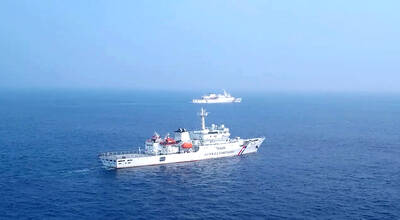
PATROL PARTNERS: The ‘Chiayi’ and the ‘Penghu’ departed for a two-day joint patrol of Palau’s exclusive economic zone, the CGA’s second diplomatic visit to the country The Coast Guard Administration (CGA) set a record for its southernmost deployment of a coast guard vessel as the vessels Chiayi and the Penghu reached Palau’s Pulo Anna Island on Saturday in a cooperative exercise between the two countries. The island, about 217 nautical miles (401km) southwest of Koror in the Palauan state of Sonsorol and 1,220 nautical miles from Taiwan’s southernmost point, Oluanpi (鵝鑾鼻), is the furthest south a CGA vessel has sailed. The two vessels are in Palau for the coast guard’s second diplomatic visit to the country. They docked at Malakal Harbor on Tuesday last week. The coast guard
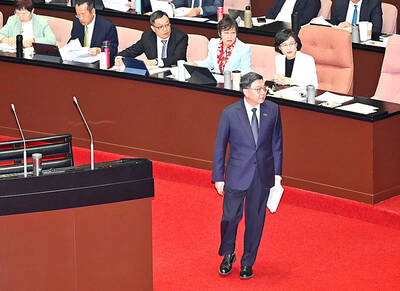
The government is monitoring online rumors that a pneumonic plague outbreak has spread from Russia into China, and it might enhance quarantine measures, Premier Cho Jung-tai (卓榮泰) said yesterday. During a legislative meeting, Democratic Progressive Party Legislator Wang Ting-yu (王定宇) said that rumors had circulated that the disease had spread across several Chinese provinces. He asked Cho whether the government was prepared to prevent the disease spreading to Taiwan, given the volume of traffic between the two sides, and how concerned the government was about the alleged outbreak. The Ministry of Health and Welfare had implemented border quarantine measures after briefing the Executive
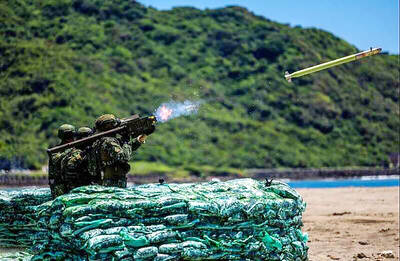
BATCH 1: The military has plans to assign the weapons to the army to defend Taiwan proper, as well as outlying islands and the navy for the Marine Corps, the official said Taiwan is to receive 500 Stinger missiles and 178 launchers from the US by the end of the year, the first batch under a planned two-stage acquisition totaling 2,621 missiles and 763 launchers, a defense official said yesterday on condition of anonymity. The portable missiles would play a vital role in the nation’s air defense capabilities, the source said. The army plans to deploy 2,235 missiles and 657 launchers to defend Taiwan proper and outlying islands, they said, citing military documents. The navy is allotted 295 missiles and 85 launchers to arm the Marine Corps and some surface vessels that lack air defense
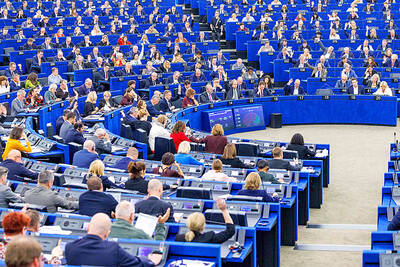
The European Parliament on Wednesday adopted a recommendation on EU-China political relations that rejected China’s efforts to restrict Taiwan’s participation in international organizations and exchanges. The recommendation, addressed to the European Council, the European Commission and EU High Representative for Foreign Affairs and Security Policy Kaja Kallas, includes several references to EU-Taiwan relations and expresses support for closer ties, saying they would bring positive benefits and have strategic importance. Describing Taiwan as a valuable partner in trade and technology, the European Parliament said it “rejects China’s attempts to coerce international organizations, third countries and other actors into restricting Taiwan’s international participation and


 RSS
RSS