


Israel ended its naval blockade of Lebanon yesterday afternoon after an Italian-led international force began patrolling the country's coastline, a government spokeswoman said.
"The Italian-led task force will continue to enforce the international embargo against the supply of armaments to Hezbollah," government spokeswoman Miri Eisin said.
Italian and UN officials had announced earlier yesterday that the blockade was over. But Eisin said it took several hours to coordinate the final details.
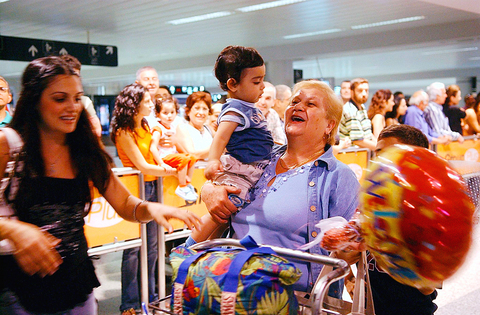
PHOTO: EPA
Israel imposed the blockade shortly after the outbreak of fighting on July 12 to prevent arms from reaching Hezbollah. It lifted an air blockade of Lebanon on Thursday.
Even before the Israeli announcement, the head of the UN peacekeeping force in Lebanon said European warships were patrolling the coast.
"The force is now operational and I understand that the [Israeli] naval blockade is lifted," the commander, Major-General Alain Pellegrini, said in a faxed statement.
The UN, which brokered the Aug. 14 truce that ended a month of fighting between Israel and Lebanese Hezbollah guerrillas, has been pressuring Israel to pull out all of its soldiers as international and Lebanese forces deploy. At a meeting on Thursday, Israeli security officials said the target was to have the remaining thousands of troops out by the Jewish New Year, which begins the evening of Sept. 22.
Israel has been gradually pulling out its soldiers -- whose number peaked at 30,000 at the war's end -- since the ceasefire. Under the truce agreement, they are to be replaced by 15,000 Lebanese army troops and up to 15,000 members of a UN peacekeeping mission.
Israel partially lifted its embargo of Lebanon on Thursday and said the sea cordon -- in place to fight weapons smuggling to Hezbollah -- would be lifted as soon as a multinational naval force was in place to take over.
Intense international efforts are under way to ensure that the truce holds, with a beefed up UN-force being deployed along the coast and in southern Lebanon as Israeli troops pull out in line with UN Resolution 1701.
A Lebanese official said the Israeli restrictions could be lifted within 24 hours once details on the deployment of the international vessels set to patrol the coast are worked out with the UN.
"The lifting of the maritime blockade was delayed because of certain technical details related to the deployment," a Lebanese official told reporters without elaborating.
German forces are expected to lead the international naval patrols that will initially involve Italian, French, British, Greek and Turkish ships and aircraft.
In Beirut, the country's only international airport was bustling with activity as business gradually returned to normal following Israel's move on Thursday to ease a blockade that had left Lebanon almost completely isolated from the outside world and shattered its already debt-laden economy.
"Everything is going normally today, like before the war," said Mohammed Chihab el-Din, deputy manager at Rafiq Hariri International Airport, whose runways were bombed by Israel at the start of its massive month-long offensive.
Beirut airport, which was recently renovated, typically handles about 100 flights a day. The country's main port in Beirut, however, was playing a waiting game.
"This is like a cold shower," Hassan Kraytem, head of Beirut's port authority, said of Israel's initial announcement on Thursday that the naval blockade would not be lifted immediately. "The port is open but no vessels have come in."
Kraytem said six ships had been scheduled to dock on Friday.
In related news, Olmert has signaled that Israel might cede disputed territory to Lebanon if the Lebanese carry out all provisions of their recent ceasefire with Israel, including the disarming of Hezbollah guerrillas, media reported yesterday.
In a meeting with Russian Minister Sergey Lavrov on Thursday, Olmert said if the UN decides the area is Lebanese, and if Lebanon implements UN resolutions ending the war, "we'll agree to discuss it," the Haaretz daily said.

A signaling system malfunction disrupted high-speed rail (HSR) services beginning at 8am today, with trains temporarily reduced to three northbound and three southbound trains per hour as authorities conduct inspections. The malfunction occurred on a section of track in Miaoli County during pre-operation checks early this morning, forcing northbound and southbound trains to use a single track, the HSR operator said. The regular schedule has been replaced with three hourly trains offering only nonreserved seating in each direction, stopping at every station, it said, adding that business class cars would still have reserved seating. Departures from terminal stations are scheduled at the top

Taiwan is still in the process of assessing the possibility of recruiting workers from Eswatini, the Ministry of Foreign Affairs said yesterday, adding that its goal is to help Eswatini upgrade its vocational training centers. If there are plans to recruit workers from Eswatini, safeguarding national security, protecting public health and ensuring the employment rights of Taiwanese would be prerequisites, Department of West Asian and African Affairs Director-General Yen Chia-liang (顏嘉良) told a news conference. Key considerations would also include filling labor shortages in specific industries, and fostering bilateral professional and technical exchanges, he said. Yen was asked about the progress of labor

VERBOSE VESSELS: A CGA cutter and a China Coast Guard exchanged verbal barbs for more than a day in Taiwanese-controlled waters before the Chinese vessel left The Taiwanese and Chinese coast guards had a standoff near the strategically located Pratas Islands (Dongsha Islands, 東沙群島) in the north of the South China Sea, the Coast Guard Administration (CGA) said yesterday. The two sides engaged in intense radio exchanges over sovereignty claims during the 33-hour standoff. China Coast Guard vessel 3501 eventually left the restricted waters, 26.6 nautical miles (49.2km) west of the Pratas Islands, at 5pm yesterday, the CGA said. Lying approximately between southern Taiwan and Hong Kong, the Taiwan-controlled Pratas are seen by some security experts as vulnerable to Chinese attack due to their distance — more than

A US uncrewed surface vessel (USV) encountered multiple Chinese warships during an autonomous transit of the Taiwan Strait, US defense company Seasats said in a statement on Wednesday. Seasats announced that a Lightfish USV had completed the first autonomous transit of the Taiwan Strait. Over five days, the USV traversed the entire length of the Strait while constantly monitoring surface vessel traffic, the company said. The Lightfish encountered multiple Chinese warships, one of which was a Chinese People’s Liberation Army Navy (PLAN) Type 056 corvette, it said. The Chinese vessels were operating “well within Taiwan’s exclusive economic zone without transmitting their identity via the


 RSS
RSS