


The government wants to change the name of the Chiang Kai-shek International Airport to "Taiwan Taoyuan International Airport," pending approval during next Wednesday's weekly Cabinet meeting.
"It is difficult to change the name, but it is definitely not impossible," President Chen Shui-bian (
The president announced the proposed name change at a ceremony at which soldiers received awards for outstanding service ahead of Soldier's Day tomorrow, although his remarks were not directly related to the military.
PHOTO: CHU PEI-HSIUNG, TAIPEI TIMES
In addition to promoting the name change, Chen said that the four Kidd-class destroyers which the Navy bought from the US would be given names that are relevant to Taiwan.
"These destroyers should be named after cities in Taiwan," Chen said. "In the past, the navy named its vessels after historical heroes or cities in China."
"How can we bring the nation closer to the military if the new ships are named after something or somebody unrelated to us?" he said.
Premier Su Tseng-chang (蘇貞昌) backed the president's name-change proposal.
The premier said that "Taiwan Taoyuan International Airport" had been the original name for the airport when it was established 27 yeas ago, but the Cabinet later decided to change the name to Chiang Kai-shek Memorial International Airport in memory of the late dictator.
Su said that Taoyuan residents have for years been hoping to have the airport's name changed.
"I have discussed the issue with Taoyuan County Commissioner Chu Li-lun (
The premier said that it was the government's job to introduce Taiwan to more foreign friends, and that the new name would clearly reflect its location and help promote Taiwan abroad.
"Most major airports in the world are named after cities, and this is what we are doing," Su said.
The opposition parties yesterday responded to the proposal with caution.
Chinese Nationalist Party (KMT) Chairman Ma Ying-jeou (
"We don't know the detailed situation yet. ... The government has done too many things that we can't predict," he said at a municipal event in Taipei.
Legislative Speaker Wang Jin-Pyng (
He refused to comment on the move's possible impact.
The KMT legislative caucus expressed partial support for the proposal.
KMT caucus whip Tsai Chin-lung (
"We suggest using `Taiwan Taoyuan Chiang Kai-shek International Airport,' out of consideration for people's historical feelings," Tsai said.
But People First Party legislative caucus whip Lee Hung-chun (
"Changing the name won't do any good to reverse the drop in air traffic at the airport," Lee said.
Democratic Progressive Party caucus whip Yeh Yi-ching (
Taiwan Solidarity Union legislative caucus whip Liao Pen-yen (廖本煙) also spoke in favor of the idea, calling it the most welcome move in Chen's six-year presidency.
Ministry of Transportation and Communications Minister Tsai Duei (蔡堆) said yesterday that the ministry had been planning to name the airport "Tao-yuan International Airport" when construction was completed in 1979, but then transport minister Lin Chin-sheng (林金生) suggested that the Cabinet name it after former president Chiang Kai-shek (蔣介石) instead.
Tsai yesterday appeared flabbergasted when asked whether the ministry had conducted a public opinion survey of the name change.
Terminal I of the airport was completed and opened on Feb. 26, 1979, and Terminal II was opened on July 29, 2000. Approximately 29 million passengers and 149,000 airplanes land and take off from this airport every year.
The airport has two main runways and 28 taxiways. There are 18 gates at Terminal I and another 20 gates at Terminal II, with a total of 126 apron positions for passenger and cargo aircraft.
Additional reporting by Mo Yan-chih and Shelley Shan
also see story:
Editorial: Goodbye `CKS,' you won't be missed

‘NO SECURITY RISK’: The Railway Bureau reassured the public that the technicians’ activities were limited to technical guidance and did not involve sensitive systems The Railway Bureau yesterday said it had invited eight Chinese technicians to assist with an airport MRT construction project. The bureau issued the confirmation after an Internet user said Chinese nationals had entered the construction zone of Taiwan Taoyuan International Airport’s Terminal 3 project. They asked why “individuals from an enemy state” were allowed access to such a major national infrastructure project, which raised serious concerns over Taiwan’s industrial safety, sensitive systems and information security. The bureau’s Northern Region Engineering Branch Office said subcontractor Taiwan Handle Industrial Co (台灣手把工業) of the Taoyuan airport MRT’s “Contract No. CU05 Project A14 Station Civil, MEP &

A US uncrewed surface vessel (USV) encountered multiple Chinese warships during an autonomous transit of the Taiwan Strait, US defense company Seasats said in a statement on Wednesday. Seasats announced that a Lightfish USV had completed the first autonomous transit of the Taiwan Strait. Over five days, the USV traversed the entire length of the Strait while constantly monitoring surface vessel traffic, the company said. The Lightfish encountered multiple Chinese warships, one of which was a Chinese People’s Liberation Army Navy (PLAN) Type 056 corvette, it said. The Chinese vessels were operating “well within Taiwan’s exclusive economic zone without transmitting their identity via the
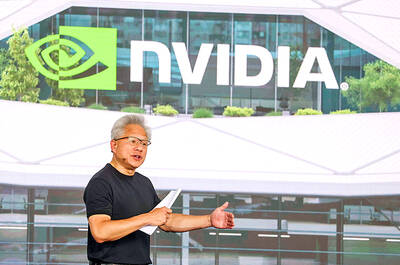
‘BOOMING’: ’ The number of partners we have here is incredible. You can see from their stock prices. They’re doing so well, they’re so happy,’ Jensen Huang said Nvidia Corp’s spending in Taiwan has ballooned to about US$150 billion a year, 10 times the US$10 billion to US$15 billion the company spent five years ago, Nvidia chief executive officer Jensen Huang (黃仁勳) said yesterday, suggesting Taiwan’s strategic importance in the global artificial intelligence (AI) supply chain. “Taiwan is the epicenter of the AI revolution. This is where the chips come, packaging comes. This is where the systems are made. This is where AI supercomputers were created,” Huang said at a meeting for the company’s employees in Beitou-Shilin Technology Park (北投士林科技園區) in Taipei, the planned site of Nvidia’s Taipei headquarters. “Taiwan
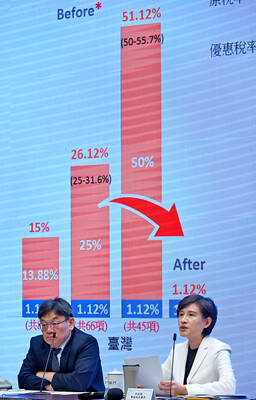
GREATER REACH? Auto parts and wood products would face tariffs of up to 15%, matching those targeting the EU, Japan and South Korea, Vice Premier said The US has announced that preferential tariff treatment for Taiwan’s non-semiconductor Section 232 goods would take effect retroactively from May 1, the Executive Yuan said yesterday. The US government yesterday posted a notice on the Federal Register’s public inspection Web site previewing tariff concessions for Taiwan under a memorandum of understanding (MOU) on Taiwan-US investment after two months of negotiations. The MOU signed on Jan. 15 stipulated three major preferential tariff arrangements: a 15 percent “reciprocal” tariff rate for Taiwan without stacking most-favored nation (MFN) rates; preferential Section 232 treatment for semiconductors and related products; and preferential Section 232 treatment for non-semiconductor


 RSS
RSS