


A Chinese online encyclopedia has closed down due to government pressure as China continues to crack down on Internet information it sees as dangerous, an international rights group said.
e-Wiki, a collaborative Internet encyclopedia modeled on the hugely successful Wikipedia, closed itself down late last month, Reporters Without Borders said in a statement received yesterday.
e-Wiki decided to close after it called Taiwan the "Republic of China" and posted information on James Lung (
"It is regrettable that government threats forced e-Wiki's editor to censor himself," Reporters Without Borders said. "We understand that he felt in danger in the current context, as the authorities have significantly stepped up their control over online publications."
A notice on e-Wiki's now otherwise non-functioning Web site appeared to confirm the media watchdog's assertions.
"We all aspire to freedom, but we live in the embrace of the motherland so we have to be subjected to relevant restraints and cannot cause trouble for others," the notice said. "e-Wiki has temporarily shut down and we apologize for the inconvenience."
Wikipedia has been blocked in China since late last year, although a similar but heavily censored online encyclopedia was launched by popular Chinese Web portal Baidu this year.
The Chinese-language version of Wikipedia, which relies on voluntary users and contributors, was enjoying soaring popularity until Beijing blocked access to the site.
The government maintains a tight grip over information flow on the Internet, fearing it could sow the seeds of thoughts and ideas it regards as dangerous.
Reporters Without Borders ranks China 159th on a list of 167 countries in its global press freedom index and describes the Chinese government as an "enemy" of the Internet.

A signaling system malfunction disrupted high-speed rail (HSR) services beginning at 8am today, with trains temporarily reduced to three northbound and three southbound trains per hour as authorities conduct inspections. The malfunction occurred on a section of track in Miaoli County during pre-operation checks early this morning, forcing northbound and southbound trains to use a single track, the HSR operator said. The regular schedule has been replaced with three hourly trains offering only nonreserved seating in each direction, stopping at every station, it said, adding that business class cars would still have reserved seating. Departures from terminal stations are scheduled at the top

Taiwan is still in the process of assessing the possibility of recruiting workers from Eswatini, the Ministry of Foreign Affairs said yesterday, adding that its goal is to help Eswatini upgrade its vocational training centers. If there are plans to recruit workers from Eswatini, safeguarding national security, protecting public health and ensuring the employment rights of Taiwanese would be prerequisites, Department of West Asian and African Affairs Director-General Yen Chia-liang (顏嘉良) told a news conference. Key considerations would also include filling labor shortages in specific industries, and fostering bilateral professional and technical exchanges, he said. Yen was asked about the progress of labor

VERBOSE VESSELS: A CGA cutter and a China Coast Guard exchanged verbal barbs for more than a day in Taiwanese-controlled waters before the Chinese vessel left The Taiwanese and Chinese coast guards had a standoff near the strategically located Pratas Islands (Dongsha Islands, 東沙群島) in the north of the South China Sea, the Coast Guard Administration (CGA) said yesterday. The two sides engaged in intense radio exchanges over sovereignty claims during the 33-hour standoff. China Coast Guard vessel 3501 eventually left the restricted waters, 26.6 nautical miles (49.2km) west of the Pratas Islands, at 5pm yesterday, the CGA said. Lying approximately between southern Taiwan and Hong Kong, the Taiwan-controlled Pratas are seen by some security experts as vulnerable to Chinese attack due to their distance — more than
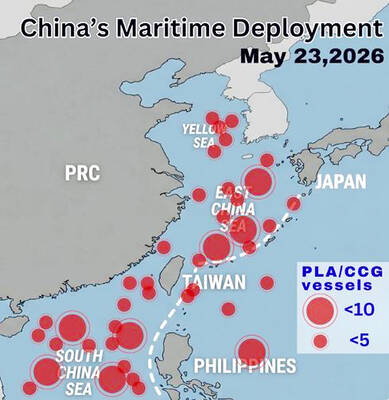
WARNING: China should stop engaging in actions that undermine regional peace and stability, as it would only build resentment among people across the Strait, the CGA said China has deployed more than 100 navy, coast guard and other vessels in waters from the Yellow Sea to the South China Sea and the western Pacific since US President Donald Trump and Chinese President Xi Jinping (習近平) met in Beijing, National Security Council Secretary-General Joseph Wu (吳釗燮) said yesterday. “In this part of the world, #China is the one & only PROBLEM wrecking the #StatusQuo & threatening regional peace & stability,” Wu wrote on X. In a separate post, he said Beijing was coercing Taiwan’s maritime domain, calling it illegal and provocative, after the Coast Guard Administration (CGA) expelled a


 RSS
RSS