


While no major accords on cross-strait economic relations were reached yesterday on the second and last day of the Conference on Sustaining Taiwan's Economic Development, participants left just enough room for suggestions on easing the China-bound investment ceiling to be debated by the Cabinet.
After a half-day of intensive deliberation during the session on cross-strait economic relations, Legislative Speaker Wang Jin-pyng (王金平), who presided over the session, ruled that relaxing the China-bound investment cap of 40 percent of a company's net value would be listed among the "other opinions" expressed at the conference.
Issues listed as "other opinions" are intended to serve as advice for the government, but they would have no binding effect on the Cabinet.
Topics listed as "consensus" issues require the Cabinet to implement the proposed policy within the next few months.
Other suggestions listed as "other opinions" yesterday included pushing for further direct cross-strait air transportation links, lifting the ban on Taiwanese banks setting up subsidiaries in China, expediting the implementation of regular cross-strait air and sea cargo links, and asking the Chinese government to recognize Taiwanese professional licenses.
The issue of easing the 40 percent cap on investment in China was the focus of heated debate at the session, with 19 participants speaking in favor of easing the ban, and the other 18 opposing the measure.
The Taiwan Solidarity Union (TSU) lawmakers, who opposed easing the investment ceiling, also opposed listing the measure under "other opinions" after the failure to reach consensus.
Concluding the session, Wang insisted that the measure be included as part of the policy suggestions for the government and asked Premier Su Tseng-chang (蘇貞昌) to increase efforts to improve the nation's investment environment.
"The biggest consensus of the conference was that we agreed that the cross-strait economic and trade relations have both positive and negative effects. It's a highly complex issue ... and any opinions on which the meeting couldn't reach consensus should be listed under `other opinions,' as stated in the conference's procedural rules," Wang said.
Failing to prevent the relaxation measures from being completely excluded from the conference, TSU lawmakers walked out of the session.
TSU caucus whip David Huang (
The session concluded that exports of technology to China should be limited to keep cutting-edge and core technologies at home, and to only allow lower-end technologies of a less sensitive type to China.
Other topics included as "other opinions" included stipulating a sunshine law for the "Chinese lobby" to make the lobbying mechanism for expanding cross-strait ties more transparent; abolishing the mechanism to delegate proxies acting on behalf of the government for cross-strait negotiations in the absence of official contacts between the two governments, and expanding direct cross-strait air links.
Several environmental protection groups dropped out of the meeting yesterday as well, complaining that the conference was "anti-sustainability."
Taiwan Environmental Protection Union chairwoman Chen Chiao-hua (陳椒華) said the conference was meaningless in terms of both "sustainability" and "development."
AGREEMENTS REACHED
Su last night said that 515 agreements had been reached at the conference.
"The government shall make those 515 agreements our future policies, submit them to the legislature for approval and then carry them out as soon as possible," he said.
Su especially mentioned Chung-hua Institution for Economic Research chairman Vincent Siew's (
The proposal included goals of an annual average economic growth rate of 5 percent, per capita annual GDP of US$30,000 and an unemployment rate of less than 4 percent, to be achieved by the year 2015.
REGRETTABLE
Vice Premier Tsai Ing-wen (
"It is natural to have conflicts or arguments during a conference like this. We respect all kinds of different voices and choices," she said.
Cabinet Spokesman Cheng Wen-tsang (鄭文燦) said the conference could be called a success because everybody tried hard to make their voices heard during proceedings, all in the spirit of democracy.
BIRTHDAY
The conference concluded on Su's 60th birthday, and the premier said his birthday wishes were "a safe environment for the people [and that] everything will work out all right for my fellow Cabinet members," he said.
"I hope my fellow Taiwanese will be happy. I hope our country is growing stronger and stronger and I hope the economy will keep growing," he said.
Additional reporting by CNA

‘NO SECURITY RISK’: The Railway Bureau reassured the public that the technicians’ activities were limited to technical guidance and did not involve sensitive systems The Railway Bureau yesterday said it had invited eight Chinese technicians to assist with an airport MRT construction project. The bureau issued the confirmation after an Internet user said Chinese nationals had entered the construction zone of Taiwan Taoyuan International Airport’s Terminal 3 project. They asked why “individuals from an enemy state” were allowed access to such a major national infrastructure project, which raised serious concerns over Taiwan’s industrial safety, sensitive systems and information security. The bureau’s Northern Region Engineering Branch Office said subcontractor Taiwan Handle Industrial Co (台灣手把工業) of the Taoyuan airport MRT’s “Contract No. CU05 Project A14 Station Civil, MEP &

A US uncrewed surface vessel (USV) encountered multiple Chinese warships during an autonomous transit of the Taiwan Strait, US defense company Seasats said in a statement on Wednesday. Seasats announced that a Lightfish USV had completed the first autonomous transit of the Taiwan Strait. Over five days, the USV traversed the entire length of the Strait while constantly monitoring surface vessel traffic, the company said. The Lightfish encountered multiple Chinese warships, one of which was a Chinese People’s Liberation Army Navy (PLAN) Type 056 corvette, it said. The Chinese vessels were operating “well within Taiwan’s exclusive economic zone without transmitting their identity via the
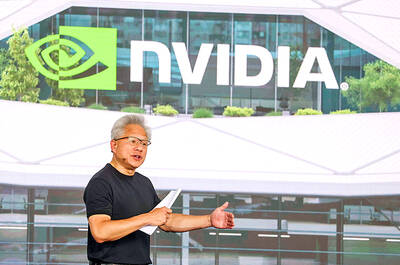
‘BOOMING’: ’ The number of partners we have here is incredible. You can see from their stock prices. They’re doing so well, they’re so happy,’ Jensen Huang said Nvidia Corp’s spending in Taiwan has ballooned to about US$150 billion a year, 10 times the US$10 billion to US$15 billion the company spent five years ago, Nvidia chief executive officer Jensen Huang (黃仁勳) said yesterday, suggesting Taiwan’s strategic importance in the global artificial intelligence (AI) supply chain. “Taiwan is the epicenter of the AI revolution. This is where the chips come, packaging comes. This is where the systems are made. This is where AI supercomputers were created,” Huang said at a meeting for the company’s employees in Beitou-Shilin Technology Park (北投士林科技園區) in Taipei, the planned site of Nvidia’s Taipei headquarters. “Taiwan
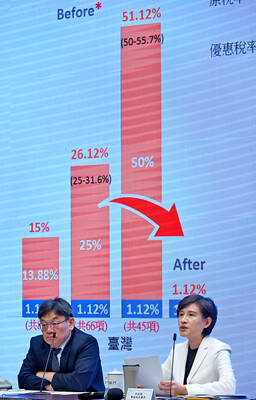
GREATER REACH? Auto parts and wood products would face tariffs of up to 15%, matching those targeting the EU, Japan and South Korea, Vice Premier said The US has announced that preferential tariff treatment for Taiwan’s non-semiconductor Section 232 goods would take effect retroactively from May 1, the Executive Yuan said yesterday. The US government yesterday posted a notice on the Federal Register’s public inspection Web site previewing tariff concessions for Taiwan under a memorandum of understanding (MOU) on Taiwan-US investment after two months of negotiations. The MOU signed on Jan. 15 stipulated three major preferential tariff arrangements: a 15 percent “reciprocal” tariff rate for Taiwan without stacking most-favored nation (MFN) rates; preferential Section 232 treatment for semiconductors and related products; and preferential Section 232 treatment for non-semiconductor


 RSS
RSS