


The wife of former US State Department official Donald Keyser, Margaret Lyons, is a CIA official on loan to the office of the US' top spy, John Negroponte, Negroponte's office has confirmed.
Lyons "is a CIA employee currently on a detail assignment to the office of the Director of National Intelligence," a spokeswoman told the Taipei Times on Monday.
The spokeswoman said that her office would "decline to respond" to any other questions about Lyons.
Security clearance
A CIA spokesman also confirmed that Lyons works for the agency. She is a "senior officer" who has worked with the agency for "decades," he said. Despite the case against her husband, the agency has not revoked Lyons' security clearance, he said.
The open-source unit that Lyons is now detailed to is the successor to the Foreign Broadcast Information Service, which monitored and translated broadcasts in countries around the world, and made them available to government officials, scholars, journalists and others.
Lyons' name surfaced in a story in the current issue of Time magazine, which described her as a senior CIA officer, and said her job was a "sensitive post" helping to set up a new open-source unit.
Relationship
The revelation adds a new wrinkle to the case in which Keyser has pleaded guilty to three charges stemming from his relationship with Isabelle Cheng (程念慈), a former National Security Bureau intelligence officer in Washington, and whom, the FBI is trying to prove, Keyser assisted to spy on the US.
Keyser, through his lawyer, has denied that he was a spy.
One of the three charges to which Keyser pleaded guilty was having a large volume of secret and classified documents stored on his home computer and on floppy discs found in his home.
In a filing on July 5, the prosecution, without naming Lyons, said Keyser's wife knew for a year that Keyser had kept the documents at home, in violation of US law and government policy.
Time reported that, in addition, government officials have told the magazine that during an FBI search of the couple's home, agents found CIA documents that Lyons herself put there without authorization. The magazine said that Lyons admitted that the couple had failed "to properly secure" the material.
In its July 5 filing, the prosecutor said that during a search of Keyser's house in September 2004, investigators found more than 3,600 classified documents, including 28 top secret documents and nearly 2,000 secret documents. Nearly half of the documents were found in a bookshelf in a recently refinished basement den.
The raid took place the same day Keyser was arrested after a lunch at a well-known Washington area restaurant with Cheng and her boss, Michael Huang (黃光勳), reputedly the National Security Bureau's top intelligence operative in Washington.
According to the FBI, Keyser told investigators that a secretary mistakenly boxed up the documents and he did not know they were there.
He said he did not know of the basement documents until "his wife told him she had discovered classified material while sorting through the boxes in the basement closet [after the refinishing was completed], and asked him to do something about it," the FBI said.
At one point, Keyser said he did not believe her, and at another he said he could not remember her telling him about the files.
"He also claimed that his wife, not him, must have removed classified documents from the boxes and placed them in the basement bookcase," the FBI alleges.
Lyons has not been charged in the case.
Many documents were found on a laptop that Keyser took with him on a 2003 trip to China, during which he also had a secret three-day rendezvous with Cheng in Taiwan which he failed to report to his superiors, and for which he pleaded guilty to one charge last year. He allegedly accessed some of the documents in China, an unlawful act, and also carried the laptop to Taiwan.
A US Federal District Court in a Virginia suburb of Washington has set an Aug. 9 hearing date on the FBI's request to bring additional charges against Keyser. Since much information will be classified, the judge ordered the hearing to be held in secret.
Meanwhile, Ministry of Foreign Affairs Spokesman Michel Lu (呂慶龍) said yesterday that US-Taiwan communications through the Washington based Taipei Economic and Cultural Representative Office during 2003 and 2004 had been smooth and effective. He made the comments in response to media reports that Keyser had resorted to communicating through the National Security Bureau to make Taiwan better understand Washington's policies.
"He [Keyser] claimed that he met with Cheng and her supervisor Michael Huang because he did not believe that US policy was being adequately conveyed to Taiwan, and regarded [National Security Bureau] channels as another means to communicate US policy to the government in Taipei," a court document from the FBI said.
Lu said US-Taiwan relations had remained healthy after news of the Keyser case broke in 2004.

A signaling system malfunction disrupted high-speed rail (HSR) services beginning at 8am today, with trains temporarily reduced to three northbound and three southbound trains per hour as authorities conduct inspections. The malfunction occurred on a section of track in Miaoli County during pre-operation checks early this morning, forcing northbound and southbound trains to use a single track, the HSR operator said. The regular schedule has been replaced with three hourly trains offering only nonreserved seating in each direction, stopping at every station, it said, adding that business class cars would still have reserved seating. Departures from terminal stations are scheduled at the top

Taiwan is still in the process of assessing the possibility of recruiting workers from Eswatini, the Ministry of Foreign Affairs said yesterday, adding that its goal is to help Eswatini upgrade its vocational training centers. If there are plans to recruit workers from Eswatini, safeguarding national security, protecting public health and ensuring the employment rights of Taiwanese would be prerequisites, Department of West Asian and African Affairs Director-General Yen Chia-liang (顏嘉良) told a news conference. Key considerations would also include filling labor shortages in specific industries, and fostering bilateral professional and technical exchanges, he said. Yen was asked about the progress of labor

VERBOSE VESSELS: A CGA cutter and a China Coast Guard exchanged verbal barbs for more than a day in Taiwanese-controlled waters before the Chinese vessel left The Taiwanese and Chinese coast guards had a standoff near the strategically located Pratas Islands (Dongsha Islands, 東沙群島) in the north of the South China Sea, the Coast Guard Administration (CGA) said yesterday. The two sides engaged in intense radio exchanges over sovereignty claims during the 33-hour standoff. China Coast Guard vessel 3501 eventually left the restricted waters, 26.6 nautical miles (49.2km) west of the Pratas Islands, at 5pm yesterday, the CGA said. Lying approximately between southern Taiwan and Hong Kong, the Taiwan-controlled Pratas are seen by some security experts as vulnerable to Chinese attack due to their distance — more than
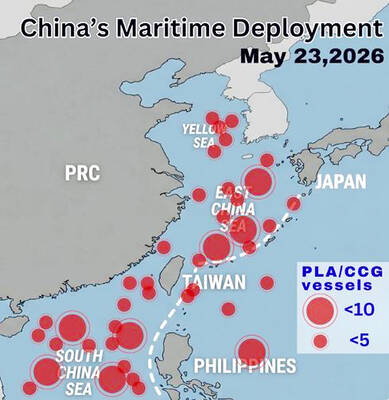
WARNING: China should stop engaging in actions that undermine regional peace and stability, as it would only build resentment among people across the Strait, the CGA said China has deployed more than 100 navy, coast guard and other vessels in waters from the Yellow Sea to the South China Sea and the western Pacific since US President Donald Trump and Chinese President Xi Jinping (習近平) met in Beijing, National Security Council Secretary-General Joseph Wu (吳釗燮) said yesterday. “In this part of the world, #China is the one & only PROBLEM wrecking the #StatusQuo & threatening regional peace & stability,” Wu wrote on X. In a separate post, he said Beijing was coercing Taiwan’s maritime domain, calling it illegal and provocative, after the Coast Guard Administration (CGA) expelled a


 RSS
RSS