


The US yesterday stepped up its pressure on China to take stronger action over the North Korean missile crisis, but the chief US envoy left talks in Beijing without an agreement on sanctions.
A day after the US again failed to marshal support from Russia and China at the UN Security Council for sanctions on Pyongyang, envoy Christopher Hill came to Beijing to directly lobby North Korea's closest ally.
The talks came as the secretive state, which test-fired seven missiles into the Sea of Japan (East Sea) on Wednesday, reportedly threatened Japan over its own unilateral sanctions put in force against the communist North.
South Korea, the other major player in the regional drama, ratcheted up the pressure yesterday by saying it would indefinitely put off crucial food aid to North Korea in response to the tests.
Hill, the chief US negotiator for the six-nation talks on North Korea's nuclear program, met his Chinese counterpart, vice foreign minister Wu Dawei (
He said as he prepared to leave for Seoul on the next leg of the trip, which will also take in Tokyo, that he had discussed how both nations could best react to North Korea's move.
Hill said both sides agreed that the stalled six-nation talks on North Korea's nuclear program should resume. However, there was no agreement on the contentious issue of sanctions.
"We did have some discussion on the best way to put pressure on. Discussions ... on sanctions were touched upon," he said.
US President George W. Bush lumped North Korea in with Saddam Hussein's Iraq and Islamic Iran as an "axis of evil" in 2002, and Washington has repeatedly called on the self-declared nuclear power to abandon its atomic ambitions.
The US has rejected calls for direct talks with the North and instead has urged the Stalinist state to return to six-nation negotiations that it abandoned last year -- because of unilateral US sanctions.
The 15 nations of the Security Council met for a second day on Thursday to discuss a Japanese draft resolution that could lead to sanctions but again ran into opposition from China and Russia, which both have council veto power.
Envoys from the council's five permanent veto-holding members -- the UK, China, France, Russia and the US -- along with Japan were to meet at the US mission to the UN in New York from 1:30pm GMT yesterday.
Bush called Chinese President Hu Jintao (
One of the missiles tested on Wednesday, the Taepodong-2, could possibly reach the US once fully developed, and Bush said it was difficult for the international community to assess North Korean leader Kim Jong-il's intentions.
South Korea said yesterday that despite its sanctions it would stand by its policy of engaging its neighbor, and press ahead with ministerial talks with the North from Tuesday to Friday next week in the southern port of Busan.
"It is hard to predict whether the North will come to the talks or not," said a senior official from the South, which in 2000 launched a "sunshine policy" to reconcile with its longtime adversary.
"We promised to ship 100,000 tonnes of fertilizer aid to the North but we will shelve it. We will also put off 500,000 tonnes of rice aid until any breakthrough is made in the missile issue," the official told journalists.
Seoul has also rejected separate talks requested by North Korea aimed at easing tension on their border, in the first such move since they began to reconcile in 2000.
North Korea, one of the world's most isolated and impoverished nations, has repeatedly expressed anger over sanctions against it and Friday called on Japan to lift its unilateral punitive measures.
"We said that we would take stronger physical actions, should criticism against [North Korea] become even stronger. That comment was made with Japan in mind," warned the North's envoy to talks on normalization of diplomatic relations with Japan, Song Il-Ho, Japanese public broadcaster NHK reported.
"Japan occupied Korea with its military 40 years ago, but settlement for that past has not yet been finished," NHK quoted Song as saying, lambasting Tokyo's demand for multilateral sanctions as "preposterous."
"It was extremely regrettable and we feel resentment," Japanese Chief Cabinet Secretary Shinzo Abe said.
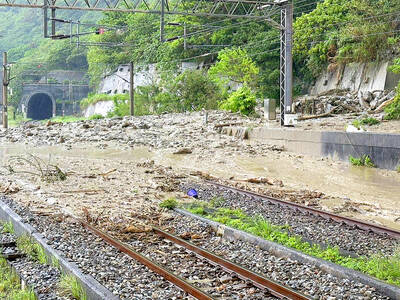
ROLLER-COASTER RIDE: More than five earthquakes ranging from magnitude 4.4 to 5.5 on the Richter scale shook eastern Taiwan in rapid succession yesterday afternoon Back-to-back weather fronts are forecast to hit Taiwan this week, resulting in rain across the nation in the coming days, the Central Weather Administration said yesterday, as it also warned residents in mountainous regions to be wary of landslides and rockfalls. As the first front approached, sporadic rainfall began in central and northern parts of Taiwan yesterday, the agency said, adding that rain is forecast to intensify in those regions today, while brief showers would also affect other parts of the nation. A second weather system is forecast to arrive on Thursday, bringing additional rain to the whole nation until Sunday, it
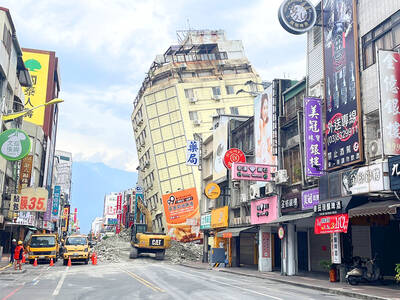
LANDSLIDES POSSIBLE: The agency advised the public to avoid visiting mountainous regions due to more expected aftershocks and rainfall from a series of weather fronts A series of earthquakes over the past few days were likely aftershocks of the April 3 earthquake in Hualien County, with further aftershocks to be expected for up to a year, the Central Weather Administration (CWA) said yesterday. Based on the nation’s experience after the quake on Sept. 21, 1999, more aftershocks are possible over the next six months to a year, the agency said. A total of 103 earthquakes of magnitude 4 on the local magnitude scale or higher hit Hualien County from 5:08pm on Monday to 10:27am yesterday, with 27 of them exceeding magnitude 5. They included two, of magnitude
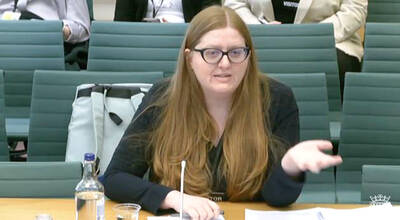
CONDITIONAL: The PRC imposes secret requirements that the funding it provides cannot be spent in states with diplomatic relations with Taiwan, Emma Reilly said China has been bribing UN officials to obtain “special benefits” and to block funding from countries that have diplomatic ties with Taiwan, a former UN employee told the British House of Commons on Tuesday. At a House of Commons Foreign Affairs Committee hearing into “international relations within the multilateral system,” former Office of the UN High Commissioner for Human Rights (OHCHR) employee Emma Reilly said in a written statement that “Beijing paid bribes to the two successive Presidents of the [UN] General Assembly” during the two-year negotiation of the Sustainable Development Goals. Another way China exercises influence within the UN Secretariat is

Taiwan’s first drag queen to compete on the internationally acclaimed RuPaul’s Drag Race, Nymphia Wind (妮妃雅), was on Friday crowned the “Next Drag Superstar.” Dressed in a sparkling banana dress, Nymphia Wind swept onto the stage for the final, and stole the show. “Taiwan this is for you,” she said right after show host RuPaul announced her as the winner. “To those who feel like they don’t belong, just remember to live fearlessly and to live their truth,” she said on stage. One of the frontrunners for the past 15 episodes, the 28-year-old breezed through to the final after weeks of showcasing her unique


 RSS
RSS