


The Bush administration yesterday dismissed North Korea's threat to test-fire more missiles and pressed for international efforts to get the communist regime to "cease and desist" from such actions.
"We're certainly not going to overreact ... to these wild statements out of Pyongyang and North Korea," said Undersecretary Nicholas Burns. "We've seen them before."
The North Korean Foreign Ministry, in a statement carried by the state-run Korean Central News Agency, insisted that the communist state had the right to conduct missile tests and argued the weapons were needed for defense.
On Wednesday, the country launched several missiles, including a long-range Taepodong-2 missile -- the object of intense international attention for more than a month -- that failed 42 seconds after liftoff, suggesting a catastrophic failure of the rocket's first, or booster, stage.
That heartened US officials, since an earlier version of the missile -- last tested in 1998 -- failed later in its flight, apparently due to a third-stage malfunction. A working version of the intercontinental missile, with a top range of 8,045km to 12,065km, could potentially reach the US with a light payload.
"One thing we have learned is that the rocket didn't stay up for very long," President George W. Bush said on Wednesday. "It tumbled into the sea."
The South Korean press reported yesterday that the North had three or four short or medium-range missiles on launch pads ready for firing.
Burns, asked on a round of morning television news shows about North Korea's latest threat, said: "I think the North Koreans would like to pit the United States against themselves in a one-on-one battle of wills. We're not going to fall for that."
Instead, Burns said, the US would work to muster international pressure on North Korea to "cease and desist" such actions.
"We are much stronger, frankly, from a diplomatic standpoint, and much better off if we have a wide range of countries working together and sending the same message to the North Koreans," Burns said.
On Wednesday night, Bush spoke by phone to Japan's and South Korea's leaders and stressed the need for a unified response in the UN and elsewhere to the North's missile tests, the White House said in a statement. He also told the leaders that he seeks a diplomatic solution through the six-party talks, which had sought to deal with North Korea's nuclear ambitions but were suspended last fall.
also see stories:
Editorial: China profits from missile madness
Abe plays down missile tests' significance
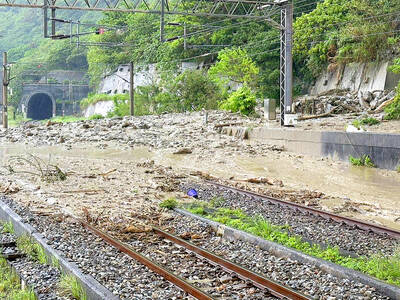
ROLLER-COASTER RIDE: More than five earthquakes ranging from magnitude 4.4 to 5.5 on the Richter scale shook eastern Taiwan in rapid succession yesterday afternoon Back-to-back weather fronts are forecast to hit Taiwan this week, resulting in rain across the nation in the coming days, the Central Weather Administration said yesterday, as it also warned residents in mountainous regions to be wary of landslides and rockfalls. As the first front approached, sporadic rainfall began in central and northern parts of Taiwan yesterday, the agency said, adding that rain is forecast to intensify in those regions today, while brief showers would also affect other parts of the nation. A second weather system is forecast to arrive on Thursday, bringing additional rain to the whole nation until Sunday, it
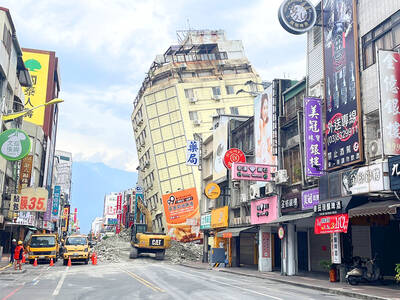
LANDSLIDES POSSIBLE: The agency advised the public to avoid visiting mountainous regions due to more expected aftershocks and rainfall from a series of weather fronts A series of earthquakes over the past few days were likely aftershocks of the April 3 earthquake in Hualien County, with further aftershocks to be expected for up to a year, the Central Weather Administration (CWA) said yesterday. Based on the nation’s experience after the quake on Sept. 21, 1999, more aftershocks are possible over the next six months to a year, the agency said. A total of 103 earthquakes of magnitude 4 on the local magnitude scale or higher hit Hualien County from 5:08pm on Monday to 10:27am yesterday, with 27 of them exceeding magnitude 5. They included two, of magnitude
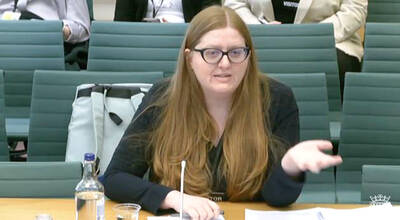
CONDITIONAL: The PRC imposes secret requirements that the funding it provides cannot be spent in states with diplomatic relations with Taiwan, Emma Reilly said China has been bribing UN officials to obtain “special benefits” and to block funding from countries that have diplomatic ties with Taiwan, a former UN employee told the British House of Commons on Tuesday. At a House of Commons Foreign Affairs Committee hearing into “international relations within the multilateral system,” former Office of the UN High Commissioner for Human Rights (OHCHR) employee Emma Reilly said in a written statement that “Beijing paid bribes to the two successive Presidents of the [UN] General Assembly” during the two-year negotiation of the Sustainable Development Goals. Another way China exercises influence within the UN Secretariat is

Taiwan’s first drag queen to compete on the internationally acclaimed RuPaul’s Drag Race, Nymphia Wind (妮妃雅), was on Friday crowned the “Next Drag Superstar.” Dressed in a sparkling banana dress, Nymphia Wind swept onto the stage for the final, and stole the show. “Taiwan this is for you,” she said right after show host RuPaul announced her as the winner. “To those who feel like they don’t belong, just remember to live fearlessly and to live their truth,” she said on stage. One of the frontrunners for the past 15 episodes, the 28-year-old breezed through to the final after weeks of showcasing her unique


 RSS
RSS