


The Ministry of Foreign Affairs will stop authenticating marriage certificates between Taiwanese and Cambodian citizens next month because the Cambodian government considers Taiwanese to be citizens of the People's Republic of China.
The ministry yesterday urged Taiwanese married to Cambodian to register for interviews with the Taipei Economic and Cultural Office in Ho Chi Minh City before July 7 in order to obtain a marriage certificate authenticated by the government.
However, this only applies to couples who submitted applications for interviews before Jan. 26 because the ministry stopped accepting such applications on Jan. 23.
After July 7, the government will no longer provide marriage authentication services for Taiwanese-Cambodian couples, the ministry said in a press statement yesterday.
Cambodian spouses can't apply for resident permits in Taiwan without such certificates.
A ministry official said the government had decided to suspend document authentication services for Cambodians because there had been an upsurge in fake documents.
The ministry had asked Cambodia to tackle the problem but Phnom Penh responded by demanding that Taiwanese seeking certificates or services present identity documents provided by the Chinese embassy in Cambodia.
"The Cambodian government's measure has seriously undermined Taiwan's national dignity," the official said.
The new rules would also serve as a warning to Taiwanese about the risks involved in marrying Cambodians, the official said.
Cambodia is a staunch ally of China. Taiwan has no diplomatic representation in the country and all consular services related to Cambodia are handled by Taiwan's representative offices in Vietnam.
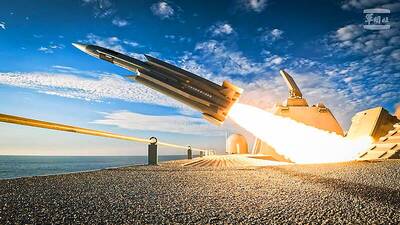
DETERRENCE: With 1,000 indigenous Hsiung Feng II and III missiles and 400 Harpoon missiles, the nation would boast the highest anti-ship missile density in the world With Taiwan wrapping up mass production of Hsiung Feng II and III missiles by December and an influx of Harpoon missiles from the US, Taiwan would have the highest density of anti-ship missiles in the world, a source said yesterday. Taiwan is to wrap up mass production of the indigenous anti-ship missiles by the end of year, as the Chungshan Institute of Science and Technology has been meeting production targets ahead of schedule, a defense official with knowledge of the matter said. Combined with the 400 Harpoon anti-ship missiles Taiwan expects to receive from the US by 2028, the nation would have

North Korea yesterday fired about 10 ballistic missiles to the sea toward Japan, the South Korean Joint Chiefs of Staff (JCS) said, days after Pyongyang warned of “terrible consequences” over ongoing South Korea-US military drills. Pyongyang recently dashed hopes of a diplomatic thaw with Seoul, Washington’s security ally, describing its latest peace efforts as a “clumsy, deceptive farce.” Seoul’s military detected “around 10 ballistic missiles launched from the Sunan area in North Korea toward the East Sea [Sea of Japan] at around 1:20pm,” JCS said in a statement, referring to South Korea’s name for the body of water. The missiles
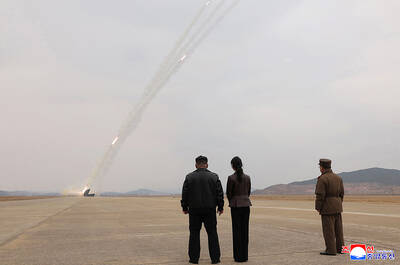
North Korea tested nuclear-capable rocket launchers, state media reported yesterday, a day after Seoul detected the launch of about 10 ballistic missiles. The test comes after South Korean and US forces launched their springtime military drills, due to run until Thursday. North Korean leader Kim Jong-un on Saturday oversaw the testing of the multiple rocket launcher system (MRLS), the Korean Central News Agency (KCNA) said. The test involved 12 600mm-caliber ultra-precision multiple rocket launchers and two artillery companies, it said. Kim said the drill gave Pyongyang’s enemies, within the 420km striking range, a sense of “uneasiness” and “a deep understanding

‘UNWAVERING FRIENDSHIP’: A representative of a Japanese group that co-organized a memorial, said he hopes Japanese never forget Taiwan’s kindness President William Lai (賴清德) yesterday marked the 15th anniversary of the Tohoku earthquake and tsunami, urging continued cooperation between Taiwan and Japan on disaster prevention and humanitarian assistance. Lai wrote on social media that Taiwan and Japan have always helped each other in the aftermath of major disasters. The magnitude 9 earthquake struck northeastern Japan on March 11, 2011, triggering a massive tsunami that claimed more than 19,000 lives, according to data from Japanese authorities. Following the disaster, Taiwan donated more than US$240 million in aid, making it one of the largest contributors of financial assistance to Japan. In addition to cash donations and


 RSS
RSS