


A landmark deal between Nepal's authorities and Maoist rebels which will see parliament dissolved and power shared in a new interim government was hailed in the troubled Himalayan kingdom yesterday.
The deal, aimed at ending 10 years of bloody insurgency by the rebels, was thrashed out at unprecedented day-long talks in Kathmandu on Friday between Maoists, led by their elusive chief Prachanda, and government leaders headed by Prime Minister Girija Prasad Koirala.
Under the deal, the new parliament, which reconvened after King Gyanendra ended 14 months of direct rule in April, is to be dissolved and an interim government containing the Maoists set up within a month.
Newspapers trumpeted the accord on their front pages, branding it "historic" and a "giant leap forward," although some politicians gave the move a more guarded response.
"The agreement reached in an effort to restore peace is very promising but there are lots of challenges," said Ram Chandra Poudel, general secretary of the Nepali Congress, the kingdom's largest political party.
"The government should move forward very cautiously and avoid making hodge-podge decisions," he said.
The deal was warmly welcomed by Raghuji Pant, a leader of the Communist Party of Nepal (Unified Marxist-Leninist), the tiny nation's second largest political grouping.
"This is a very positive development and it shows that the government and Maoists are willing to resolve the political crisis," he said.
As well as dissolving the new parliament, the two sides agreed on Friday to seek UN assistance in arms management, and to draft a temporary constitution within 15 days.
The rebels and government had previously agreed to hold elections for a body that would redraft the constitution permanently, a key rebel demand.
Political analyst Krishna Khanal said the agreement would pave the way for sweeping changes in Nepal's political landscape.
"The parties and the Maoists have made a huge leap on the way to constructing a new Nepal. They are heading on the right track," said Khanal, a professor of politics at Nepal's Tribhuvan University.
"The decisions reached between them are in accordance with the spirit of the `people's movement,'" Khanal said, referring to the three weeks of mass protests in April.
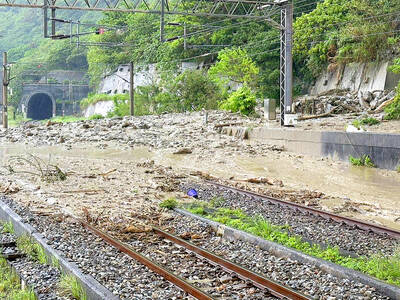
ROLLER-COASTER RIDE: More than five earthquakes ranging from magnitude 4.4 to 5.5 on the Richter scale shook eastern Taiwan in rapid succession yesterday afternoon Back-to-back weather fronts are forecast to hit Taiwan this week, resulting in rain across the nation in the coming days, the Central Weather Administration said yesterday, as it also warned residents in mountainous regions to be wary of landslides and rockfalls. As the first front approached, sporadic rainfall began in central and northern parts of Taiwan yesterday, the agency said, adding that rain is forecast to intensify in those regions today, while brief showers would also affect other parts of the nation. A second weather system is forecast to arrive on Thursday, bringing additional rain to the whole nation until Sunday, it

LANDSLIDES POSSIBLE: The agency advised the public to avoid visiting mountainous regions due to more expected aftershocks and rainfall from a series of weather fronts A series of earthquakes over the past few days were likely aftershocks of the April 3 earthquake in Hualien County, with further aftershocks to be expected for up to a year, the Central Weather Administration (CWA) said yesterday. Based on the nation’s experience after the quake on Sept. 21, 1999, more aftershocks are possible over the next six months to a year, the agency said. A total of 103 earthquakes of magnitude 4 on the local magnitude scale or higher hit Hualien County from 5:08pm on Monday to 10:27am yesterday, with 27 of them exceeding magnitude 5. They included two, of magnitude

CONDITIONAL: The PRC imposes secret requirements that the funding it provides cannot be spent in states with diplomatic relations with Taiwan, Emma Reilly said China has been bribing UN officials to obtain “special benefits” and to block funding from countries that have diplomatic ties with Taiwan, a former UN employee told the British House of Commons on Tuesday. At a House of Commons Foreign Affairs Committee hearing into “international relations within the multilateral system,” former Office of the UN High Commissioner for Human Rights (OHCHR) employee Emma Reilly said in a written statement that “Beijing paid bribes to the two successive Presidents of the [UN] General Assembly” during the two-year negotiation of the Sustainable Development Goals. Another way China exercises influence within the UN Secretariat is

Taiwan’s first drag queen to compete on the internationally acclaimed RuPaul’s Drag Race, Nymphia Wind (妮妃雅), was on Friday crowned the “Next Drag Superstar.” Dressed in a sparkling banana dress, Nymphia Wind swept onto the stage for the final, and stole the show. “Taiwan this is for you,” she said right after show host RuPaul announced her as the winner. “To those who feel like they don’t belong, just remember to live fearlessly and to live their truth,” she said on stage. One of the frontrunners for the past 15 episodes, the 28-year-old breezed through to the final after weeks of showcasing her unique


 RSS
RSS