


Pandemonium broke out on the legislative floor yesterday as the pan-green camp for the third time blocked a proposal to establish direct transport links with China from being put to a vote -- with one legislator even snatching the proposal away and stuffing it in her mouth in protest.
On the last day of the legislative session, the Chinese Nationalist Party (KMT) and People First Party (PFP) proposed that their cross-strait direct links proposal be put to a vote.
Cross-party negotiations on the amendments to the Statute Governing the Relations Between the People of the Taiwan Area and the Mainland Area (
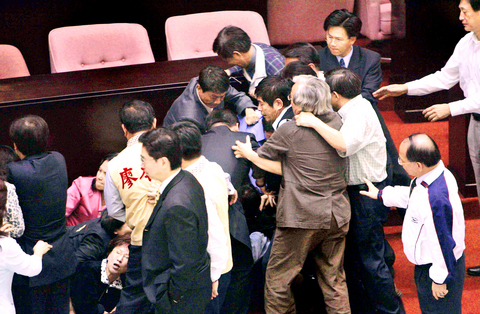
PHOTO: WALLY SANTANA, AP
The pan-blue camp's proposal would lift restrictions on cross-strait transport, effective three months after the amendments were passed.
The pan-green camp has opposed the measure on the grounds that it would undermine the government's authority to set cross-strait economic policy.
The pan-green camp had vowed that it would thwart the pan-blue's efforts, and it made good on that promise again yesterday.

PHOTO: CHIEN JUNG-FENG, TAIPEI TIMES
Snatched away
Just as PFP Legislator Ko Shu-ming (柯淑敏) was about to submit the revised clauses to be voted on one by one, DPP Legislator Wang Shu-hui (王淑慧) grabbed the proposal paper from Ko's hands and stuffed it in her mouth, in a sudden move that astonished other lawmakers.
Wang later spat out the document and tore it up after opposition lawmakers failed to get her to cough it up by pulling her hair.
During the melee, another DPP legislator, Chuang Ho-tzu (
"She spat saliva," yelled Hung Hsiu-chu (
Other pan-green and pan-blue lawmakers began to shove and shout at each other, forcing the legislative session to grind to a halt amid the chaotic free-for-all.
Legislative Speaker Wang Jin-pyng (
Back for more
There was a second round of chaos in the late afternoon, with lawmakers once again clashing with each other. Wang then announced a review of other provisional motions, while the pan-blue camp boycotted all motions proposed by the pan-green camp. The session then shuddered to a halt as Deputy Legislative Speaker Chung Jung-chi (
With the pan-blue camp's refusal to extend the legislative session, the legislature went into a recess until September.
Only 75 bills were passed during the past legislative session. Many major bills have been postponed, including the arms procurement bill, the special budgets for the Special Statute for Increasing Investment in Public Construction (
Those issues will not be taken up until the fall, unless a special session is held.
DPP caucus whip Ker Chien-ming (
But the PFP caucus said it would consent to holding an extraordinary secession. The KMT caucus said that it will discuss the matter in order to decide whether to accept the DPP's suggestion.
KMT Chairman Ma Ying-jeou (馬英九) later yesterday denounced the pan-green camp for blocking the establishment of direct transport links by taking over the podium in the legislature.
"We hope that the governing party will take measures to restrain its members from taking over the podium. Taiwan will lose face if they keep doing this," Ma said.
Ma called on the pan-green camp to sit down and discuss the issue rationally with opposition parties.
"Businesses and the general public all want the bill to pass the legislature, but the ruling party has blocked it with such a measure. History will judge this," he said.
Additional reporting by Mo Yan-chih

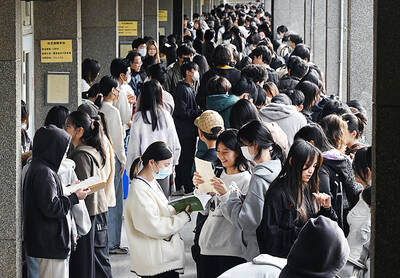
A global survey showed that 60 percent of Taiwanese had attained higher education, second only to Canada, the Ministry of the Interior said. Taiwan easily surpassed the global average of 43 percent and ranked ahead of major economies, including Japan, South Korea and the US, data from the Organisation for Economic Co-operation and Development (OECD) for 2024 showed. Taiwan has a high literacy rate, data released by the ministry showed. As of the end of last year, Taiwan had 20.617 million people aged 15 or older, accounting for 88.5 percent of the total population, with a literacy rate of 99.4 percent, the data

NEW LOW: The council in 2024 based predictions on a pessimistic estimate for the nation’s total fertility rate of 0.84, but last year that rate was 0.69, 17 percent lower An expected National Development Council (NDC) report expects the nation’s population to drop below 12 million by 2065, with the old-age dependency ratio to top 100 percent sooner than 2070, sources said yesterday. The council is slated to release its latest population projections in August, using an ultra-low fertility model, the sources said. The previous report projected that Taiwan’s population would fall to 14.37 million by 2070, but based on a new estimate of the total fertility rate (TFR) — the average number of children born to a woman over her lifetime — the population is expected to reach 12 million by
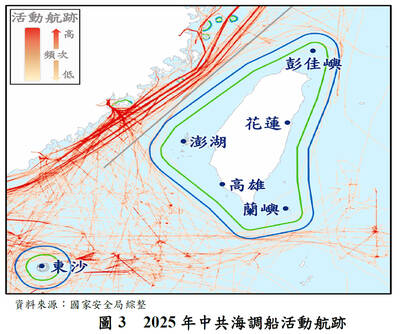
INTENSIFYING THREATS: Beijing’s tactics include massive attacks on the government service network, aircraft and naval vessel incursions and damaging undersea cables China is prepared to interfere in November’s nine-in-one local elections by launching massive attacks on the Taiwanese government’s service network (GSN), a report published by the National Security Bureau showed. The report was submitted to the Legislative Yuan ahead of the bureau’s scheduled briefing at the Foreign Affairs and National Defense Committee tomorrow. The national security team has identified about 13,000 suspicious Internet accounts and 860,000 disputed messages, the bureau said of China’s cognitive warfare against Taiwan. The disputed messages focus on major foreign affairs, national defense and economic issues, which were produced using generative artificial intelligence (AI) and distributed through Chinese

CCP ‘PAWN’? Beijing could use the KMT chairwoman’s visit to signal to the world that many people in Taiwan support the ‘one China’ principle, an academic said Chinese Nationalist Party (KMT) Chairwoman Cheng Li-wun (鄭麗文) yesterday arrived in China for a “peace” mission and potential meeting with Chinese President Xi Jinping (習近平), while a Taiwanese minister detailed the number of Chinese warships currently deployed around the nation. Cheng is visiting at a time of increased Chinese military pressure on Taiwan, as the opposition-dominated Legislative Yuan stalls a government plan for US$40 billion in extra defense spending. Speaking to reporters before going to the airport, Cheng said she was going on a “historic journey for peace,” but added that some people felt uneasy about her trip. “If you truly love Taiwan,


 RSS
RSS