


Taiwan's latest attempt to gain observer status at the World Health Assembly (WHA) seems to be stalled because of a memorandum of understanding (MOU) signed by China and the WHO that stipulates China has authority over Taiwan's WHO participation.
Taiwan has failed in every attempt over the last nine years when applying for observer status at the WHA because of China's opposition.
In May last year, the Chinese government signed the MOU with the WHO, claiming the memo serves to facilitate Taiwan's technical participation in the WHO, albeit under the watchful eye of Beijing, which considers Taiwan part of China.
Taiwanese foreign ministry and health officials said it was an extremely difficult task to push the observer bid.
This year, they came up with a "practical" campaign to strive for "meaningful participation," namely to ask for Taiwan's inclusion in the Global Outbreak and Alert Network (GOARN) and recognition as a partner in the International Health Regulations.
In a press conference to launch Taiwan's bid for WHA observer status this week, Vice Minister of Foreign Affairs Michael Kau (高英茂) spoke of the impact of the MOU, which he said had both positive and negative effects for Taiwan.
Despite the memo only offering Taiwan limited access to WHO-related activities, Taiwan was granted a total of 14 approvals to attend WHO technical meetings out of 32 that it requested to join.
But the negative impact of it was that Taiwan had to participate in those meetings under the guise of a province of China; either under the name of "Taiwan, China" or "Taipei, China," Kau said.
Health officials in Taiwan also emphasized that the political issue was not as important as participation as Taiwan was able to engage with the international health community.
A WHO official who was approached by Taiwanese journalists yesterday said the MOU serves to help and facilitate Taiwan's participation. Although, in most cases, Taiwan has to first obtain Beijing's approval, in times of emerging disease threats, like that of bird flu or SARS, the WHO can bypass Beijing and establish direct contact with the Taiwanese authorities.
"It's entirely a political issue," said a WHO official, who wished to remain anonymous, admitting that the WHO does not regard Taiwan's exclusion from the world health body as acute an issue as the medical incapacities facing other developing countries.
However, the signing of the MOU drew criticism from Taiwan that the memo severely undermines the country's status.
Democratic Progressive Party Legislator Winston Dang (
President of the Medical Professional Alliance of Taiwan Wu Shu-min (吳樹民) said that although it was important to have "substantive participation" in WHO activities, any kind of participation that was not based on observer status or full membership was unsustainable.
Secretary general of the alliance Lin Shih-chia (林世嘉) criticized China for using the MOU as a ploy to allow for Taiwan's technical and substantive participation in WHO in exchange for downgrading Taiwan to the status of a local government.
"The MOU is bait, and China uses `substantive participation' as a lure to exercise its unification campaign," Lin said.
Last year's MOU was a bilateral agreement between the WHO and Beijing and was kept confidential. Up until now Taiwanese officials still do not have access to the exact content of the document.
But a recent publication by British academic Martin McKee from the London School of Hygiene and Tropical Medicine revealed part of the MOU which detailed Beijing's control over technical exchanges between Taiwan and the WHO.
In an article entitled "Beyond Borders: Public-health Surveillance" which was published in the medical journal The Lancet on April 15 this year, McKee used Taiwan as an example to illustrate how political factors have impeded the integration of global surveillance of infectious disease outbreaks.
He said the memorandum of understanding between the WHO and China allows only very limited official communication between the WHO and the Taiwanese health authorities.
"The Chinese authorities have insisted that the highly bureaucratic procedures should not in any way imply independent status for Taiwan. All possible contacts need to be cleared with the Chinese delegation in Geneva no less than five weeks before meetings take place, and the Chinese authorities decide which Taiwanese individuals will be contacted," McKee wrote in the article.
Beijing also demanded that contact between the WHO and Taiwan "should not identify Taiwan, but just the city from which the expert comes from, and Taiwanese citizens are not to be invited to join expert advisory panels," McKee said of the MOU.
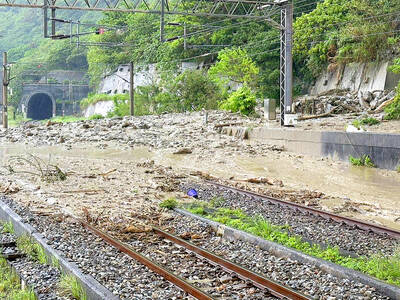
ROLLER-COASTER RIDE: More than five earthquakes ranging from magnitude 4.4 to 5.5 on the Richter scale shook eastern Taiwan in rapid succession yesterday afternoon Back-to-back weather fronts are forecast to hit Taiwan this week, resulting in rain across the nation in the coming days, the Central Weather Administration said yesterday, as it also warned residents in mountainous regions to be wary of landslides and rockfalls. As the first front approached, sporadic rainfall began in central and northern parts of Taiwan yesterday, the agency said, adding that rain is forecast to intensify in those regions today, while brief showers would also affect other parts of the nation. A second weather system is forecast to arrive on Thursday, bringing additional rain to the whole nation until Sunday, it
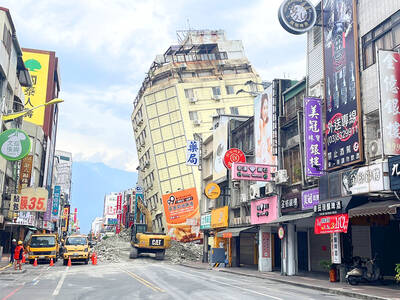
LANDSLIDES POSSIBLE: The agency advised the public to avoid visiting mountainous regions due to more expected aftershocks and rainfall from a series of weather fronts A series of earthquakes over the past few days were likely aftershocks of the April 3 earthquake in Hualien County, with further aftershocks to be expected for up to a year, the Central Weather Administration (CWA) said yesterday. Based on the nation’s experience after the quake on Sept. 21, 1999, more aftershocks are possible over the next six months to a year, the agency said. A total of 103 earthquakes of magnitude 4 on the local magnitude scale or higher hit Hualien County from 5:08pm on Monday to 10:27am yesterday, with 27 of them exceeding magnitude 5. They included two, of magnitude
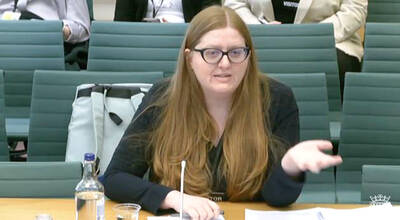
CONDITIONAL: The PRC imposes secret requirements that the funding it provides cannot be spent in states with diplomatic relations with Taiwan, Emma Reilly said China has been bribing UN officials to obtain “special benefits” and to block funding from countries that have diplomatic ties with Taiwan, a former UN employee told the British House of Commons on Tuesday. At a House of Commons Foreign Affairs Committee hearing into “international relations within the multilateral system,” former Office of the UN High Commissioner for Human Rights (OHCHR) employee Emma Reilly said in a written statement that “Beijing paid bribes to the two successive Presidents of the [UN] General Assembly” during the two-year negotiation of the Sustainable Development Goals. Another way China exercises influence within the UN Secretariat is

Taiwan’s first drag queen to compete on the internationally acclaimed RuPaul’s Drag Race, Nymphia Wind (妮妃雅), was on Friday crowned the “Next Drag Superstar.” Dressed in a sparkling banana dress, Nymphia Wind swept onto the stage for the final, and stole the show. “Taiwan this is for you,” she said right after show host RuPaul announced her as the winner. “To those who feel like they don’t belong, just remember to live fearlessly and to live their truth,” she said on stage. One of the frontrunners for the past 15 episodes, the 28-year-old breezed through to the final after weeks of showcasing her unique


 RSS
RSS