


A wave of car bombs hit Baghdad yesterday, killing at least eight people and wounding nearly 80 as the trial of former Iraqi president Saddam Hussein heard his signature was on documents linking him to the killings of 148 people.
The bloodshed comes while Prime Minister-designate Jawad al-Maliki works on choosing a Cabinet, which will share power among Shiites, Sunni Arabs and Kurds in a bid to end the sectarian violence that threatens to drag Iraq into a civil war.
Two car bombs near Baghdad's Mustansiriya University killed at least five people and wounded 25 others. Another bomb near the health ministry in the city center killed three and wounded 25, police said. Four more bombs across the city wounded at least another 27 people.
Maliki has four weeks to choose a new Cabinet and form a government of national unity, widely seen as the only way to halt sectarian violence.
The Cabinet and Maliki's own appointment, made by President Jalal Talabani on Saturday, must be ratified by parliament.
A key test of Maliki's ability to lead and to unite will be his choice of interior minister, perhaps the most sensitive post given the brutal past many Iraqis endured under Saddam's rule and a present wracked by relentless instability and violence.
"We want nothing but security and a safe community in which we can live and raise our children safely," said Wael Khamis, a 44-year-old businessman.
"Despite all that happened, I think we can still make a new beginning and forget the past if the new government makes a genuine good beginning by forming a Cabinet away from sectarian interests and the militias," Khamis said.
"All we have now is a hope and a dream of a better life. The coming government is our last chance. My wish is to take my family on a car ride without fear," he said.
The prosecution in Saddam's trial wrapped up its evidence against him yesterday after a new report by handwriting experts that linked him to the massacre of Shiite villagers in the 1980s.
After a 90-minute session with Saddam and the seven other defendants all in court, the trial was adjourned for three weeks to May 15, when the defense is expected to start presenting witnesses.
The tribunal's chief investigative judge Raed al-Juhi said the prosecution had "finished submitting evidence, though we cannot say that it has rested its case."
"The process of prosecution will continue until a verdict is passed," Juhi said.
The prosecution yesterday submitted a new report from handwriting experts that confirmed Saddam's signature was on documents linking him to the killings of 148 Shiites after an attempt on his life in the village of Dujail in 1982.
The latest report claimed that the signatures of all defendants were "matching," except for that of Mizhar Abdallah Ruweid, a former Baath party official in the Dujail area.
Saddam and his seven co-accused pleaded not guilty to charges including murder and torture over Dujail killings when the trial opened last October.
The prosecution also played a CD of a conversation between Saddam and his former vice president Taha Yassin Ramadan in which the two men reportedly discussed the retaliatory destruction of farms and orchards belonging to Dujail villagers.
In the recording, a voice said to be Saddam's is heard asking the caller, reportedly Ramadan, "What have you done to Dujail farms?"
"We have finished the maps of farms of Dujail and nearby Balad towns and we need a month to completely level these farms," the caller is heard saying.
"We will give them farms in other regions and this also gives us opportunity to build modern towns in Dujail and Balad," the caller said, to which Saddam says "fine ... fine."
Saddam's half-brother and feared former secret police chief Barzan Ibrahim Hassan al-Tikriti dismissed the evidence.
"Even if you bring 50 handwriting experts, they will all say the same thing," Barzan said.
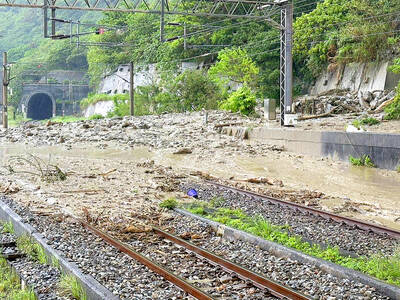
ROLLER-COASTER RIDE: More than five earthquakes ranging from magnitude 4.4 to 5.5 on the Richter scale shook eastern Taiwan in rapid succession yesterday afternoon Back-to-back weather fronts are forecast to hit Taiwan this week, resulting in rain across the nation in the coming days, the Central Weather Administration said yesterday, as it also warned residents in mountainous regions to be wary of landslides and rockfalls. As the first front approached, sporadic rainfall began in central and northern parts of Taiwan yesterday, the agency said, adding that rain is forecast to intensify in those regions today, while brief showers would also affect other parts of the nation. A second weather system is forecast to arrive on Thursday, bringing additional rain to the whole nation until Sunday, it
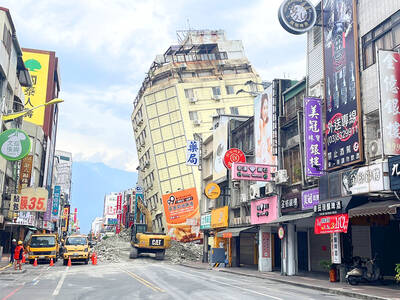
LANDSLIDES POSSIBLE: The agency advised the public to avoid visiting mountainous regions due to more expected aftershocks and rainfall from a series of weather fronts A series of earthquakes over the past few days were likely aftershocks of the April 3 earthquake in Hualien County, with further aftershocks to be expected for up to a year, the Central Weather Administration (CWA) said yesterday. Based on the nation’s experience after the quake on Sept. 21, 1999, more aftershocks are possible over the next six months to a year, the agency said. A total of 103 earthquakes of magnitude 4 on the local magnitude scale or higher hit Hualien County from 5:08pm on Monday to 10:27am yesterday, with 27 of them exceeding magnitude 5. They included two, of magnitude
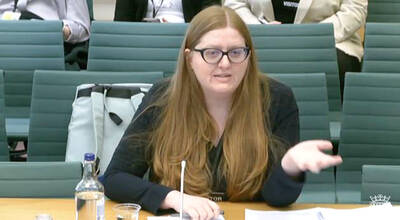
CONDITIONAL: The PRC imposes secret requirements that the funding it provides cannot be spent in states with diplomatic relations with Taiwan, Emma Reilly said China has been bribing UN officials to obtain “special benefits” and to block funding from countries that have diplomatic ties with Taiwan, a former UN employee told the British House of Commons on Tuesday. At a House of Commons Foreign Affairs Committee hearing into “international relations within the multilateral system,” former Office of the UN High Commissioner for Human Rights (OHCHR) employee Emma Reilly said in a written statement that “Beijing paid bribes to the two successive Presidents of the [UN] General Assembly” during the two-year negotiation of the Sustainable Development Goals. Another way China exercises influence within the UN Secretariat is

Taiwan’s first drag queen to compete on the internationally acclaimed RuPaul’s Drag Race, Nymphia Wind (妮妃雅), was on Friday crowned the “Next Drag Superstar.” Dressed in a sparkling banana dress, Nymphia Wind swept onto the stage for the final, and stole the show. “Taiwan this is for you,” she said right after show host RuPaul announced her as the winner. “To those who feel like they don’t belong, just remember to live fearlessly and to live their truth,” she said on stage. One of the frontrunners for the past 15 episodes, the 28-year-old breezed through to the final after weeks of showcasing her unique


 RSS
RSS