


Nepalese security forces fought back a communist rebel attack yesterday as officials placed the capital under curfew for the fifth straight day in an effort to stop anti-monarchy protests.
Five Maoist rebels and a government soldier died in fighting yesterday after the guerrillas attacked security bases and government buildings in the north-central town of Chautara, said a statement from Defense Ministry Spokesman Indiresh Dahal.
He said the army flew four civilians, injured in the attack in the remote mountain town, to a hospital in Kathmandu.
The attackers knocked down an antenna tower, severing the town's communications, and raided an area army base, police post, district administration office and jail, Dahal said.
He said the rebels bombed the local hospital, post office and education office, and that soldiers were combing the area for the attackers.
The Maoists have seized control of much of Nepal's countryside in a 10-year communist anti-monarchist insurgency that has killed about 13,000 people.
Protests have rocked Kathmandu for the past three weeks, and police have clashed with demonstrators demanding King Gyanendra relinquish the absolute power he seized 14 months ago. The communist rebels and Nepal's main political parties are both backing the movement.
In other developments, the US State Department yesterday ordered all non-emergency embassy staff and family members to leave Nepal, according to an embassy spokesman, Robert Hugins. He said about half of the mission's staff would leave.
Police fired tear gas and rubber bullets at a group of protesters marching along the city's Ring Road on Kathmandu's northern edge. At least seven people were injured, independent Kantipur radio reported.
The road circles the capital and is outside the zone of the city's 11am-6pm curfew. It was not clear why police decided to stop the demonstration.
Opposition parties said they expected hundreds of thousands at protests today, set to start from several points along the Ring Road.
Yesterday, activists prepared for the mass gathering.
"We are going door-to-door informing people of the program so they will be ready," said Nepali Congress Party activist Pradeep Dhakal.
In Geneva, a UN rights official urged Nepal to end its "shoot-on-sight" policy for curfew breakers.
"The government is, in effect, instructing its forces to shoot innocent people," said Philip Alston, the UN's special investigator on illegal and arbitrary executions.
Security forces have killed at least 14 protesters since the strike began. Despite the policy, however, there are no known cases of curfew-breakers being shot when they were not at protests.
The protests have intensified since Friday, when Gyanendra offered to let the seven-party opposition alliance nominate a prime minister and form a government. The opposition has rejected the offer.
also see story:
Nepal's monarchy faces an Everest-sized battle for survival
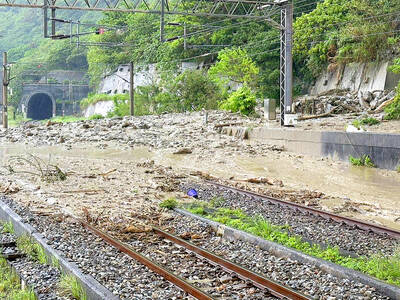
ROLLER-COASTER RIDE: More than five earthquakes ranging from magnitude 4.4 to 5.5 on the Richter scale shook eastern Taiwan in rapid succession yesterday afternoon Back-to-back weather fronts are forecast to hit Taiwan this week, resulting in rain across the nation in the coming days, the Central Weather Administration said yesterday, as it also warned residents in mountainous regions to be wary of landslides and rockfalls. As the first front approached, sporadic rainfall began in central and northern parts of Taiwan yesterday, the agency said, adding that rain is forecast to intensify in those regions today, while brief showers would also affect other parts of the nation. A second weather system is forecast to arrive on Thursday, bringing additional rain to the whole nation until Sunday, it
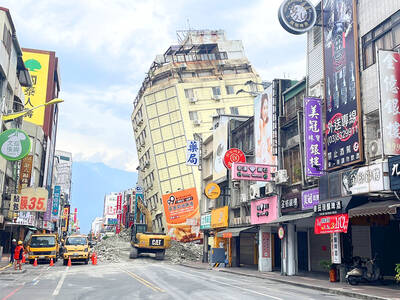
LANDSLIDES POSSIBLE: The agency advised the public to avoid visiting mountainous regions due to more expected aftershocks and rainfall from a series of weather fronts A series of earthquakes over the past few days were likely aftershocks of the April 3 earthquake in Hualien County, with further aftershocks to be expected for up to a year, the Central Weather Administration (CWA) said yesterday. Based on the nation’s experience after the quake on Sept. 21, 1999, more aftershocks are possible over the next six months to a year, the agency said. A total of 103 earthquakes of magnitude 4 on the local magnitude scale or higher hit Hualien County from 5:08pm on Monday to 10:27am yesterday, with 27 of them exceeding magnitude 5. They included two, of magnitude

CONDITIONAL: The PRC imposes secret requirements that the funding it provides cannot be spent in states with diplomatic relations with Taiwan, Emma Reilly said China has been bribing UN officials to obtain “special benefits” and to block funding from countries that have diplomatic ties with Taiwan, a former UN employee told the British House of Commons on Tuesday. At a House of Commons Foreign Affairs Committee hearing into “international relations within the multilateral system,” former Office of the UN High Commissioner for Human Rights (OHCHR) employee Emma Reilly said in a written statement that “Beijing paid bribes to the two successive Presidents of the [UN] General Assembly” during the two-year negotiation of the Sustainable Development Goals. Another way China exercises influence within the UN Secretariat is

Taiwan’s first drag queen to compete on the internationally acclaimed RuPaul’s Drag Race, Nymphia Wind (妮妃雅), was on Friday crowned the “Next Drag Superstar.” Dressed in a sparkling banana dress, Nymphia Wind swept onto the stage for the final, and stole the show. “Taiwan this is for you,” she said right after show host RuPaul announced her as the winner. “To those who feel like they don’t belong, just remember to live fearlessly and to live their truth,” she said on stage. One of the frontrunners for the past 15 episodes, the 28-year-old breezed through to the final after weeks of showcasing her unique


 RSS
RSS