


President Chen Shui-bian (
"Democracy is the right way to go and there is no turning back," he said on the eve of a meeting between US President George W. Bush and Chinese President Hu Jintao (胡錦濤) in Washington last night.
sleeping giant
Chen cited Napoleon, who is frequently misattributed as having said China was a "sleeping giant" that would shake the world when she awoke. Chen said that he hoped to see China awake to become a responsible stakeholder in the international community.
"Although Taiwan may seem naive to entertain the hope that China will become a democracy, I sincerely hope that the `rise of China' would be accompamied by democratic development, because it would be a blessing for the entire human race," he said.
Chen made the remarks yesterday morning while receiving Chinese dissidents and democracy activists, including Cao Changqing (
Chen said that no matter whether China remained an authoritarian regime or collapsed like the former Soviet Union, democracy would eventually prevail.
"China cannot resist the megatrend of freedom and democracy, even if it uses nuclear weapons, ballistic missiles or dictatorship," he said.
Taiwan's dispute with China is not about ideology or nationalism, Chen said. It is about a way of life and a political system.
Chen said that it was possible that the people of Taiwan would eventually choose to unite with China, but unification with China could not be set as the ultimate goal and only option for the people.
It is impossible for Taiwan to unite with China in the foreseeable future, he said, because it was inconceivable that Beijing would abandon authoritarian rule and allow China to become a democracy.
High alert
Meanwhile, the Ministry of Foreign Affairs yesterday said it was on heightened alert for the meeting between Bush and Hu, with ministry staff working round the clock to monitor what the two leaders had to say about Taiwan.
Ministry Spokesman Michel Lu (呂慶龍) yesterday said "we have to be confident about ourselves" in response to concerns that the Bush administration might make adverse comments about Taiwan under pressure from China.
However, Washington has assured Taipei that "no surprises" would come out of the meeting, Taiwan's representative to the US said in a recent interview with a US newspaper.
David Lee (
"I have met with a number of administration officials, and the word I keep getting is that there will be no surprises," Lee was quoted by the Washington Times as saying.
In related news, Premier Su Tseng-chang (
Additional reporting by Jimmy Chuang and Chang Yun-ping
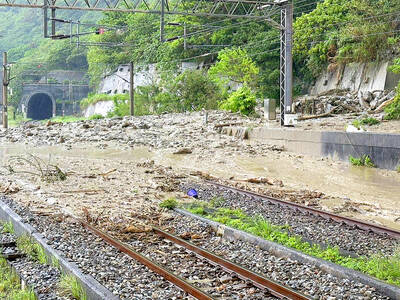
ROLLER-COASTER RIDE: More than five earthquakes ranging from magnitude 4.4 to 5.5 on the Richter scale shook eastern Taiwan in rapid succession yesterday afternoon Back-to-back weather fronts are forecast to hit Taiwan this week, resulting in rain across the nation in the coming days, the Central Weather Administration said yesterday, as it also warned residents in mountainous regions to be wary of landslides and rockfalls. As the first front approached, sporadic rainfall began in central and northern parts of Taiwan yesterday, the agency said, adding that rain is forecast to intensify in those regions today, while brief showers would also affect other parts of the nation. A second weather system is forecast to arrive on Thursday, bringing additional rain to the whole nation until Sunday, it
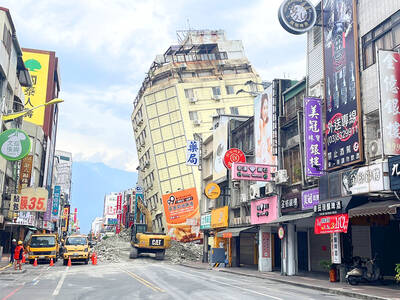
LANDSLIDES POSSIBLE: The agency advised the public to avoid visiting mountainous regions due to more expected aftershocks and rainfall from a series of weather fronts A series of earthquakes over the past few days were likely aftershocks of the April 3 earthquake in Hualien County, with further aftershocks to be expected for up to a year, the Central Weather Administration (CWA) said yesterday. Based on the nation’s experience after the quake on Sept. 21, 1999, more aftershocks are possible over the next six months to a year, the agency said. A total of 103 earthquakes of magnitude 4 on the local magnitude scale or higher hit Hualien County from 5:08pm on Monday to 10:27am yesterday, with 27 of them exceeding magnitude 5. They included two, of magnitude
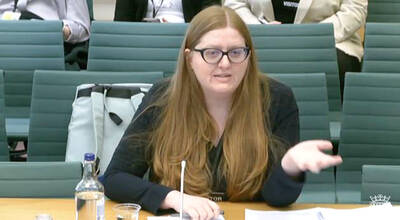
CONDITIONAL: The PRC imposes secret requirements that the funding it provides cannot be spent in states with diplomatic relations with Taiwan, Emma Reilly said China has been bribing UN officials to obtain “special benefits” and to block funding from countries that have diplomatic ties with Taiwan, a former UN employee told the British House of Commons on Tuesday. At a House of Commons Foreign Affairs Committee hearing into “international relations within the multilateral system,” former Office of the UN High Commissioner for Human Rights (OHCHR) employee Emma Reilly said in a written statement that “Beijing paid bribes to the two successive Presidents of the [UN] General Assembly” during the two-year negotiation of the Sustainable Development Goals. Another way China exercises influence within the UN Secretariat is

Taiwan’s first drag queen to compete on the internationally acclaimed RuPaul’s Drag Race, Nymphia Wind (妮妃雅), was on Friday crowned the “Next Drag Superstar.” Dressed in a sparkling banana dress, Nymphia Wind swept onto the stage for the final, and stole the show. “Taiwan this is for you,” she said right after show host RuPaul announced her as the winner. “To those who feel like they don’t belong, just remember to live fearlessly and to live their truth,” she said on stage. One of the frontrunners for the past 15 episodes, the 28-year-old breezed through to the final after weeks of showcasing her unique


 RSS
RSS