


US President George W. Bush yesterday reaffirmed the US' one-China policy and urged Beijing and Taipei to avoid confrontation in their territorial dispute.
Speaking on the White House lawn as Chinese President Hu Jintao (
"The United States maintains our one-China policy based on the three communiques and the Taiwan relations act," he said.
"We oppose unilateral changes in the status quo in the Taiwan Strait by either side and urge all parties to avoid confrontational or provocative acts," Bush said. "We believe the future of Taiwan should be resolved peacefully."
In his reply, Hu said China appreciated the US policy and warned that Taiwan would not be allowed to fully break away.
"Taiwan is an inalienable part of Chinese territory," he said.
He added that China would "strive for the prospect of peaceful reunification of the two sides across the Taiwan Strait.
"We will work with our Taiwan compatriots to work for the development of cross-straits relation, however we will never allow anyone to let Taiwan secede from China by any means," he said.
Bush welcomed Hu with pomp and pageantry as the two leaders embarked on talks aimed at cooling tensions over several matters including a yawning US-China trade gap.
As Hu began speaking at the carefully choreographed ceremony, he was interrupted by a Chinese woman who had made her way onto the camera stand and shouted protests against Hu in English and Chinese.
The woman on the camera stand shouted in English, "President Bush, stop him from persecuting the Falun Gong!" She also shouted in Chinese, "President Hu, your days are numbered," according to a translation by reporters on the scene.
Uniformed Secret Service personnel hustled her from the South Lawn.
In welcoming Hu to his first visit to the White House as Chinese leader, Bush said: "The United states and China are two nations divided by a vast ocean yet connected through a global economy that has created opportunity for both our peoples."
He was quick to serve notice that he would continue to press for China to move "toward a flexible market exchange rate for its currency."
Bush also pressed for more cooperation on addressing the nuclear ambitions of Iran and North Korea.
Demonstrators massed outside protested Beijing's human-rights policies. Many were from the Falun Gong, a spiritual movement condemned by the Chinese government as an evil cult.
As the ceremony began, Bush and Hu stood side by side, under bright sunshine on the South Lawn of the White House, as a military band played the national anthems of both countries.
Bush and Hu then engaged in a ceremonial review of US troops, some dressed in 18th-century Continental Army uniforms.
In his speech, Hu pledged China's help in working diplomatically to ease nuclear tensions with both North Korea and Iran, and he vowed in general terms to work to promote human rights.
Hu was visiting Washington for the first time as China's leader, and the talks with Bush were expected to produce no substantive gains in the trade dispute, nor any breakthrough on China's tightly controlled currency.
The visit attracted high-profile attention both inside and outside the White House gates. Falun Gong gathered hundreds of demonstrators on street corners near the White House in the early morning. Marchers banged gongs, chanted and waved US and Chinese flags. Banners denounced Hu as a "Chinese dictator" responsible for genocide and other "crimes in Chinese labor camps and prisons."
In addition to trade, Bush was to raise a number of other issues with Hu, including a bid for China's help in dealing with current nuclear standoffs with North Korea and Iran, complaints about China's human rights record and questions over China's growing military strength and whether it poses a threat to Taiwan.
Also see stories:
Chabot pans Hu's Washington welcomeEditorial: Right people make the difference
Be proactive with cross-strait policy
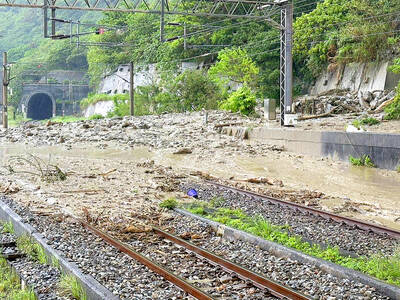
ROLLER-COASTER RIDE: More than five earthquakes ranging from magnitude 4.4 to 5.5 on the Richter scale shook eastern Taiwan in rapid succession yesterday afternoon Back-to-back weather fronts are forecast to hit Taiwan this week, resulting in rain across the nation in the coming days, the Central Weather Administration said yesterday, as it also warned residents in mountainous regions to be wary of landslides and rockfalls. As the first front approached, sporadic rainfall began in central and northern parts of Taiwan yesterday, the agency said, adding that rain is forecast to intensify in those regions today, while brief showers would also affect other parts of the nation. A second weather system is forecast to arrive on Thursday, bringing additional rain to the whole nation until Sunday, it
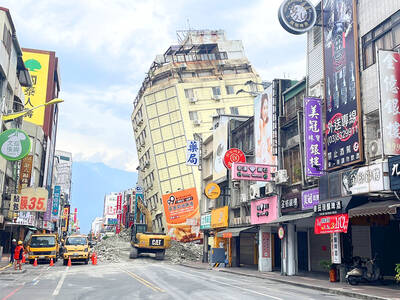
LANDSLIDES POSSIBLE: The agency advised the public to avoid visiting mountainous regions due to more expected aftershocks and rainfall from a series of weather fronts A series of earthquakes over the past few days were likely aftershocks of the April 3 earthquake in Hualien County, with further aftershocks to be expected for up to a year, the Central Weather Administration (CWA) said yesterday. Based on the nation’s experience after the quake on Sept. 21, 1999, more aftershocks are possible over the next six months to a year, the agency said. A total of 103 earthquakes of magnitude 4 on the local magnitude scale or higher hit Hualien County from 5:08pm on Monday to 10:27am yesterday, with 27 of them exceeding magnitude 5. They included two, of magnitude
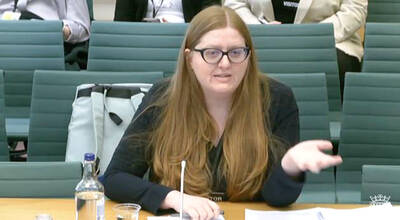
CONDITIONAL: The PRC imposes secret requirements that the funding it provides cannot be spent in states with diplomatic relations with Taiwan, Emma Reilly said China has been bribing UN officials to obtain “special benefits” and to block funding from countries that have diplomatic ties with Taiwan, a former UN employee told the British House of Commons on Tuesday. At a House of Commons Foreign Affairs Committee hearing into “international relations within the multilateral system,” former Office of the UN High Commissioner for Human Rights (OHCHR) employee Emma Reilly said in a written statement that “Beijing paid bribes to the two successive Presidents of the [UN] General Assembly” during the two-year negotiation of the Sustainable Development Goals. Another way China exercises influence within the UN Secretariat is
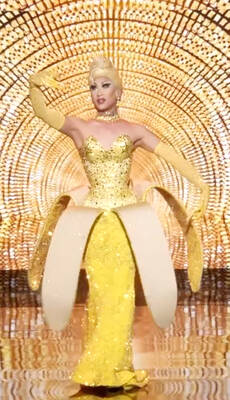
Taiwan’s first drag queen to compete on the internationally acclaimed RuPaul’s Drag Race, Nymphia Wind (妮妃雅), was on Friday crowned the “Next Drag Superstar.” Dressed in a sparkling banana dress, Nymphia Wind swept onto the stage for the final, and stole the show. “Taiwan this is for you,” she said right after show host RuPaul announced her as the winner. “To those who feel like they don’t belong, just remember to live fearlessly and to live their truth,” she said on stage. One of the frontrunners for the past 15 episodes, the 28-year-old breezed through to the final after weeks of showcasing her unique


 RSS
RSS