


A group of academics in Taipei on Thursday suggested that Taiwan file an application with the UN to make traditional Chinese characters a world cultural heritage entitled to special protection.
Wang Kai-fu (
Wang said he was confident that traditional, full-form Chinese characters would survive and even thrive because of the medium's strong "vitality," despite political pressure from Beijing, which has made it increasingly difficult for Taiwan to promote traditional Chinese characters around the world.
The best way to prevent traditional characters from being marginalized was to list them as a UN-protected world cultural heritage, he said.
Taiwan, Hong Kong and Macau still use the full-form characters, with the rest of the world mostly using the simplified characters developed in China, supposedly to "boost literacy."
Meanwhile, Hsu Ching-yun (
However, he said, the Chinese people have come to increasingly "crave" traditional characters as living standards continue to rise in China, generating a growing cultural awareness.
Hsu also suggested that Taiwan convene an international Sinology conference to raise global awareness about the importance and significance of traditional Chinese characters.
A Chinese Nationalist Party (KMT) lawmaker, however, yesterday urged the Ministry of Education to ditch a policy proposal under which students would lose marks for using simplified Chinese characters in examinations.
KMT Legislator Wang Yu-ting (
Wang said that according to a list of standard characters published by the ministry, 57 commonly seen simplified characters are now considered standard characters.
While the policy is expected to apply to basic ability tests for junior high school students starting next month, the ministry has so far not made public the criteria for mark deductions, which has caused anxiety among students, she said.
Minister of Education Tu Cheng-sheng (杜正勝) said on Tuesday that students taking the tests are prohibited from using the simplified characters created by the Chinese authorities, but are allowed to use those that have "become commonly accepted."
Under KMT rule, non-government publications were banned for using simplified script, in some cases even for using a single simplified character.
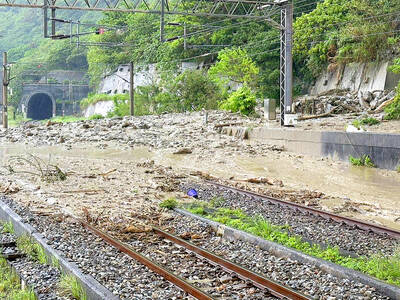
ROLLER-COASTER RIDE: More than five earthquakes ranging from magnitude 4.4 to 5.5 on the Richter scale shook eastern Taiwan in rapid succession yesterday afternoon Back-to-back weather fronts are forecast to hit Taiwan this week, resulting in rain across the nation in the coming days, the Central Weather Administration said yesterday, as it also warned residents in mountainous regions to be wary of landslides and rockfalls. As the first front approached, sporadic rainfall began in central and northern parts of Taiwan yesterday, the agency said, adding that rain is forecast to intensify in those regions today, while brief showers would also affect other parts of the nation. A second weather system is forecast to arrive on Thursday, bringing additional rain to the whole nation until Sunday, it
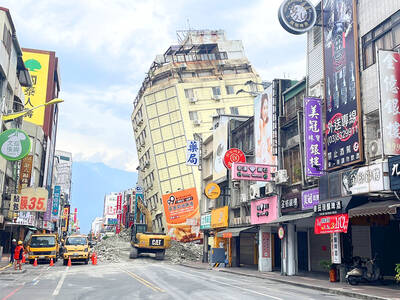
LANDSLIDES POSSIBLE: The agency advised the public to avoid visiting mountainous regions due to more expected aftershocks and rainfall from a series of weather fronts A series of earthquakes over the past few days were likely aftershocks of the April 3 earthquake in Hualien County, with further aftershocks to be expected for up to a year, the Central Weather Administration (CWA) said yesterday. Based on the nation’s experience after the quake on Sept. 21, 1999, more aftershocks are possible over the next six months to a year, the agency said. A total of 103 earthquakes of magnitude 4 on the local magnitude scale or higher hit Hualien County from 5:08pm on Monday to 10:27am yesterday, with 27 of them exceeding magnitude 5. They included two, of magnitude
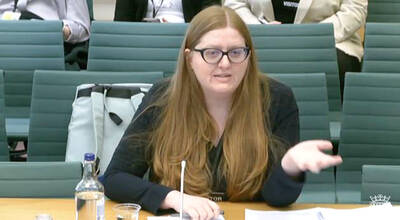
CONDITIONAL: The PRC imposes secret requirements that the funding it provides cannot be spent in states with diplomatic relations with Taiwan, Emma Reilly said China has been bribing UN officials to obtain “special benefits” and to block funding from countries that have diplomatic ties with Taiwan, a former UN employee told the British House of Commons on Tuesday. At a House of Commons Foreign Affairs Committee hearing into “international relations within the multilateral system,” former Office of the UN High Commissioner for Human Rights (OHCHR) employee Emma Reilly said in a written statement that “Beijing paid bribes to the two successive Presidents of the [UN] General Assembly” during the two-year negotiation of the Sustainable Development Goals. Another way China exercises influence within the UN Secretariat is
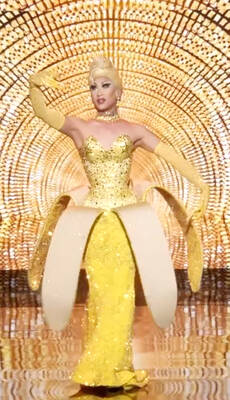
Taiwan’s first drag queen to compete on the internationally acclaimed RuPaul’s Drag Race, Nymphia Wind (妮妃雅), was on Friday crowned the “Next Drag Superstar.” Dressed in a sparkling banana dress, Nymphia Wind swept onto the stage for the final, and stole the show. “Taiwan this is for you,” she said right after show host RuPaul announced her as the winner. “To those who feel like they don’t belong, just remember to live fearlessly and to live their truth,” she said on stage. One of the frontrunners for the past 15 episodes, the 28-year-old breezed through to the final after weeks of showcasing her unique


 RSS
RSS