


A new report issued in Washington paints a bleak picture of Taiwan's ability to counter a Chinese missile attack, even with the help of the US, citing what it calls the "chaotic" political atmosphere surrounding the issue of missile defense and military squabbling over the issue.
"Taiwan is starting essentially from scratch" in trying to fashion a missile defense capability, "and fractious internal politics mean there is no national consensus for such defenses or even the severity of the threat," the report says.
The study, The Paths Ahead: Missile Defense in Asia, was released on Thursday by the Center for Strategic and International Studies (CSIS). It was prepared by Kurt Campbell, the Deputy Assistant Secretary of Defense under former president Clinton, and CSIS senior fellow Jeremiah Gertler. It covers the entire region and has a large section on Taiwan.
outnumbered
It estimates that in any attack, Chinese incoming missiles would outnumber Taiwan's interceptor missiles by six or seven to one, and would afford Taiwan only a brief timespan to respond.
Taiwan's government "is under no illusion about the ability of even ideal missile defense to absorb a full-scale Chinese attack," the authors say. "Neither do they expect to defend point targets successfully, even with US assistance."
In interviews, Campbell and Gertler say, Taiwanese officials say their goal in acquiring a ballistic missile defense would be to "avoid diplomatic coercion and raise uncertainties" in China about the success of a "quick, perhaps limited decapitation strike."
"Even those modest goals seem quite remote today," the report says.
The study describes missile defense as "an unusually polarizing issue" in Taiwan politically, noting the opposition by the pan-blues, who see missile defense as "a provocation to ... China and an obstacle to peace and stability across the Taiwan Strait."
It also notes that Taiwan's military is split, with the Army opposed to missile defense, the Navy for it and the Air Force split. This stems from "internecine budgetary and power rivalries," since the Army would have to pay for the weapons, while the Air Force and Navy would operate them.
"With political polarization and debates over the costs and benefits of BMD [ballistic missile defense] for Taiwan, it is difficult to see how the island will be able to proceed with missile defense in the near future," the authors say.
"Given the cost tradeoffs and a booming economy, China could easily continue to deploy six or seven offensive missiles for every Taiwanese defensive missile to overwhelm the island's defenses. The alternatives may be little more palatable. Relying completely on the United States to provide for its defense undercuts Taiwan's claim to be a fully sovereign nation, and is a course the US is ever less likely to accept," it says.
denying access
The report underscores an issue that has become a topic of increased discussion in Washington over the past year or two: China's ability to deny US forces access to the Taiwan Strait area in the event of an attack. New Chinese anti-ship cruise missiles, submarines and fast-attack boats are "creating the capability to push US ships out of even marginally-effective missile defense range. Even if US AEGIS ships find a way to survive in an increasingly hostile anti-access environment, they face a real challenge to effectively defending Taiwan," Campbell and Gertler say.
Not only would the ships have to allocate their missiles between self-defense and defending Taiwan, but also the Chinese missiles would "challenge the limits" of the AEGIS' weapons.
"That leaves the brunt of Taiwan's missile defense to PAC-3" and other new US systems, the report says.
The pan-blue-controlled Legislative Yuan has refused to fund the purchase of PAC-3's, which US President George W. Bush offered to Taiwan in April 2001.
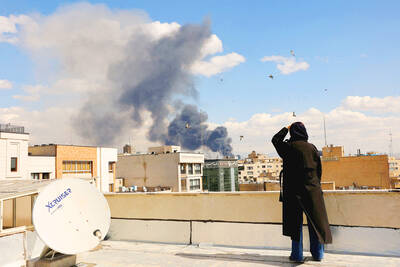
CHAOS: Iranians took to the streets playing celebratory music after reports of Khamenei’s death on Saturday, while mourners also gathered in Tehran yesterday Iranian Supreme Leader Ayatollah Ali Khamenei was killed in a major attack on Iran launched by Israel and the US, throwing the future of the Islamic republic into doubt and raising the risk of regional instability. Iranian state television and the state-run IRNA news agency announced the 86-year-old’s death early yesterday. US President Donald Trump said it gave Iranians their “greatest chance” to “take back” their country. The announcements came after a joint US and Israeli aerial bombardment that targeted Iranian military and governmental sites. Trump said the “heavy and pinpoint bombing” would continue through the week or as long
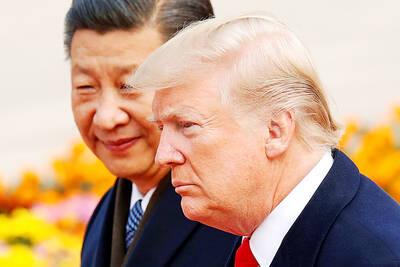
TRUST: The KMT said it respected the US’ timing and considerations, and hoped it would continue to honor its commitments to helping Taiwan bolster its defenses and deterrence US President Donald Trump is delaying a multibillion-dollar arms sale to Taiwan to ensure his visit to Beijing is successful, a New York Times report said. The weapons sales package has stalled in the US Department of State, the report said, citing US officials it did not identify. The White House has told agencies not to push forward ahead of Trump’s meeting with Chinese President Xi Jinping (習近平), it said. The two last month held a phone call to discuss trade and geopolitical flashpoints ahead of the summit. Xi raised the Taiwan issue and urged the US to handle arms sales to

An Emirates flight from Dubai arrived at Taiwan Taoyuan International Airport yesterday afternoon, the first service of the airline since the US and Israel launched strikes against Iran on Saturday. Flight EK366 took off from the United Arab Emirates (UAE) at 3:51am yesterday and landed at 4:02pm before taxiing to the airport’s D6 gate at Terminal 2 at 4:08pm, data from the airport and FlightAware, a global flight tracking site, showed. Of the 501 passengers on the flight, 275 were Taiwanese, including 96 group tour travelers, the data showed. Tourism Administration Deputy Director-General Huang He-ting (黃荷婷) greeted Taiwanese passengers at the airport and
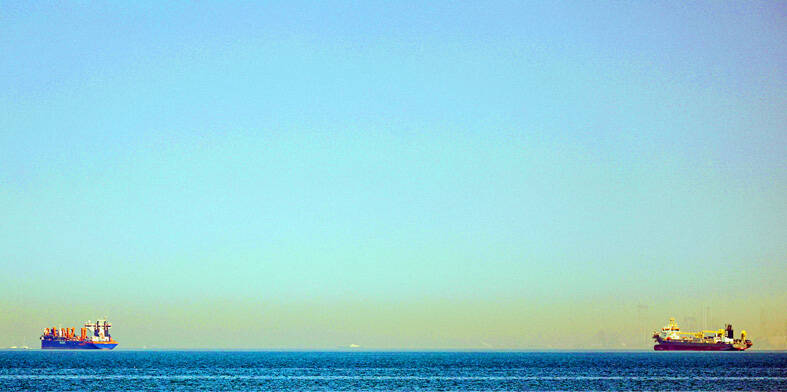
State-run CPC Corp, Taiwan (CPC, 台灣中油) yesterday said that it had confirmed on Saturday night with its liquefied natural gas (LNG) and crude oil suppliers that shipments are proceeding as scheduled and that domestic supplies remain unaffected. The CPC yesterday announced the gasoline and diesel prices will rise by NT$0.2 and NT$0.4 per liter, respectively, starting Monday, citing Middle East tensions and blizzards in the eastern United States. CPC also iterated it has been reducing the proportion of crude oil imports from the Middle East and diversifying its supply sources in the past few years in response to geopolitical risks, expanding


 RSS
RSS