


Lewis "Scooter" Libby apparently had serious qualms about leaking classified intelligence to the media, but he was quickly persuaded to drop them. There was pressure from his boss, US Vice President Dick Cheney, who advised him that the US president had authorized Libby to do so. End of discussion.
That's the picture that emerges from court papers filed by the prosecutor in the CIA leak case against Libby, who is depicted as doing the bidding of President George W. Bush and Cheney in striking back at administration critic Joseph Wilson.
On Thursday, disclosure of official authorization for Libby's leaks to reporters brought strong criticism from administration political foes, but little likelihood that their demands for explanations would be met.
Senator John Kerry, a Massachusetts Democrat, citing Bush's call two years ago to find the person who leaked the CIA identity of Wilson's wife, Valerie Plame, said the latest disclosures meant the president needed to go no further than a mirror.
In his court filing, Special Counsel Patrick Fitzgerald asserted that "the president was unaware of the role" that Libby "had in fact played in disclosing" Plame's CIA status. The prosecutor gave no such assurance, though, regarding Cheney.
Senate Democratic leader Harry Reid, of Nevada, said that "in light of today's shocking revelation, President Bush must fully disclose his participation in the selective leaking of classified information. The American people must know the truth."
Attorney General Alberto Gonzales said the president had the "inherent authority to decide who should have classified information." The White House declined to comment, citing the ongoing criminal investigation into the leak of Plame's identity.
In July 2003, Wilson's accusation that the Bush administration had twisted prewar intelligence to exaggerate the Iraqi threat "was viewed in the office of the vice president as a direct attack on the credibility of the vice president, and the president," Fitzgerald's court papers stated.
Part of the counterattack was a July 8, 2003, meeting with New York Times reporter Judith Miller at which Libby discussed the contents of a then-classified CIA report that seemed to undercut what Wilson was saying in public.
Separately, Libby said he understood he was also to tell Miller that prewar intelligence assessments had been that Iraq was "vigorously trying to procure" uranium, the prosecutor stated. In the run-up to the war, Cheney had insisted Iraq was trying to build a nuclear bomb.
The conclusion on uranium was contained in a National Intelligence Estimate (NIE), a consensus document of the US intelligence community. Libby's statements came in grand jury testimony before he was charged with five counts of perjury, obstruction and lying to the FBI in the Plame probe.
Libby at first told the vice president that he could not have the July 8, 2003, conversation with Miller because of the classified nature of the National Intelligence Estimate on Iraq, Fitzgerald said.
Libby testified to the grand jury "that the vice president later advised him that the president had authorized [the] defendant to disclose the relevant portions" of the NIE.
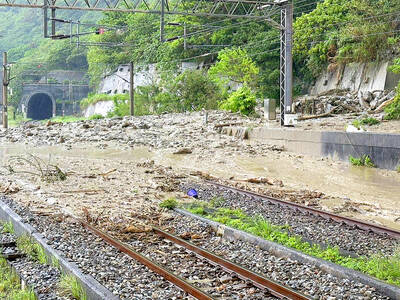
ROLLER-COASTER RIDE: More than five earthquakes ranging from magnitude 4.4 to 5.5 on the Richter scale shook eastern Taiwan in rapid succession yesterday afternoon Back-to-back weather fronts are forecast to hit Taiwan this week, resulting in rain across the nation in the coming days, the Central Weather Administration said yesterday, as it also warned residents in mountainous regions to be wary of landslides and rockfalls. As the first front approached, sporadic rainfall began in central and northern parts of Taiwan yesterday, the agency said, adding that rain is forecast to intensify in those regions today, while brief showers would also affect other parts of the nation. A second weather system is forecast to arrive on Thursday, bringing additional rain to the whole nation until Sunday, it
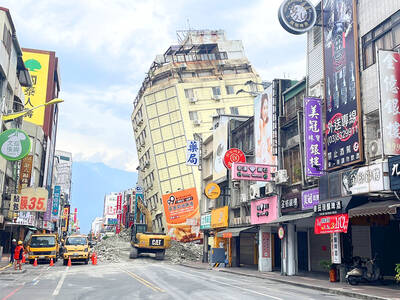
LANDSLIDES POSSIBLE: The agency advised the public to avoid visiting mountainous regions due to more expected aftershocks and rainfall from a series of weather fronts A series of earthquakes over the past few days were likely aftershocks of the April 3 earthquake in Hualien County, with further aftershocks to be expected for up to a year, the Central Weather Administration (CWA) said yesterday. Based on the nation’s experience after the quake on Sept. 21, 1999, more aftershocks are possible over the next six months to a year, the agency said. A total of 103 earthquakes of magnitude 4 on the local magnitude scale or higher hit Hualien County from 5:08pm on Monday to 10:27am yesterday, with 27 of them exceeding magnitude 5. They included two, of magnitude
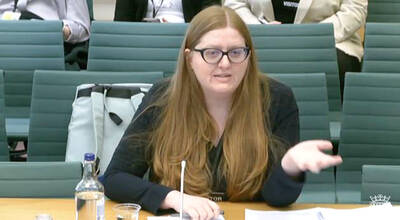
CONDITIONAL: The PRC imposes secret requirements that the funding it provides cannot be spent in states with diplomatic relations with Taiwan, Emma Reilly said China has been bribing UN officials to obtain “special benefits” and to block funding from countries that have diplomatic ties with Taiwan, a former UN employee told the British House of Commons on Tuesday. At a House of Commons Foreign Affairs Committee hearing into “international relations within the multilateral system,” former Office of the UN High Commissioner for Human Rights (OHCHR) employee Emma Reilly said in a written statement that “Beijing paid bribes to the two successive Presidents of the [UN] General Assembly” during the two-year negotiation of the Sustainable Development Goals. Another way China exercises influence within the UN Secretariat is

Taiwan’s first drag queen to compete on the internationally acclaimed RuPaul’s Drag Race, Nymphia Wind (妮妃雅), was on Friday crowned the “Next Drag Superstar.” Dressed in a sparkling banana dress, Nymphia Wind swept onto the stage for the final, and stole the show. “Taiwan this is for you,” she said right after show host RuPaul announced her as the winner. “To those who feel like they don’t belong, just remember to live fearlessly and to live their truth,” she said on stage. One of the frontrunners for the past 15 episodes, the 28-year-old breezed through to the final after weeks of showcasing her unique


 RSS
RSS