


Supreme leader Ayatollah Ali Khamenei said that he approved of proposed talks between US and Iranian officials on Iraq, but warned that the US must not try to "bully" Iran.
It was the first confirmation that Khamenei, who holds final say on all state matters in Iran, is in favor of the talks. His comments on Tuesday appeared aimed at calming criticism by hard-liners over a major shift in policy by the regime, which long shunned high-level contacts with a country Tehran brands "the Great Satan."
Khamenei spoke hours after US President George W. Bush said he favors the talks, in which he said US officials would show Iran "what's right or wrong in their activities inside of Iraq."
Khamenei said that "if the Iranian officials can make the US understand some issues about Iraq, there is no problem with the negotiations."
"But if the talks mean opening a venue for bullying and imposition by the deceitful party [the US], then it will be forbidden," he said in a nationally televised speech in the holy Shiite city of Mashhad in northeastern Iran.
Both the US and Iran have said the talks would focus solely on stabilizing Iraq and not deal with the heated issue of Iran's nuclear program. No time or place has yet been set for talks, though the US ambassador to Iraq, Zalmay Khalilzad, who is to head the US side, has proposed holding them in Baghdad.
Last week, a top Iranian official -- Ali Larijani, the secretary of the Supreme National Security Council -- announced that Tehran was willing to enter talks with the US.
The announcement drew criticism from some hard-liners in Iran's clerical regime. Hossein Shariatmadari, a close adviser to Khamenei, called Larijani's statements "deplorable" and said holding talks with the US would signal that "Iran gave in to Washington."
Khamenei appeared to be weighing in to end the criticism, while insisting Iran would not bow to the US in any talks. He said some US officials had depicted the talks as if the US were "summoning Iranian officials."
"I say here that the US government has no right to summon Iranian officials," Khamenei said.
Khamenei is considered the leader of hard-liners in Iran who largely prevented reformists from opening greater contacts with the US. Still, under his rule, Iran has held lower-level talks with US officials, particularly in multilateral gatherings for efforts to stabilize Afghanistan and counter narcotics, for instance.
But the Iraq talks are the first time Iran has formally agreed to hold direct meetings with the US.
Iranian Foreign Minister Manouchehr Mottaki said on Friday that the talks could help Iraq form a government, while Larijani said Iran hopes the meetings will help lead to US troop withdrawals.
Iran has considerable influence with Shiite political parties who dominate Iraq's parliament, and US Secretary of State Condoleezza Rice has said US-Iranian talks on Iraq could be "useful."
Bush on Tuesday told reporters that he had instructed Khalilzad to make Iran understand that "attempts to spread sectarian violence or to maybe move parts that could be used for [improvised explosive devices] is unacceptable to the United States."
The Bush administration has accused Iran's elite Revolutionary Guard of smuggling bomb-making parts across the border into Iraq, though General Peter Pace, chairman of the Joints Chiefs of Staff, acknowledged last week he has no evidence Iran's government is sponsoring such activity. Bomb attacks have mainly been carried out by Sunni insurgents attacking the Shiite-led Iraqi government.
In Tuesday's speech, Khamenei also dismissed the threat of UN Security Council action over Iran's nuclear program, saying Tehran would reject any measures it considered against its interests.
Khamenei made the comments as the five permanent members of the Security Council continued to debate what action to take, with Iran's allies Russia and China resisting British attempts to draw up a sharply worded statement demanding Tehran give up uranium enrichment.
"If it is against the interests of our country, we do not accept it. They threatened us with the Security Council as if the council is the end of the world," Khamenei said, adding that Iran would pursue its nuclear program and would achieve it with all its "heart and soul."
The US accuses Iran of seeking to develop nuclear weapons, a charge denied by Tehran, which says its program aims only to generate electricity. Iran has insisted it has a right to carry out uranium enrichment, a key process that can develop either fuel for a reactor or material for a nuclear warhead.
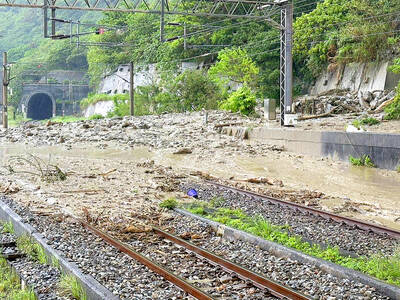
ROLLER-COASTER RIDE: More than five earthquakes ranging from magnitude 4.4 to 5.5 on the Richter scale shook eastern Taiwan in rapid succession yesterday afternoon Back-to-back weather fronts are forecast to hit Taiwan this week, resulting in rain across the nation in the coming days, the Central Weather Administration said yesterday, as it also warned residents in mountainous regions to be wary of landslides and rockfalls. As the first front approached, sporadic rainfall began in central and northern parts of Taiwan yesterday, the agency said, adding that rain is forecast to intensify in those regions today, while brief showers would also affect other parts of the nation. A second weather system is forecast to arrive on Thursday, bringing additional rain to the whole nation until Sunday, it
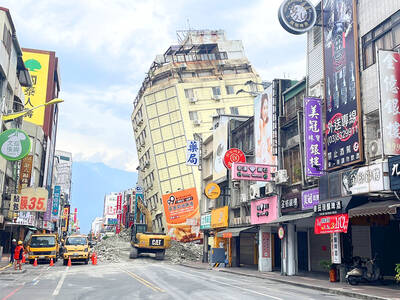
LANDSLIDES POSSIBLE: The agency advised the public to avoid visiting mountainous regions due to more expected aftershocks and rainfall from a series of weather fronts A series of earthquakes over the past few days were likely aftershocks of the April 3 earthquake in Hualien County, with further aftershocks to be expected for up to a year, the Central Weather Administration (CWA) said yesterday. Based on the nation’s experience after the quake on Sept. 21, 1999, more aftershocks are possible over the next six months to a year, the agency said. A total of 103 earthquakes of magnitude 4 on the local magnitude scale or higher hit Hualien County from 5:08pm on Monday to 10:27am yesterday, with 27 of them exceeding magnitude 5. They included two, of magnitude
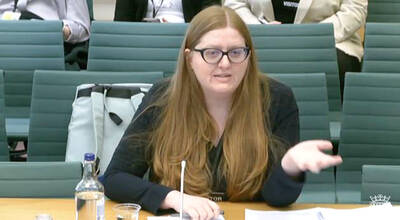
CONDITIONAL: The PRC imposes secret requirements that the funding it provides cannot be spent in states with diplomatic relations with Taiwan, Emma Reilly said China has been bribing UN officials to obtain “special benefits” and to block funding from countries that have diplomatic ties with Taiwan, a former UN employee told the British House of Commons on Tuesday. At a House of Commons Foreign Affairs Committee hearing into “international relations within the multilateral system,” former Office of the UN High Commissioner for Human Rights (OHCHR) employee Emma Reilly said in a written statement that “Beijing paid bribes to the two successive Presidents of the [UN] General Assembly” during the two-year negotiation of the Sustainable Development Goals. Another way China exercises influence within the UN Secretariat is

Taiwan’s first drag queen to compete on the internationally acclaimed RuPaul’s Drag Race, Nymphia Wind (妮妃雅), was on Friday crowned the “Next Drag Superstar.” Dressed in a sparkling banana dress, Nymphia Wind swept onto the stage for the final, and stole the show. “Taiwan this is for you,” she said right after show host RuPaul announced her as the winner. “To those who feel like they don’t belong, just remember to live fearlessly and to live their truth,” she said on stage. One of the frontrunners for the past 15 episodes, the 28-year-old breezed through to the final after weeks of showcasing her unique


 RSS
RSS