


In a surprise concession, China yesterday dropped a case against New York Times researcher Zhao Yan (趙岩) that was threatening to overshadow Chinese President Hu Jintao's (胡錦濤) planned visit to the US next month.
His attorney, Mo Shaoping (
Mo said the court told him that prosecutors "applied to withdraw the charges and the Beijing court agreed."
"In effect, this means that only if new evidence or facts come up, can prosecutors revive these charges and I'm confident that's not going to happen," Mo said.
He said it was unclear whether Zhao, who worked for the Times before his arrest in September 2004, would be sent abroad.
Zhao faced 10 years in jail after security officials charged him with telling the paper details of a rivalry between former president Jiang Zemin (
Before starting work for the Times in 2004, Zhao had established a reputation as a campaigning journalist who focused on rural corruption and discontent.
Beijing continued its crackdown on people who express anti-government views yesterday as a court in Shandong Province jailed a secondary-school teacher for 10 years over an essay he posted on the Internet, New York-based Human Rights in China said.
Ren Zhiyuan, who was arrested last May, was sentenced by the Jining City Intermediate Court for "subverting state sovereignty," the group said.
Prosecutors accused Ren of posting an essay entitled "The Road to Democracy" on the Internet and attempting to recruit members to set up an organization called "Mainland Democracy Frontline."
In other news, the UN Human Rights Commission has expressed concern to Beijing about an AIDS activist who disappeared last month after going on a hunger strike to protest violence against dissidents, his wife said yesterday.
Zeng Jinyan (曾金燕) gave reporters a copy of a document from the commission saying it expressed concerns about her husband, Hu Jia (胡佳), to Beijing on March 10. It did not say whether there had been a response.
Hu, 32, is among hundreds of activists who have staged brief hunger strikes in support of a protest launched on Feb. 6 by Beijing lawyer Gao Zhisheng (
Zeng last saw Hu on Feb. 16, while he was under house arrest and watched by police.
Beijing AIDS activist Wan Yanhai (萬延海) yesterday circulated a petition demanding that authorities investigate Hu's disappearance.
Meanwhile, Dutch psychiatrists have determined that a prominent Chinese dissident who spent 13 years in a police-run psychiatric institution in Beijing did not have mental problems that would justify his incarceration, two human rights groups said on Thursday.
The two doctors, B.C.M. Raes of the Free University of Amsterdam and B.B. van der Meer, a forensic psychiatrist, spent two days examining Wang Wanxing (王萬星) in Germany in January, five months after China released him and sent him abroad.
They said in a statement that their examination "did not reveal any form of mental disorder." Their findings were released on Thursday by the Global Initiative of Psychiatry and Human Rights Watch, two groups that have been critical of China's use of psychiatric prisons.
Wang, now 56, was confined to the psychiatric facility after he was detained in 1992 for unfurling a banner that criticized the Chinese Communist Party. After his release, Wang described widespread abuses in the asylum. He said he lived in cells with psychotically disturbed inmates convicted of murder and was forced to swallow drugs to blunt his will. He also said that the facility used electrified acupuncture needles to punish patients while other inmates were made to watch.

NO-LIMITS PARTNERSHIP: ‘The bottom line’ is that if the US were to have a conflict with China or Russia it would likely open up a second front with the other, a US senator said Beijing and Moscow could cooperate in a conflict over Taiwan, the top US intelligence chief told the US Senate this week. “We see China and Russia, for the first time, exercising together in relation to Taiwan and recognizing that this is a place where China definitely wants Russia to be working with them, and we see no reason why they wouldn’t,” US Director of National Intelligence Avril Haines told a US Senate Committee on Armed Services hearing on Thursday. US Senator Mike Rounds asked Haines about such a potential scenario. He also asked US Defense Intelligence Agency Director Lieutenant General Jeffrey Kruse

INSPIRING: Taiwan has been a model in the Asia-Pacific region with its democratic transition, free and fair elections and open society, the vice president-elect said Taiwan can play a leadership role in the Asia-Pacific region, vice president-elect Hsiao Bi-khim (蕭美琴) told a forum in Taipei yesterday, highlighting the nation’s resilience in the face of geopolitical challenges. “Not only can Taiwan help, but Taiwan can lead ... not only can Taiwan play a leadership role, but Taiwan’s leadership is important to the world,” Hsiao told the annual forum hosted by the Center for Asia-Pacific Resilience and Innovation think tank. Hsiao thanked Taiwan’s international friends for their long-term support, citing the example of US President Joe Biden last month signing into law a bill to provide aid to Taiwan,

China’s intrusive and territorial claims in the Indo-Pacific region are “illegal, coercive, aggressive and deceptive,” new US Indo-Pacific Commander Admiral Samuel Paparo said on Friday, adding that he would continue working with allies and partners to keep the area free and open. Paparo made the remarks at a change-of-command ceremony at Joint Base Pearl Harbor-Hickam in Hawaii, where he took over the command from Admiral John Aquilino. “Our world faces a complex problem set in the troubling actions of the People’s Republic of China [PRC] and its rapid buildup of forces. We must be ready to answer the PRC’s increasingly intrusive and
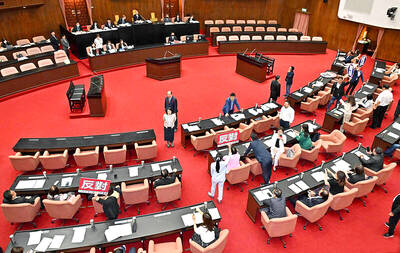
STATE OF THE NATION: The legislature should invite the president to deliver an address every year, the TPP said, adding that Lai should also have to answer legislators’ questions The Chinese Nationalist Party (KMT) yesterday proposed inviting president-elect William Lai (賴清德) to make a historic first state of the nation address at the legislature following his inauguration on May 20. Lai is expected to face many domestic and international challenges, and should clarify his intended policies with the public’s representatives, KMT caucus secretary-general Hung Meng-kai (洪孟楷) said when making the proposal at a meeting of the legislature’s Procedure Committee. The committee voted to add the item to the agenda for Friday, along with another similar proposal put forward by the Taiwan People’s Party (TPP). The invitation is in line with Article 15-2


 RSS
RSS