


The acrimonious fight over the election-eve shooting of the president and vice president again reared its head yesterday, as family members of the man police said was behind the shooting retracted their previous statements, claiming police intimidation.
After a lengthy investigation, Chen Yi-hsiung (
The family of Chen had previously said he carried out the shooting because he was depressed about being unemployed and blamed the president's policies.
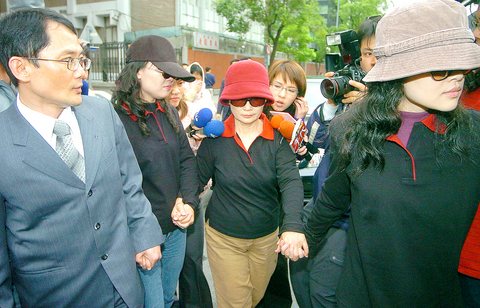
PHOTO: LU HSIN-DE, TAIPEI TIMES
They now say they were coerced into making these claims.
"We had no choice but to say what the police wanted us to say when we were questioned again and again, until they were satisfied with our answers," the family said in a statement, asking the police to make public the interrogation records.
Different story
About a year ago, Chen's wife Lee Shu-chiang (
Yesterday, however, Lee and three of her children denied their previous claims in a press conference in the legislature, saying that Chen was not the shooter, that he was falsely accused and that he had been murdered.
Police and prosecutors scoffed at what the family claimed was new evidence.
"It is not new at all," Lin Teh-hua (
"We have 11 witnesses who identified the man in the photo as Chen Yi-hsiung," he said.
Lee said that she was asked by Hou You-yi (
"Hou said that I would have to accept the consequences if I didn't say [what they wanted]. In order to protect my children, I read what they wanted me to read and apologized," Lee said.
Rebuttal
Later in the day, Hou, who is now the director-general of the National Police Agency, held a press conference to rebut the accusation.
"All the evidence we used to establish Chen's guilt was obtained from the investigation. We didn't fake anything and we didn't force any confessions," Hou said.
Hou said that he could understand why Chen's family might have had a hard time accepting that Chen was the shooter.
On March 7 last year, Chen was identified after the police traced people who had made purchases from an arms maker. They narrowed down their search to a bald man in a yellow jacket, who was taped standing in the "hot zone" at the crime scene.
The Supreme Prosecutors Office then announced on Aug. 17 that the investigation of the 319 shooting was closed. They concluded that Chen, whom the prosecutors believe committed suicide, was entirely responsible for the shooting.
However, opposition parties have highlighted some aspects of the case -- such as the weapon not being found, Chen's body being found in a fishing net and the family's claim to having destroyed a suicide note -- to cast doubt on Chen's guilt.
"The `yellow coated bald guy' was not my father," Chen's daughter said.
She added, "[The police] told me that I would be sentenced to seven years in prison if I didn't make the confession [they wanted]."
No new evidence
Still, the Tainan Prosecutors' Office said it was unlikely to reopen the case without new evidence.
Lin said he suspected political motives were behind the family's move, which coincided with an opposition rally and came a week before the anniversary of the shooting.
"We hope the Chen family was not used by some people with ulterior motives," he said.
Meanwhile, former TSU lawmaker -- now a member of the KMT -- Su Ying-kuei (蘇盈貴) accused the police of faking the videotape of the shooter. He displayed another photo to back his argument.
"Although there was a time lag of 17 seconds between the two photos, it is unreasonable that the crime scene of the videotape contained just a few people, while the photo I had was jam-packed with people," Su said.
Vice President Annette Lu (
also see story:
Pan-blue big guns attend KMT rally

‘NO SECURITY RISK’: The Railway Bureau reassured the public that the technicians’ activities were limited to technical guidance and did not involve sensitive systems The Railway Bureau yesterday said it had invited eight Chinese technicians to assist with an airport MRT construction project. The bureau issued the confirmation after an Internet user said Chinese nationals had entered the construction zone of Taiwan Taoyuan International Airport’s Terminal 3 project. They asked why “individuals from an enemy state” were allowed access to such a major national infrastructure project, which raised serious concerns over Taiwan’s industrial safety, sensitive systems and information security. The bureau’s Northern Region Engineering Branch Office said subcontractor Taiwan Handle Industrial Co (台灣手把工業) of the Taoyuan airport MRT’s “Contract No. CU05 Project A14 Station Civil, MEP &

A US uncrewed surface vessel (USV) encountered multiple Chinese warships during an autonomous transit of the Taiwan Strait, US defense company Seasats said in a statement on Wednesday. Seasats announced that a Lightfish USV had completed the first autonomous transit of the Taiwan Strait. Over five days, the USV traversed the entire length of the Strait while constantly monitoring surface vessel traffic, the company said. The Lightfish encountered multiple Chinese warships, one of which was a Chinese People’s Liberation Army Navy (PLAN) Type 056 corvette, it said. The Chinese vessels were operating “well within Taiwan’s exclusive economic zone without transmitting their identity via the
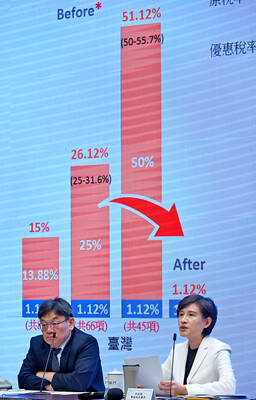
GREATER REACH? Auto parts and wood products would face tariffs of up to 15%, matching those targeting the EU, Japan and South Korea, Vice Premier said The US has announced that preferential tariff treatment for Taiwan’s non-semiconductor Section 232 goods would take effect retroactively from May 1, the Executive Yuan said yesterday. The US government yesterday posted a notice on the Federal Register’s public inspection Web site previewing tariff concessions for Taiwan under a memorandum of understanding (MOU) on Taiwan-US investment after two months of negotiations. The MOU signed on Jan. 15 stipulated three major preferential tariff arrangements: a 15 percent “reciprocal” tariff rate for Taiwan without stacking most-favored nation (MFN) rates; preferential Section 232 treatment for semiconductors and related products; and preferential Section 232 treatment for non-semiconductor

The National Chungshan Institute of Science and Technology yesterday showcased its locally developed variants of the Vision 60 robotic patrol dog, which it plans to deploy on the nation’s outlying territories in the South China Sea. The variants were produced under the Joint Lab project — created by the institute and domestic companies — and assembled with domestically produced motors, lenses and artificial intelligence (AI) systems alongside licensed tech from the US, Missile and Rocket Systems Research Division deputy director Jen Kuo-kang (任國光) told the media event at a military base in Taipei’s Dazhi (大直) area. Taiwan has built up its strengths


 RSS
RSS