


Representatives of the world's biggest polluters insisted yesterday that industry leaders can be relied upon to voluntarily slash emissions blamed for heating the earth's atmosphere, as they opened a two-day climate conference in Sydney.
The Asia Pacific Partnership on Clean Development and Climate brought together senior ministers from the US, Australia, Japan, China, South Korea and India along with executives from energy and resource firms.
The countries -- with 45 percent of the world's population -- account for nearly half of the world's gross domestic product, energy consumption and global greenhouse gas emissions, the Australian government said in a statement.
Environmentalists have branded the meeting a stunt to divert attention from the US and Australian governments' refusal to sign the Kyoto Protocol, which legally binds countries to targets for cutting greenhouse gas emissions by 2012, and criticized its failure to impose similar cuts on their industries.
At a peaceful protest outside the downtown Sydney hotel hosting the conference, Greenpeace spokesman Ben Pearson said his group wants the meeting to agree to pump money into renewable energy sources that do not contribute to global warming.
Global warming has been blamed for rising sea levels and an increase in the frequency of extreme weather events, like the string of hurricanes that lashed the US last year.
"It seems very clear that they need to cover themselves for the fact they haven't ratified Kyoto," Pearson said of the US and Australia. "They need to pretend they are doing something so they have erected this facade."
Canberra and Washington say industry will regulate itself without specific targets or taxes on the amount of carbon they pump into the atmosphere.
"I believe that the people who run the private sector, who run these companies, they do have children, they do have grandchildren, they do live and breathe in the world," US Energy Secretary Samuel Bodman said.
"It's a matter of working with the leadership of these companies and seeking their participation, seeking their leadership in making the types of adjustments that are required," he added.
Australia's Foreign Minister Alexander Downer agreed that industry leaders have to take a lead in tackling emissions.
"The point here is that individual companies have to develop their individual strategies -- we're not trying to run a police state here," he said.
But Frank Zumbo, associate professor in business law at the University of New South Wales, said allowing businesses to regulate themselves under a voluntary code could lead to patchy compliance.
"When you have a voluntary system the danger is that good corporate citizens will behave according to the code, but those who have other agendas do not," he said.
"Some people may be concerned about their children and others think, `Well, thinking about my children is tomorrow's problem. Today I'm here to compete and make the most profits,'" Zumbo said.
Greenpeace agreed.
"Talk is cheap and the price of inaction is expensive," the group said in a statement. "Simply relying on the good will of industry and promoting business-as-usual cannot ensure that we will reduce pollution at all, let alone enough to tackle climate change."
The US and Australia say enforcing mandatory cuts in emissions will harm their economies by driving up the price of commodities like coal and oil, while simply driving the polluting industries to other countries not covered by the Kyoto Protocol.
They maintain the new partnership complements Kyoto by driving investment in new energy technologies such as geosequestration -- a process of burying carbon emissions underground -- and clean coal, which is treated so that it gives off fewer emissions when burned.

PROVOCATIVE: Chinese Deputy Ambassador to the UN Sun Lei accused Japan of sending military vessels to deliberately provoke tensions in the Taiwan Strait China denounced remarks by Japan and the EU about the South China Sea at a UN Security Council meeting on Monday, and accused Tokyo of provocative behavior in the Taiwan Strait and planning military expansion. Ayano Kunimitsu, a Japanese vice foreign minister, told the Council meeting on maritime security that Tokyo was seriously concerned about the situation in the East China and South China seas, and reiterated Japan’s opposition to any attempt to change the “status quo” by force, and obstruction of freedom of navigation and overflight. Stavros Lambrinidis, head of the EU delegation to the UN, also highlighted South China Sea
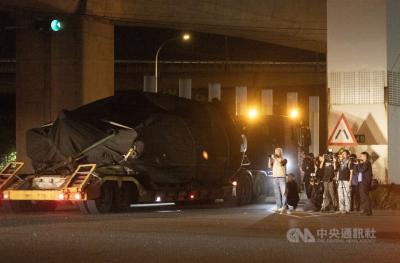
The final batch of 28 M1A2T Abrams tanks purchased from the US arrived at Taipei Port last night and were transported to the Armor Training Command in Hsinchu County’s Hukou Township (湖口), completing the military’s multi-year procurement of 108 of the tanks. Starting at 12:10am today, reporters observed more than a dozen civilian flatbed trailers departing from Taipei Port, each carrying an M1A2T tank covered with black waterproof tarps. Escorted by military vehicles, the convoy traveled via the West Coast Expressway to the Armor Training Command, with police implementing traffic control. The army operates about 1,000 tanks, including CM-11 Brave Tiger
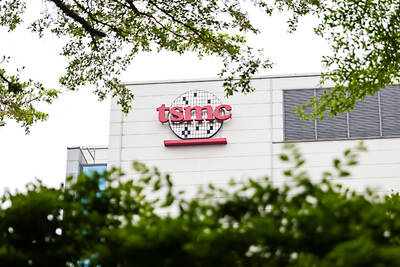
Taiwan Semiconductor Manufacturing Co (TSMC, 台積電), the world’s largest contract chipmaker, said it expects its 2-nanometer (2nm) chip capacity to grow at a compound annual rate of 70 percent from this year to 2028. The projection comes as five fabs begin volume production of 2-nanometer chips this year — two in Hsinchu and three in Kaohsiung — TSMC senior vice president and deputy cochief operating officer Cliff Hou (侯永清) said at the company’s annual technology symposium in Silicon Valley, California, last week. Output in the first year of 2-nanometer production, which began in the fourth quarter of last year, is expected to
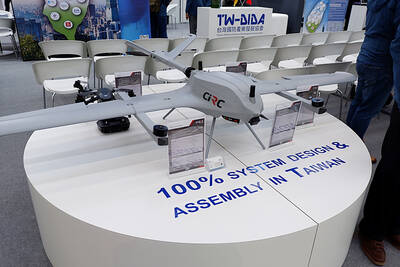
Taiwan’s drone exports surged past US$100 million in the first quarter, exceeding last year’s full-year total, with the Czech Republic emerging as the largest buyer, the Ministry of Economic Affairs said. Exports of complete drones reached US$115.85 million in the period, about 1.2 times the total recorded for all of last year, the ministry said in a report. Exports to the Czech Republic accounted for about US$100 million, far outpacing other markets. Poland, last year’s top destination, recorded about US$11.75 million in the first quarter. Taiwan’s drone exports have expanded rapidly in the past few years, with last year’s total


 RSS
RSS