


Pandas and polemics were the prominent issues in cross-strait affairs yesterday, after Beijing officially selected the two black-and-white bears it would offer to Taiwan.
The move struck a raw nerve with the Taiwanese government, which has not yet decided whether it would take the giant pandas, while opposition leaders urged that the bears be accepted as a peace offering.
Cao Qingyao (曹清堯), a spokesman for China's State Forestry Administration, announced at a press conference in Beijing yesterday that a male and a female panda had been chosen from among 11 candidates from the China Giant Panda Research Center in Wolong, Sichuan Province, to be sent as "goodwill presents to the people of Taiwan."
Meanwhile, China's Taiwan Affairs Office (TAO) attacked the policies of President Chen Shui-bian (陳水扁), even as it explained the efforts to send the pandas as a gesture of peace to Taiwan.
TAO spokesman Li Weiyi (李維一) yesterday said that the constitutional reengineering project that Chen pledged to carry out by 2007 was not acceptable to Beijing.
"This shows that risk is on the rise, as Beijing sees Chen's constitutional re-engineering project as a provocative step towards formal statehood," he said.
Speaking about the pandas, the TAO said that an association related to the Taipei City Zoo and a public relations company in Taichung have filed applications with the China Wild Animal Protection Association for the right to host the two pandas.
But Taiwan's Mainland Affairs Council (MAC) reacted negatively to both issues raised by the TAO.
"If China keeps viewing Taiwan's political development with this wrong perception, I would suppose there is really not much to expect from cross-strait relations in the future," said MAC Chairman Joseph Wu (吳釗燮), speaking during a regular news briefing at the MAC headquarters.
Wu also said that China cannot send the pandas to Taiwan without prior consent.
Saying that China decided to send the bears in June without having first discussed the matter with the Taiwanese government, Wu called on Beijing to show some respect.
The MAC chairman said that constitutional reform and independence were two separate things.
"We are not pursuing de jure independence through referendum, as the constitutional reform package would be about how to create a system of government suited to the needs of this country," Wu said.
"The current Constitution was established in China in 1947, and in it there is no clear basis for the adoption of either a presidential or a parliamentary system of government," he said, adding that this has contributed to political difficulties in recent years.
"[Taiwan has], again and again, explained the significance of the second phase of constitutional reform, which has nothing to do with Taiwan's independence. China's misunderstanding is no good for cross-strait relations in the future," he said.
The MAC chairman said China has been using the offer to send the pandas as a "united front scheme."Opposition leaders appeared to bolster his claim that China was exploiting political differences in Taiwan, as they criticized the government's stance on the issue.
"The giant pandas' coming to Taiwan can improve cross-strait relations, and I hope that the government does not politicize the issue and spoil the chances for peaceful exchanges across the Strait," said former Chinese Nationalist Party (KMT) chairman Lien Chan (
"There is no differentiation of blue and green for a panda -- they are black and white," Lien added.
KMT Chairman Ma Ying-jeou (
"Please do not paint pandas with political colors. It is important to make Taiwanese feel the friendship of China," Ma said yesterday during a press conference.
Ma, in his capacity as Taipei mayor, said that the Taipei City Zoo is working on a "Panda Center," which would be ready to accept the pandas in June.
But the government was adamant on its position that China must wait until Taiwan has decided whether it will take the bears.
"China has been insensitive and indifferent toward Taiwan by deciding unilaterally to send the two pandas while Taiwan is still discussing the matter," he said.
Noting that the MAC is not the supervising agency regarding the "panda problem," Wu said that the Council of Agriculture (COA) would make the final decision on whether, and when, Taiwan should accept the two pandas.
COA officials said on Thursday that the council will decide by March 23 whether to accept the two pandas.
Acknowledging the government's cool response, Ma said the city government can only follow the application procedure and wait for the government to decide whether it will accept the gift.
But officials at the Taipei City Zoo were optimistic.
Taipei Zoo President Chen Bao-chong (
"Our report shows that 11 out of the 18 pandas who live outside China had successfully reproduced since 2000, and this proves that reproductive technology has seen great progress," he said.
The zoo filed its panda import application with the COA in October, and a review panel will make a decision on whether the city zoo should be the pandas' home.
Wu said, however, that several matters must be weighed before the pandas could be introduced into Taiwan. These include whether the applicants to host the bears are qualified to apply; whether the would-be host has adequate resources and facilities; whether the import of the pandas complies with current stipulations of international wildlife conservation organizations; and whether independent international wildlife conservation organizations found Taiwan suitable to host pandas, an endangered species.
Under the multilateral Convention on International Trade in Endangered Species of Wild Fauna and Flora, pandas can only be lent by China to other countries, and all the net profits from the exhibition of giant pandas should be used for the conservation of the species in China. The conservation fee every country has to pay China is up to US$1 million a year.

SILENCING CRITICS: In addition to blocking Taiwan, China aimed to prevent rights activists from speaking out against authoritarian states, a Cabinet department said The Ministry of Foreign Affairs (MOFA) yesterday condemned transnational repression by Beijing after RightsCon, a major digital human rights conference scheduled to be held in Zambia this week, was abruptly canceled due to Chinese pressure over Taiwanese participation. This year’s RightsCon, the world’s largest conference discussing issues “at the intersection of human rights and technology,” was scheduled to take place from tomorrow to Friday in Lusaka, and expected to draw 2,600 in-person attendees from 150 countries, along with 1,100 online participants. However, organizers were forced to cancel the event due to behind-the-scenes pressure from China, the ministry said, expressing its “strongest condemnation”
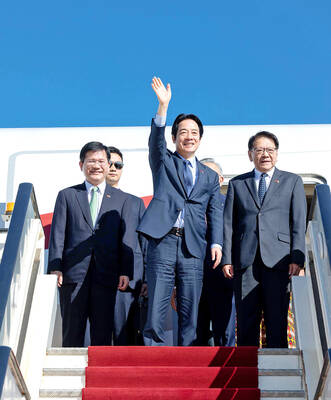
DELAYED BUT DETERMINED: The president’s visit highlights Taiwan’s right to international engagement amid regional pressure from China President Willaim Lai (賴清德) yesterday arrived in Eswatini, more than a week after his planned visit to Taiwan’s sole African ally was suspended because of revoked overflight permits. “The visit, originally scheduled for April 22, was postponed due to unforeseen external factors,” Lai wrote on social media. “After several days of careful arrangements by our diplomatic and national security teams, we successfully arrived today.” Lai said he looked forward to further deepening Taiwan-Eswatini relations through closer cooperation in the economy, agriculture, culture and education, as well as advancing the nation’s international partnerships. The president was initially scheduled to arrive in time to celebrate
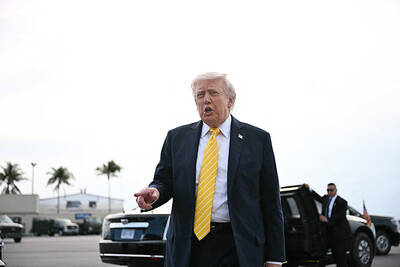
Iran’s Islamic Revolutionary Guard Corp (IRGC) yesterday said the US faced a choice between an “impossible” military operation or a “bad deal” with Tehran, after US President Donald Trump disparaged Iran’s latest peace proposal. Negotiations between the two countries have been deadlocked since a ceasefire came into effect on April 8, with only one round of direct peace talks held so far. Iran’s Tasnim and Fars news agencies reported that Tehran had submitted a 14-point proposal to mediator Pakistan, but Trump was quick to cast doubt on it. “I will soon be reviewing the plan that Iran has just sent to us, but

A group affiliated with indicted Chinese immigrant Xu Chunying (徐春鶯) is to be dissolved for monitoring Chinese immigrants in Taiwan, a source said yesterday. Xu, the secretary-general of the Cross-Strait Marriage and Family Service Alliance, was indicted on March 24 on charges of violating the Anti-Infiltration Act (反滲透法). The alliance “illegally monitored" Chinese immigrants living in Taiwan on behalf of the Chinese Communist Party (CCP) and the Ministry of the Interior is expected to dissolve the organization in the coming days under provisions of the Civil Associations Act (人民團體法), the source said. Xu, who married a Taiwanese in 1993 and became a Republic


 RSS
RSS