


The fate of a number of US congressional initiatives dealing with US-Taiwan military relations will be decided starting this week as House and Senate committees thrash out an agreement on defense authorizations.
But Taiwan's lobbyists are worried that the Senate version of the bill, which is not as Taiwan-friendly, will prevail over the House's version.
The House version contains three provisions enhancing Washington's commitment to Taiwan's defense, while the Senate's version of the bill excludes those provisions but inserts a section dealing with China's military threat.
The House on Friday named more than 70 members from 15 committees as negotiators in the joint "conference" with the Senate that will determine the final form of the defense bill.
However, there are considerable doubts that any of the House provisions, which would affect Taiwan-US military ties more directly than the Senate version, will survive the conference.
While the staffers will work on the issues starting this week, congressmen will take over early next year when they return from their holiday recess. They are expected to finish their deliberations in February.
In previous years, the House has approved numerous pro-Taiwan provisions that Senate negotiators subsequently rejected.
Taiwan's lobbyists are very concerned that "history will repeat itself" this year, said Coen Blaauw, executive director of the Formosan Association for Public Affairs.
Senate reaction to the House's Taiwan sections has been "lukewarm," he said, adding that senators are adamant about "not rocking the cross-strait boat."
He said he "would not be surprised if the Taiwan provisions in the House bill do not survive."
The House in May approved its bill by a 390-39 vote. The Senate threw out that version and passed its own bill last month by unanimous consent. Last week, the House rejected that and called for the conference to iron out the differences.
One House provision would require high-level exchanges between US and Taiwanese military officers to "improve Taiwan's defenses against the People's Liberation Army."
These would focus on threat analysis, military doctrine, force planning, logistical support, intelligence collection and analysis and "operational tactics, techniques and procedures."
The exchanges, which would take place in both the US and Taiwan, would involve generals or other officers and Pentagon officials at the level of deputy assistant secretary of defense or higher and their Taiwanese counterparts.
Another provision would impose sanctions on European and other foreign firms that supply sensitive arms to China that could be used against Taiwanese and US forces in the event of military hostilities with China.
Under the provision, the Secretary of Defense would bar foreign firms and their affiliates who provide China with weapons on the US "munitions list" from selling military goods or services to the US for five years.
A third provision would require the National Defense University in the US to include Taiwan and China as destinations in its overseas field study program for newly promoted top US military officials.
The program facilitates interaction with foreign political and military leaders.
While rejecting those provisions, the Senate added a section urging the president to immediately establish a "coherent and comprehensive plan to address the emergence of China" militarily, diplomatically and economically.
The plan would include pressing the EU to maintain its embargo on arms sales to China, and "discourage foreign defense contractors from selling sensitive military-use technology or weapons systems to China."
The Senate version of the bill notes that "China is developing a leading-edge military with the objective of intimidating Taiwan and deterring United States involvement in the Strait," and says that China's recent military gains have "resulted in a dramatic shift in the cross-Strait military balance toward China."
It also cites the "Anti-Secession" Law that China's National People's Congress enacted last March.
Observers note that one of Congress' leading champions for Taiwan, House International Relations Committee chairman Henry Hyde, is on the conference committee.
Hyde's presence will be "encouraging," Blaauw says, adding that the negotiations will be "tough."
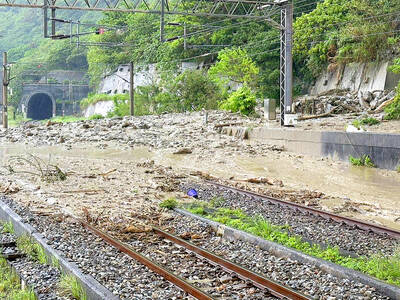
ROLLER-COASTER RIDE: More than five earthquakes ranging from magnitude 4.4 to 5.5 on the Richter scale shook eastern Taiwan in rapid succession yesterday afternoon Back-to-back weather fronts are forecast to hit Taiwan this week, resulting in rain across the nation in the coming days, the Central Weather Administration said yesterday, as it also warned residents in mountainous regions to be wary of landslides and rockfalls. As the first front approached, sporadic rainfall began in central and northern parts of Taiwan yesterday, the agency said, adding that rain is forecast to intensify in those regions today, while brief showers would also affect other parts of the nation. A second weather system is forecast to arrive on Thursday, bringing additional rain to the whole nation until Sunday, it
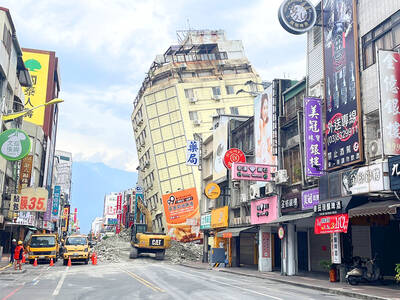
LANDSLIDES POSSIBLE: The agency advised the public to avoid visiting mountainous regions due to more expected aftershocks and rainfall from a series of weather fronts A series of earthquakes over the past few days were likely aftershocks of the April 3 earthquake in Hualien County, with further aftershocks to be expected for up to a year, the Central Weather Administration (CWA) said yesterday. Based on the nation’s experience after the quake on Sept. 21, 1999, more aftershocks are possible over the next six months to a year, the agency said. A total of 103 earthquakes of magnitude 4 on the local magnitude scale or higher hit Hualien County from 5:08pm on Monday to 10:27am yesterday, with 27 of them exceeding magnitude 5. They included two, of magnitude

CONDITIONAL: The PRC imposes secret requirements that the funding it provides cannot be spent in states with diplomatic relations with Taiwan, Emma Reilly said China has been bribing UN officials to obtain “special benefits” and to block funding from countries that have diplomatic ties with Taiwan, a former UN employee told the British House of Commons on Tuesday. At a House of Commons Foreign Affairs Committee hearing into “international relations within the multilateral system,” former Office of the UN High Commissioner for Human Rights (OHCHR) employee Emma Reilly said in a written statement that “Beijing paid bribes to the two successive Presidents of the [UN] General Assembly” during the two-year negotiation of the Sustainable Development Goals. Another way China exercises influence within the UN Secretariat is

Taiwan’s first drag queen to compete on the internationally acclaimed RuPaul’s Drag Race, Nymphia Wind (妮妃雅), was on Friday crowned the “Next Drag Superstar.” Dressed in a sparkling banana dress, Nymphia Wind swept onto the stage for the final, and stole the show. “Taiwan this is for you,” she said right after show host RuPaul announced her as the winner. “To those who feel like they don’t belong, just remember to live fearlessly and to live their truth,” she said on stage. One of the frontrunners for the past 15 episodes, the 28-year-old breezed through to the final after weeks of showcasing her unique


 RSS
RSS