


US President George W. Bush embraced Republican Senator John McCain's proposal to ban cruel, inhuman and degrading treatment of terrorism suspects, reversing months of opposition that included White House veto threats.
Bowing to pressure from the Republican-run Congress and abroad, the White House on Thursday signed off on the proposal after a fight that pitted the president against members of his own party and threatened to further tarnish a national image already soiled by the abuses at Iraq's Abu Ghraib prison.
Bush said the ban and accompanying interrogation standards will "make it clear to the world that this government does not torture and that we adhere to the international convention of torture, whether it be here at home or abroad."
After months of fierce negotiations, McCain declared "a done deal" that he said shows that the US "upholds values and standards of behavior and treatment of all people, no matter how evil or bad they are."
"We've sent a message to the world that the US is not like the terrorists," the Republican lawmaker said while appearing alongside the president in the Oval Office to announce the agreement.
The agreement still needs to be approved by Congress, whose Republican leaders hope to adjourn for the year in a few days.
The deal keeps McCain's original proposal, which was overwhelmingly approved by the Senate and then endorsed by the House. One of the final stumbling blocks in negotiations was removed when language was added allowing civilian interrogators the same legal protections as those afforded to military interrogators.
Those rules say the accused can defend themselves by arguing it was reasonable for them to believe they were obeying a legal order. The government also would provide counsel for accused interrogators.
That language was McCain's own counterproposal to the White House's early calls, pushed by Vice President Dick Cheney, for an exemption for CIA interrogators. The administration had also sought some kind of protection from prosecution for agents that were accused of violating standards.
Also added, officials said, was a statement explicitly rejecting immunity for those who violate the standards.
After the deal was announced, Republican Representative Duncan Hunter, chairman of the House Armed Services Committee, said he would block completion of one of the two defense bills that includes the ban unless he got White House assurances that "the same high level of effective intelligence gathering" would be achieved if the agreement became law.
Hunter issued a statement early yesterday saying he had dropped his objection because National Intelligence Director John Negroponte wrote in a letter that he would report to Congress six months after the ban goes into effect on its impact on intelligence gathering.
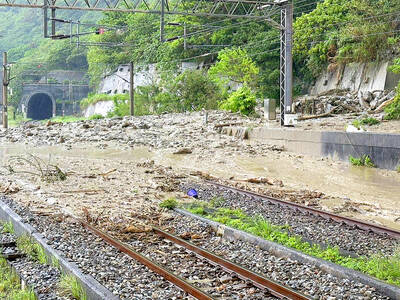
ROLLER-COASTER RIDE: More than five earthquakes ranging from magnitude 4.4 to 5.5 on the Richter scale shook eastern Taiwan in rapid succession yesterday afternoon Back-to-back weather fronts are forecast to hit Taiwan this week, resulting in rain across the nation in the coming days, the Central Weather Administration said yesterday, as it also warned residents in mountainous regions to be wary of landslides and rockfalls. As the first front approached, sporadic rainfall began in central and northern parts of Taiwan yesterday, the agency said, adding that rain is forecast to intensify in those regions today, while brief showers would also affect other parts of the nation. A second weather system is forecast to arrive on Thursday, bringing additional rain to the whole nation until Sunday, it
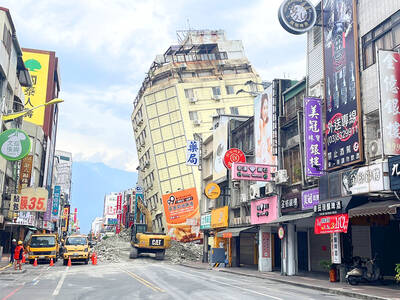
LANDSLIDES POSSIBLE: The agency advised the public to avoid visiting mountainous regions due to more expected aftershocks and rainfall from a series of weather fronts A series of earthquakes over the past few days were likely aftershocks of the April 3 earthquake in Hualien County, with further aftershocks to be expected for up to a year, the Central Weather Administration (CWA) said yesterday. Based on the nation’s experience after the quake on Sept. 21, 1999, more aftershocks are possible over the next six months to a year, the agency said. A total of 103 earthquakes of magnitude 4 on the local magnitude scale or higher hit Hualien County from 5:08pm on Monday to 10:27am yesterday, with 27 of them exceeding magnitude 5. They included two, of magnitude
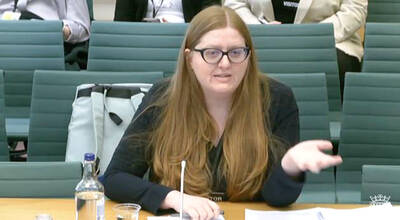
CONDITIONAL: The PRC imposes secret requirements that the funding it provides cannot be spent in states with diplomatic relations with Taiwan, Emma Reilly said China has been bribing UN officials to obtain “special benefits” and to block funding from countries that have diplomatic ties with Taiwan, a former UN employee told the British House of Commons on Tuesday. At a House of Commons Foreign Affairs Committee hearing into “international relations within the multilateral system,” former Office of the UN High Commissioner for Human Rights (OHCHR) employee Emma Reilly said in a written statement that “Beijing paid bribes to the two successive Presidents of the [UN] General Assembly” during the two-year negotiation of the Sustainable Development Goals. Another way China exercises influence within the UN Secretariat is

Taiwan’s first drag queen to compete on the internationally acclaimed RuPaul’s Drag Race, Nymphia Wind (妮妃雅), was on Friday crowned the “Next Drag Superstar.” Dressed in a sparkling banana dress, Nymphia Wind swept onto the stage for the final, and stole the show. “Taiwan this is for you,” she said right after show host RuPaul announced her as the winner. “To those who feel like they don’t belong, just remember to live fearlessly and to live their truth,” she said on stage. One of the frontrunners for the past 15 episodes, the 28-year-old breezed through to the final after weeks of showcasing her unique


 RSS
RSS