


Human rights abuses in Iraq are now as bad as they were under former president Saddam Hussein and are even in danger of eclipsing his record, according to the country's first prime minister after the fall of Saddam's regime.
In a damning indictment of Iraq's escalating human rights catastrophe, Ayad Allawi accused fellow Shiite Muslims in the government of being responsible for death squads and secret torture centers. The brutality of elements in the new security forces rivals that of Saddam's secret police, he says.
Allawi, who was prominent in the anti-Saddam opposition and was prime minister until April this year, made his remarks in an interview, as further hints emerged on Saturday that US President George W. Bush is planning to withdraw up to 40,000 US troops from the country next year, when Iraqi forces will be capable of taking over their role.
"People are doing the same as [in] Saddam Hussein's time and worse," Allawi said. "It is an appropriate comparison. People are remembering the days of Saddam. These were the precise reasons that we fought Saddam Hussein and now we are seeing the same things."
"We are hearing about secret police, secret bunkers where people are being interrogated. A lot of Iraqis are being tortured or killed in the course of interrogations. We are even witnessing Shariah courts based on Islamic law that are trying people and executing them," he said.
Unless immediate action was taken to dismantle militias that continued to operate with impunity, and that had widely infiltrated the police and other institutions, "the disease infecting [the Ministry of the Interior] will become contagious and spread to all ministries and structures of Iraq's government," he said.
In a chilling warning to the West over the danger of leaving behind a disintegrating Iraq, Allawi said: "Iraq is the centerpiece of this region. If things go wrong, neither Europe nor the US will be safe."
His uncompromising comments came on the eve of Saddam's latest court appearance on charges of crimes against humanity and seem certain to fuel the growing sense of crisis over Iraq, both in the country as well as in the US, where political support for the occupation continues to plummet.
Allawi was selected to serve as prime minister of the first interim government, ahead of last January's first national elections.
Admired in both Downing Street and the White House as a non-sectarian politician committed to strong centralized government representing all Iraqis, Allawi's list struggled in last January's elections, where it was eclipsed by Shiite religious parties, some of which have been implicated in the violence. Recently, however, his reputation has enjoyed a resurgence as he has tried to build alliances with Sunni political groups ahead of next month's national elections.
His comments come as a severe blow to those hoping Iraq was moving towards normalization under the new government. In a speech on Wednesday, Bush is expected to hail the improved readiness of Iraqi troops, which he has identified as the key condition for withdrawing US forces.
But the proximity of the latest round of elections appears only to have intensified political murders and intimidations, including members of Allawi's own list, who have been killed and attacked by political rivals.
Allawi's scathing assessment of the collapse of human rights in Iraq under the country's first democratically elected government came amid an angry denunciation of the involvement of the Iraq government's own institutions in widespread disappearances, torture and assassinations.
Allawi saved his strongest condemnation for the Ministry of the Interior.
"The Ministry of the Interior is at the heart of the matter. I am not blaming the minister [Bayan Jabr] himself, but the rank and file are behind the secret dungeons and some of the executions that are taking place," he said.
on pages and
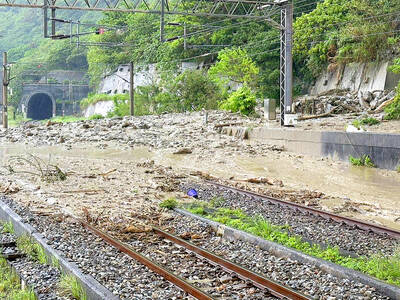
ROLLER-COASTER RIDE: More than five earthquakes ranging from magnitude 4.4 to 5.5 on the Richter scale shook eastern Taiwan in rapid succession yesterday afternoon Back-to-back weather fronts are forecast to hit Taiwan this week, resulting in rain across the nation in the coming days, the Central Weather Administration said yesterday, as it also warned residents in mountainous regions to be wary of landslides and rockfalls. As the first front approached, sporadic rainfall began in central and northern parts of Taiwan yesterday, the agency said, adding that rain is forecast to intensify in those regions today, while brief showers would also affect other parts of the nation. A second weather system is forecast to arrive on Thursday, bringing additional rain to the whole nation until Sunday, it
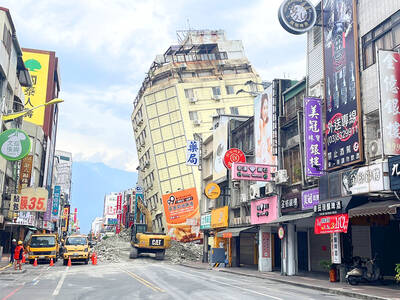
LANDSLIDES POSSIBLE: The agency advised the public to avoid visiting mountainous regions due to more expected aftershocks and rainfall from a series of weather fronts A series of earthquakes over the past few days were likely aftershocks of the April 3 earthquake in Hualien County, with further aftershocks to be expected for up to a year, the Central Weather Administration (CWA) said yesterday. Based on the nation’s experience after the quake on Sept. 21, 1999, more aftershocks are possible over the next six months to a year, the agency said. A total of 103 earthquakes of magnitude 4 on the local magnitude scale or higher hit Hualien County from 5:08pm on Monday to 10:27am yesterday, with 27 of them exceeding magnitude 5. They included two, of magnitude
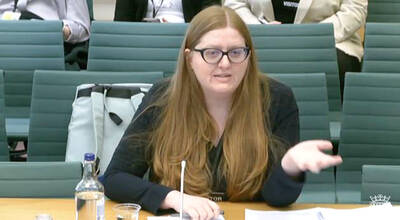
CONDITIONAL: The PRC imposes secret requirements that the funding it provides cannot be spent in states with diplomatic relations with Taiwan, Emma Reilly said China has been bribing UN officials to obtain “special benefits” and to block funding from countries that have diplomatic ties with Taiwan, a former UN employee told the British House of Commons on Tuesday. At a House of Commons Foreign Affairs Committee hearing into “international relations within the multilateral system,” former Office of the UN High Commissioner for Human Rights (OHCHR) employee Emma Reilly said in a written statement that “Beijing paid bribes to the two successive Presidents of the [UN] General Assembly” during the two-year negotiation of the Sustainable Development Goals. Another way China exercises influence within the UN Secretariat is

Taiwan’s first drag queen to compete on the internationally acclaimed RuPaul’s Drag Race, Nymphia Wind (妮妃雅), was on Friday crowned the “Next Drag Superstar.” Dressed in a sparkling banana dress, Nymphia Wind swept onto the stage for the final, and stole the show. “Taiwan this is for you,” she said right after show host RuPaul announced her as the winner. “To those who feel like they don’t belong, just remember to live fearlessly and to live their truth,” she said on stage. One of the frontrunners for the past 15 episodes, the 28-year-old breezed through to the final after weeks of showcasing her unique


 RSS
RSS