


Eight of the 1,037 birds that were smuggled into Taiwan from China on a ship have tested positive for the deadly H5N1 bird flu virus, but an outbreak is unlikely as they have been seized and destroyed, officials said yesterday.
At a press conference yesterday, Council of Agriculture (COA) officials said that eight of 276 dead birds discovered on a Panama-registered ship by the Taiwan Coast Guard in Taichung Harbor on Oct. 14 were tested and found to be carrying the H5N1 virus.
The 1,037 birds on board were smuggled from China last week, raising concerns over the risk of bird flu being brought to Taiwan.
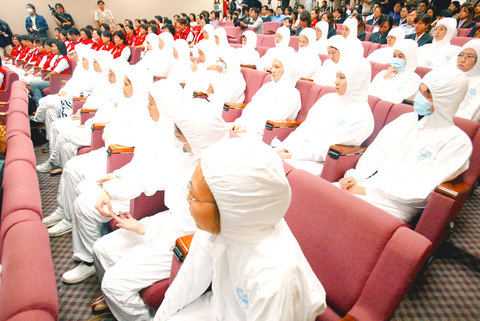
PHOTO: CNA
Officials said they did not know where the ship was heading, but had received information about it from an undisclosed source.
Nineteen types of birds were found on board the ship, with three types -- myna birds, black-naped orioles and Chinese nightingales -- found to be carrying the H5N1 virus.
According to Chao Parn-hwa (
All eight were found to have the H5N1 virus, Chao said.
Meanwhile, noting that the birds were smuggled from China, the Ministry of Foreign Affairs last night called on Beijing to adopt transparent measures in its actions against bird-flu to avoid becoming a "loophole" in other countries' efforts to combat outbreaks.
In Taichung, one crewmember from the ship, a Chinese national, is in quarantine and is being interrogated. The remaining 24 crewmembers left Taiwan with the ship on Monday.
Officials said that the quarantined crewmember has no symptoms at the moment and is taking Tamiflu, the most effective bird-flu medication available.
A 40-person team that searched the ship and destroyed the birds was not quarantined, as team members had worn protective gear and did not come in direct contact with the infected birds, officials said. But they are being monitored as a precaution, the officials added.
Watson Sung (
Smugglers face up to three years imprisonment and a NT$150,000 fine. Officials are considering tightening the smuggling law.
"All the birds on board the ship have been destroyed. Bird flu has not spread into Taiwan and we are not an infected zone," Sung said.
Meanwhile, as part of efforts to combat a possible avian flu outbreak, Taipei Municipal Hospital yesterday announced the establishment of a "vanguard team" of 108 hospital staff that will be stationed at Hoping Hospital should an outbreak occur.
The 108 doctors, nurses and other hospital staff from six municipal hospitals will be stationed at Hoping Hospital, which has been designated the anti-avian flu center for the city.
Officials hope to gain from the hospital's experience during the SARS outbreak of 2003.
At a ceremony to announce the team's establishment, Taipei Mayor Ma Ying-jeou (
also see story:
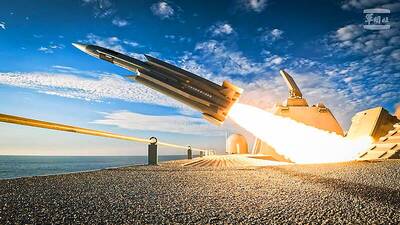
DETERRENCE: With 1,000 indigenous Hsiung Feng II and III missiles and 400 Harpoon missiles, the nation would boast the highest anti-ship missile density in the world With Taiwan wrapping up mass production of Hsiung Feng II and III missiles by December and an influx of Harpoon missiles from the US, Taiwan would have the highest density of anti-ship missiles in the world, a source said yesterday. Taiwan is to wrap up mass production of the indigenous anti-ship missiles by the end of year, as the Chungshan Institute of Science and Technology has been meeting production targets ahead of schedule, a defense official with knowledge of the matter said. Combined with the 400 Harpoon anti-ship missiles Taiwan expects to receive from the US by 2028, the nation would have

North Korea yesterday fired about 10 ballistic missiles to the sea toward Japan, the South Korean Joint Chiefs of Staff (JCS) said, days after Pyongyang warned of “terrible consequences” over ongoing South Korea-US military drills. Pyongyang recently dashed hopes of a diplomatic thaw with Seoul, Washington’s security ally, describing its latest peace efforts as a “clumsy, deceptive farce.” Seoul’s military detected “around 10 ballistic missiles launched from the Sunan area in North Korea toward the East Sea [Sea of Japan] at around 1:20pm,” JCS said in a statement, referring to South Korea’s name for the body of water. The missiles

‘UNWAVERING FRIENDSHIP’: A representative of a Japanese group that co-organized a memorial, said he hopes Japanese never forget Taiwan’s kindness President William Lai (賴清德) yesterday marked the 15th anniversary of the Tohoku earthquake and tsunami, urging continued cooperation between Taiwan and Japan on disaster prevention and humanitarian assistance. Lai wrote on social media that Taiwan and Japan have always helped each other in the aftermath of major disasters. The magnitude 9 earthquake struck northeastern Japan on March 11, 2011, triggering a massive tsunami that claimed more than 19,000 lives, according to data from Japanese authorities. Following the disaster, Taiwan donated more than US$240 million in aid, making it one of the largest contributors of financial assistance to Japan. In addition to cash donations and
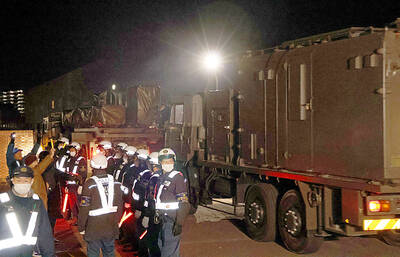
CLOSER TO CHINA: The upgraded Type-12 missile has a range of about 1,000km, compared with the original model’s range of 200km, and can reach mainland China Japan is preparing to deploy its first batch of domestically developed long-range missiles, with their launchers arriving at an army camp yesterday, as the country accelerates its offensive capability in response to rising challenges in the region. The upgraded Type-12 land-to-ship missiles are to be deployed at Camp Kengun in Japan’s southwestern prefecture of Kumamoto by the end of this month, completing the process of deployment, Japanese Chief Cabinet Secretary Minoru Kihara said without giving details. Army vehicles carrying the launchers and other equipment arrived past midnight in a highly secretive mission criticized by residents. Dozens of people stood outside of the


 RSS
RSS