


A defiant Saddam Hussein pleaded not guilty yesterday to charges of crimes against humanity, refusing to recognize the court on the first day of a trial that could see him sentenced to death.
The trial was adjourned to Nov. 28.
The decision was made by Kurdish judge Rizkar Mohammed Amin following a request by Saddam's Iraqi lawyer for a three-month delay.
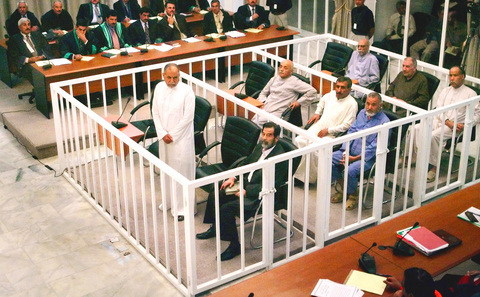
PHOTO: AP
Facing the first of what could be several cases over atrocities committed during his quarter-century in power, Saddam entered the Baghdad courtroom carrying a copy of the Koran and wearing a dark suit and open-necked shirt.
"I said what I said, I am not guilty, I am innocent," Saddam told the court after charges that included torture, murder and forced imprisonment were read out.
A bearded Saddam, who was not handcuffed, described himself as the "president of Iraq" according to footage broadcast from the courtroom with a delay of about 30 minutes, but refused to give his name.
"I don't acknowledge either the entity that authorizes you nor the aggression because everything based on falsehood is falsehood," Saddam said from the waist-high metal cage he was sitting in.
The presiding judge, looking increasingly exasperated, said: "For the record, the witness refuses to give his name."
Security was tight at the grey marble courtroom in the heart of Baghdad's highly-fortified Green Zone, where Saddam and seven of his former henchmen face trial for the murder of 143 Shiite villagers from Dujail, north of the capital.
The panel of five judges, sitting in front of large gold-colored scales of justice, could sentence them to death penalty if convicted.
"You are charged with murder, forced expulsion, imprisonment, failure to comply with international law and torture," Amin told the eight, all of whom pleaded not guilty.
"These defendants have personal responsibility in the case," he said, adding that according to the legal code, the charges carry the death penalty.
The defendants include Barzan Ibrahim Hassan al-Tikriti, Saddam's half-brother and a former director of the feared Mukhabarat intelligence service, and former vice-president Taha Yassin Ramadan, one of his feared officials.
The eight were sitting in steel-barred waist-high pens equipped with microphones, some wearing traditional chequered headdresses.
Several followed Saddam's lead and refused to give their names.
"Trial of the Century" trumpeted the headline in Al-Bayan, the mouthpiece of the Shiite Dawa party of Prime Minister Ibrahim Jaafari. "Iraqis will finally see their former dictator at the mercy of Iraqi justice."
Two mortar bombs landed in the Green Zone shortly before the trial, without causing any casualties, following calls by Saddam's supporters for attacks.
Ramadan also defied the court, telling the judge only: "I repeat what president Saddam Hussein said."
Ramadan was vice president under Saddam from 1991 and one of his regime's feared "enforcers."
also see story:
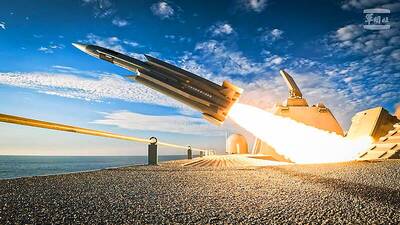
DETERRENCE: With 1,000 indigenous Hsiung Feng II and III missiles and 400 Harpoon missiles, the nation would boast the highest anti-ship missile density in the world With Taiwan wrapping up mass production of Hsiung Feng II and III missiles by December and an influx of Harpoon missiles from the US, Taiwan would have the highest density of anti-ship missiles in the world, a source said yesterday. Taiwan is to wrap up mass production of the indigenous anti-ship missiles by the end of year, as the Chungshan Institute of Science and Technology has been meeting production targets ahead of schedule, a defense official with knowledge of the matter said. Combined with the 400 Harpoon anti-ship missiles Taiwan expects to receive from the US by 2028, the nation would have
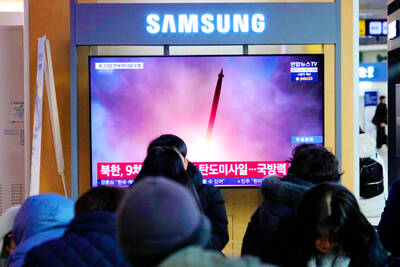
North Korea yesterday fired about 10 ballistic missiles to the sea toward Japan, the South Korean Joint Chiefs of Staff (JCS) said, days after Pyongyang warned of “terrible consequences” over ongoing South Korea-US military drills. Pyongyang recently dashed hopes of a diplomatic thaw with Seoul, Washington’s security ally, describing its latest peace efforts as a “clumsy, deceptive farce.” Seoul’s military detected “around 10 ballistic missiles launched from the Sunan area in North Korea toward the East Sea [Sea of Japan] at around 1:20pm,” JCS said in a statement, referring to South Korea’s name for the body of water. The missiles

‘UNWAVERING FRIENDSHIP’: A representative of a Japanese group that co-organized a memorial, said he hopes Japanese never forget Taiwan’s kindness President William Lai (賴清德) yesterday marked the 15th anniversary of the Tohoku earthquake and tsunami, urging continued cooperation between Taiwan and Japan on disaster prevention and humanitarian assistance. Lai wrote on social media that Taiwan and Japan have always helped each other in the aftermath of major disasters. The magnitude 9 earthquake struck northeastern Japan on March 11, 2011, triggering a massive tsunami that claimed more than 19,000 lives, according to data from Japanese authorities. Following the disaster, Taiwan donated more than US$240 million in aid, making it one of the largest contributors of financial assistance to Japan. In addition to cash donations and
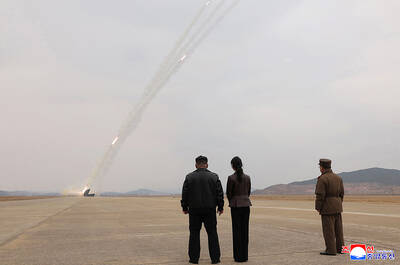
North Korea tested nuclear-capable rocket launchers, state media reported yesterday, a day after Seoul detected the launch of about 10 ballistic missiles. The test comes after South Korean and US forces launched their springtime military drills, due to run until Thursday. North Korean leader Kim Jong-un on Saturday oversaw the testing of the multiple rocket launcher system (MRLS), the Korean Central News Agency (KCNA) said. The test involved 12 600mm-caliber ultra-precision multiple rocket launchers and two artillery companies, it said. Kim said the drill gave Pyongyang’s enemies, within the 420km striking range, a sense of “uneasiness” and “a deep understanding


 RSS
RSS