


Hurricane Rita roared toward the Texas and Louisiana coasts early yesterday, a major Category 4 storm that spurred a traffic-snarled exodus toward higher ground and fears it could cripple the heart of the nation's petrochemical industry.
Forecasters said it appeared Houston and Galveston could avoid a direct hit as Rita veered slightly to the east, threatening its 225kph winds at the Beaumont and Port Arthur area about 120km east of Houston.
The unprecedented flight from the flood-prone Houston area left clogged highways at a near standstill, frustrating hundreds of thousands of people whose cars and tempers were overheating.
"It can't get much worse, 100 yards [91m] an hour," steamed Willie Bayer, 70, who was heading out of Houston and trying to get to Sulphur Springs in far northeast Texas. "It's frustrating bumper-to-bumper."
A bus carrying elderly evacuees from Hurricane Rita caught fire early yesterday on gridlocked Interstate 45, killing or injuring an unknown number of passengers, authorities said.
The bus was engulfed in flames, causing a 27km backup on a highway that was already heavily congested with evacuees from the Gulf Coast. Dallas television station WFAA reported that 20 persons were killed.
"There were 45 souls on the bus ... at this point we believe we have about half accounted for," Dallas County sheriff's spokesman Sergeant Don Peritz said.
The first rain bands were expected before nightfall yesterday with the full fury of Rita expected today. Forecasters warned of the possibility of a storm surge of 4.5m to 6m, battering waves and rain of up to 38cm along the Texas and western Louisiana coast.
Two Texas communities that may bear the brunt of the storm are Beaumont, which is a petrochemical, shipbuilding and port city of about 114,000; and Port Arthur, a city of about 58,000 that's home to industries including oil, shrimping and crawfishing.
Texas officials scrambled to reroute several inbound highways to accommodate outbound traffic, but many people were waiting so long they ran out of gas and were forced to park.
"We know you're out there," Houston Mayor Bill White said of the congestion that extended well into Louisiana. "We understand there's been fuel shortages."
Texas Army National Guard trucks were escorted by police to directly provide motorists with gasoline. The state was also working to get more than 760,000 liters of gas to fuel-starved stations in the Houston area.
By late Thursday night, the traffic was at least moving slowly, but was still backed up for about 160km, in what White called "one of the largest mass evacuations in American history."
Nearly 2 million people along the Texas and Louisiana coasts were urged to evacuate.
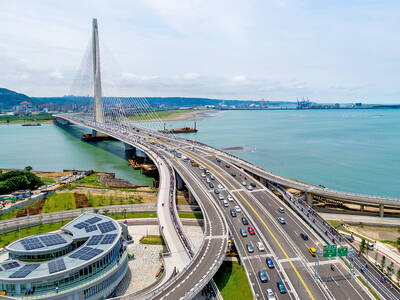
The Ministry of Transportation and Communications yesterday inaugurated the Danjiang Bridge across the Tamsui River in New Taipei City, saying that the structure would be an architectural icon and traffic artery for Taiwan. Feted as a major engineering achievement, the Danjiang Bridge is 920m long, 211m tall at the top of its pylon, and is the longest single-pylon asymmetric cable-stayed bridge in the world, the government’s Web site for the structure said. It was designed by late Iraqi-British architect Zaha Hadid. The structure, with a maximum deck of 70m, accommodates road and light rail traffic, and affords a 200m navigation channel for boats,
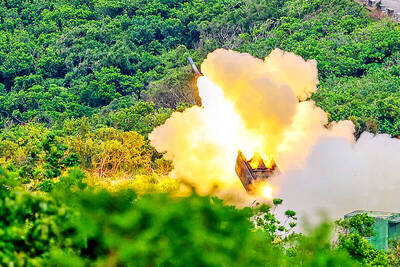
PRECISION STRIKES: The most significant reason to deploy HIMARS to outlying islands is to establish a ‘dead zone’ that the PLA would not dare enter, a source said A High Mobility Artillery Rocket System (HIMARS) would be deployed to Penghu County and Dongyin Island (東引) in Lienchiang County (Matsu) to force the Chinese military to retreat at least 100km from the coastline, a military source said yesterday. Taiwan has been procuring HIMARS and Army Tactical Missile Systems (ATACMS) from the US in batches. Once all batches have been delivered, Taiwan would possess 111 HIMARS units and 504 ATACMS, which have a range of 300km. Considering that “offense is the best defense,” the military plans to forward-deploy the systems to outlying islands such as Penghu and Dongyin so that

WHAT WAS ALL THAT FOR? Jaw Shaw-kong said that Cheng Li-wen had pushed for more drastic cuts and attacked him, just for the outcome to be nearly identical to his bill The legislature yesterday passed a supplementary budget bill to fund the purchase of separate packages of US military equipment, with the combined amount of spending capped at NT$780 billion (US$24.8 billion). The Chinese Nationalist Party (KMT) and Taiwan People’s Party (TPP) used their legislative majority to pass the bill, which runs until 2033 and has two main funding provisions. One was for NT$300 billion of arms sales already approved by the US for Taiwan on Dec. 17 last year, the other was for NT$480 billion for another arms package expected to be announced by Washington. The bill, which fell short of the NT$1.25

‘CLEAR MESSAGE’: The bill would set up an interagency ‘tiger team’ to review sanctions tools and other economic options to help deter any Chinese aggression toward Taiwan US Representative Young Kim has introduced a bill to deter Chinese aggression against Taiwan, calling for an interagency “tiger team” to preplan coordinated sanctions and economic measures in response to possible Chinese military or political action against Taiwan. “[Chinese President] Xi Jinping [習近平] has directed the People’s Liberation Army to be ready to invade Taiwan by 2027. China has a plan. America should have one too,” Kim said in a news release on Thursday last week. She introduced the “Deter PRC [People’s Republic of China] aggression against Taiwan act” to “ensure the US has a coordinated sanctions strategy ready should


 RSS
RSS