


Taiwan will step up its efforts to consolidate its political system as a tool to drive democratization in Asia, because the stability of the region has been jeopardized by several countries -- including China -- which are resisting democracy, President Chen Shui-bian (陳水扁) said yesterday.
Chen made the remarks while giving the opening speech at the first biennial World Forum for Democratization in Asia (WFDA) which began yesterday in Taipei and runs through today.
The president said that an ongoing worry in Asia is the persistence of non-democratic political systems.
"For the sake of both peace and prosperity, driving democratization in Asian countries and supporting civil society in the Asian region are crucial," Chen said.
Regional stability has been jeopardized by the actions of several non-democratic regimes, including North Korea's development of nuclear weapons, Myanmar's oppressive dictatorship and China's deployment of hundreds of missiles targeting Taiwan, the president said.
"China has placed people across the Taiwan Strait under the shadow of a war. The imbalance in military strength threatens not only the democratic system embraced by 23 million Taiwanese people but also Asian regional safety and order," Chen said.
A light to nations
He added that Taiwan's democratization sets a good example for other countries, pointing out that Taiwan was the first Asian country to establish a national democracy assistance foundation -- the Taiwan Foundation for Democracy (TFD), launched in 2003 by an initiative supported by the Legislative Yuan. In addition, Chen said that Taiwanese democracy has been a foundation of long-term peace and stability in the region, and a great asset treasured by international society.
Taiwan has to take on the duty of opening up a closed society in Asia, assist democratization in other countries controlled by autocratic regimes, and strengthen the roots of democracy in democratized countries, Chen said.
Of great attention on the conference's agenda yesterday was the Leaders Forum which included former president Lee Teng-hui (李登輝), called the "founding father of modern Taiwanese democracy" by Michael Kau (高英茂), president of the TFD.
Democracy besieged
Lee pointed out in his speech the probable factors leading to the erosion and weakening of democracy in Taiwan.
One of the main reasons, Lee said, was the election of parties that are anti-democratic, relying on ideology rather than the people's will. Democracy, Lee added, should be enforced by law and order.
The factors facilitating Taiwan's democratization are its particular history, the courage of its immigrants, vibrant economy, political activities and the existence of opposition parties and leaders that have been committed to bringing democracy to Taiwan, Lee said.
Concluding his speech, Lee shared his advice for deepening democracy in Asia. The existence of democratic neighbors in the region would help spread democracy in the area, he said.
"Taiwan is a model of freedom and democracy for other countries in Asia," Lee said. "These countries should support each other to bring democracy and human rights to non-democratic countries."
In addition, the government must continue educating people so they can continue to enjoy democratic freedoms, understand and respect human rights and learn new democratic values, Lee added.
Political equality and the equal distribution of wealth and social welfare are also ways to consolidate democracy, Lee said.
Democratic struggles
The former presidents of the Dominican Republic and El Salvador and the former prime minister of Mongolia also shared their countries' struggles to democratize.
Chee Soon Juan, chairman of the Alliance for Reform and Democracy in Asia (ARDA) said he was pleased about the establishment of WFDA. Chee is also the maker of a short documentary on democracy in Asia, which was shown at the conference, and parts of which have been banned in his home country Singapore.
"[WFDA] is an institute of democracy which we can call our own," Chee said. "We must have faith and patience. Democracy will come to those who seek it."
The conference will also discuss strategies to assist with democratic transition and consolidation in Asia, the impact of China's rise on regional democratization, the political participation of Asian women and improving political accountability in Asian democracies.

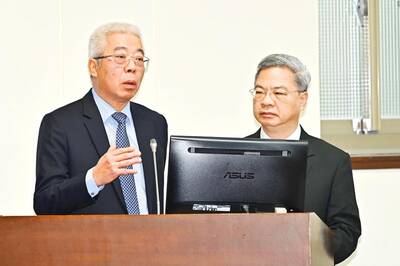
Taiwan has arranged for about 8 million barrels of crude oil, or about one-third of its monthly needs, to be shipped from the Red Sea this month to bypass the Strait of Hormuz and ease domestic supply pressures, CPC Corp, Taiwan (CPC, 台灣中油) said yesterday. The state-run oil company has worked with Middle Eastern suppliers to secure routes other than the Strait of Hormuz, through which about 20 percent of the world’s oil and liquefied natural gas typically passes, CPC chairman Fang Jeng-zen (方振仁) said at a meeting of the legislature’s Economics Committee in Taipei. Suppliers in Saudi Arabia have indicated they
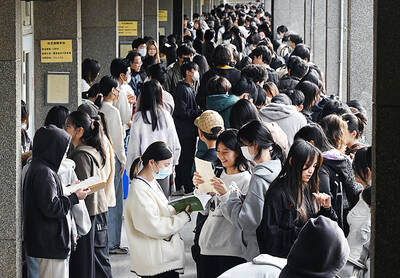
A global survey showed that 60 percent of Taiwanese had attained higher education, second only to Canada, the Ministry of the Interior said. Taiwan easily surpassed the global average of 43 percent and ranked ahead of major economies, including Japan, South Korea and the US, data from the Organisation for Economic Co-operation and Development (OECD) for 2024 showed. Taiwan has a high literacy rate, data released by the ministry showed. As of the end of last year, Taiwan had 20.617 million people aged 15 or older, accounting for 88.5 percent of the total population, with a literacy rate of 99.4 percent, the data
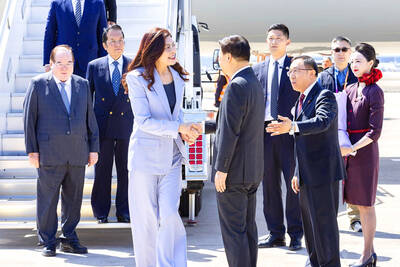
CCP ‘PAWN’? Beijing could use the KMT chairwoman’s visit to signal to the world that many people in Taiwan support the ‘one China’ principle, an academic said Chinese Nationalist Party (KMT) Chairwoman Cheng Li-wun (鄭麗文) yesterday arrived in China for a “peace” mission and potential meeting with Chinese President Xi Jinping (習近平), while a Taiwanese minister detailed the number of Chinese warships currently deployed around the nation. Cheng is visiting at a time of increased Chinese military pressure on Taiwan, as the opposition-dominated Legislative Yuan stalls a government plan for US$40 billion in extra defense spending. Speaking to reporters before going to the airport, Cheng said she was going on a “historic journey for peace,” but added that some people felt uneasy about her trip. “If you truly love Taiwan,

NEW LOW: The council in 2024 based predictions on a pessimistic estimate for the nation’s total fertility rate of 0.84, but last year that rate was 0.69, 17 percent lower An expected National Development Council (NDC) report expects the nation’s population to drop below 12 million by 2065, with the old-age dependency ratio to top 100 percent sooner than 2070, sources said yesterday. The council is slated to release its latest population projections in August, using an ultra-low fertility model, the sources said. The previous report projected that Taiwan’s population would fall to 14.37 million by 2070, but based on a new estimate of the total fertility rate (TFR) — the average number of children born to a woman over her lifetime — the population is expected to reach 12 million by


 RSS
RSS