


President Chen Shui-bian (
Presidential Office spokesperson Chen Wen-tsung (陳文宗) said Chen and Lu expected that the probe into the matter would be comprehensive. He said that the incident had had a negative impact on public safety and the nation's image.
Lu said some Taiwanese love to "do it easy" and "hate working hard," and that this was why Taiwan needed to look overseas for labor.
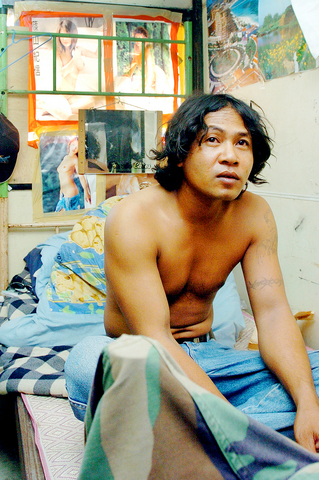
PHOTO: CHU PEI-HSIUNG, TAIPEI TIMES
But she also paid tribute to the small army of foreign laborers that man the nation's construction sites and other workplaces.
"We have to appreciate people who contribute to Taiwan no matter what their nationality. We have to see workers from other countries as our brothers and sisters rather than just as foreigners," she said.
Lu said some Taiwanese discriminated against foreign workers and that these wrong ideas had to be adjusted.
Presidential Office officials said the office would not interfere with the investigation into the riot.
Meanwhile, a delegation from Thailand's legislature arrived in Taipei yesterday to gather information on the riot as well as to offer moral support to Thai workers.
During their four-day visit, the delegation will meet officials from the Council of Labor Affairs (CLA) to discuss labor issues.
In Hsinchu County, Premier Frank Hsieh (謝長廷) yesterday said that former Presidential Office deputy secretary-general Chen Che-nan (陳哲男), the father of acting Kaohsiung Mayor Chen Chi-mai (陳其邁), was not involved in possibly corrupt conduct in relation to the hiring of the workers.
"It is not difficult to find out whether or not I am telling the truth," Hsieh said during a press conference in Sanwan Township (
Hsieh's remarks were referring to an allegation that Chen Che-nan took advantage of his position as a senior Democratic Progressive Party (DPP) figure to meddle in the hiring of Thai workers for Kaohsiung City's MRT project.
"China Steel Corp (CSC) is the firm that won the bid for the construction of the whole Kaohsiung MRT. But this company has nothing to do with Chen Che-nan," Hsieh said. "If he was really meddling in the matter, the company wouldn't have won the bid, would it?"
"Also, don't forget that then-CSC president Wang Chung-yu (王鍾渝) is now a Chinese Nationalist Party (KMT) lawmaker. If there was any reason for a scandal, how is it that the KMT was so quiet?" he asked.
"Officials from Kaohsiung City's Labor Bureau and the MRT Bureau visited them [the Thai workers] to learn if they needed anything. Things were in good shape then," Hsieh said. "However, it is my understanding that the employer did not expand the facilities that were needed, despite hiring another 900 Thai workers in May."
DPP Chairman Su Tseng-chang (蘇貞昌) yesterday gave his support for the Cabinet and the Presidential Office's position, saying that political and electoral considerations should be put aside and that prosecutions should quickly follow if an investigation found collusion between the Kaohsiung City Government and the labor broker for the Thai workers.
Su also rebutted speculation that the scandal was being fueled by DPP factionalism ahead of the Kaohsiung mayoral election.
"The DPP's tradition is that we always thoroughly and courageously scrutinize the mistakes we make and find out why they happened," Su said. "We know that people look to the DPP to remain a reformer [party] and we will correct all the mistakes in response to public expectations."
Both Council of Labor Affairs Chairwoman Chen Chu (陳菊) and Chen Chi-mai have expressed interest in running for Kaohsiung mayor next year.

‘NO SECURITY RISK’: The Railway Bureau reassured the public that the technicians’ activities were limited to technical guidance and did not involve sensitive systems The Railway Bureau yesterday said it had invited eight Chinese technicians to assist with an airport MRT construction project. The bureau issued the confirmation after an Internet user said Chinese nationals had entered the construction zone of Taiwan Taoyuan International Airport’s Terminal 3 project. They asked why “individuals from an enemy state” were allowed access to such a major national infrastructure project, which raised serious concerns over Taiwan’s industrial safety, sensitive systems and information security. The bureau’s Northern Region Engineering Branch Office said subcontractor Taiwan Handle Industrial Co (台灣手把工業) of the Taoyuan airport MRT’s “Contract No. CU05 Project A14 Station Civil, MEP &

A US uncrewed surface vessel (USV) encountered multiple Chinese warships during an autonomous transit of the Taiwan Strait, US defense company Seasats said in a statement on Wednesday. Seasats announced that a Lightfish USV had completed the first autonomous transit of the Taiwan Strait. Over five days, the USV traversed the entire length of the Strait while constantly monitoring surface vessel traffic, the company said. The Lightfish encountered multiple Chinese warships, one of which was a Chinese People’s Liberation Army Navy (PLAN) Type 056 corvette, it said. The Chinese vessels were operating “well within Taiwan’s exclusive economic zone without transmitting their identity via the
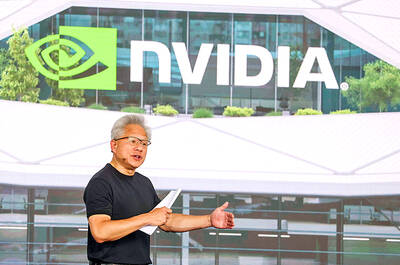
‘BOOMING’: ’ The number of partners we have here is incredible. You can see from their stock prices. They’re doing so well, they’re so happy,’ Jensen Huang said Nvidia Corp’s spending in Taiwan has ballooned to about US$150 billion a year, 10 times the US$10 billion to US$15 billion the company spent five years ago, Nvidia chief executive officer Jensen Huang (黃仁勳) said yesterday, suggesting Taiwan’s strategic importance in the global artificial intelligence (AI) supply chain. “Taiwan is the epicenter of the AI revolution. This is where the chips come, packaging comes. This is where the systems are made. This is where AI supercomputers were created,” Huang said at a meeting for the company’s employees in Beitou-Shilin Technology Park (北投士林科技園區) in Taipei, the planned site of Nvidia’s Taipei headquarters. “Taiwan
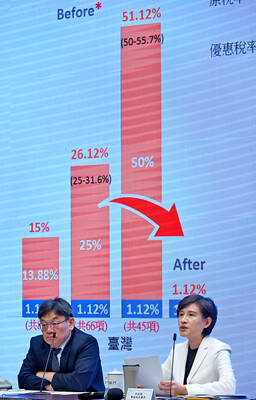
GREATER REACH? Auto parts and wood products would face tariffs of up to 15%, matching those targeting the EU, Japan and South Korea, Vice Premier said The US has announced that preferential tariff treatment for Taiwan’s non-semiconductor Section 232 goods would take effect retroactively from May 1, the Executive Yuan said yesterday. The US government yesterday posted a notice on the Federal Register’s public inspection Web site previewing tariff concessions for Taiwan under a memorandum of understanding (MOU) on Taiwan-US investment after two months of negotiations. The MOU signed on Jan. 15 stipulated three major preferential tariff arrangements: a 15 percent “reciprocal” tariff rate for Taiwan without stacking most-favored nation (MFN) rates; preferential Section 232 treatment for semiconductors and related products; and preferential Section 232 treatment for non-semiconductor


 RSS
RSS