


Former President Lee Teng-hui (
Implying that Taiwan is under the protection of the US, Lee said it was necessary to procure arms from the US.
"You can't take a bus without paying for it," he said.
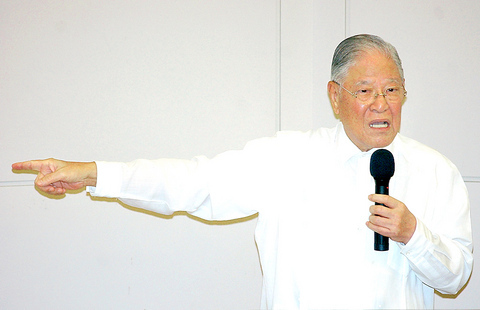
PHOTO: LIU HSIN-DE, TAIPEI TIMES
Lee made the remarks yesterday while expressing his opinion about the current international situation to the members of the "Friends of Lee Teng-hui Association," a non-profit organization created to support Lee Teng-hui and his localization policies.
However, a senior US military official told the Taipei Times that it had been standing policy for the US to maintain a "nuclear deterrent," most of which is kept aboard a number of nuclear missile subs that are constantly on patrol worldwide.
The patrols were not specifically directed at China, and the missiles would only be given specific targeting instructions on the order of the US president, the source said.
Still, Lee encouraged the Taiwanese people to remain confident and not to be afraid of China, saying as it is "impossible" for China to attack Taiwan.
"Given the US nuclear submarines patrolling in the Pacific Ocean and all of their equipped nuclear warheads, China can't move at all. It would take at least an army of ten divisions for China to attack Taiwan, which is an impossible mission," Lee told the members.
It is unclear how Lee arrived at his conclusion, given that the People's Liberation Army is usually estimated to have at least 20 infantry divisions, 10 armor divisions, and five mechanized infantry divisions, not including its air, naval and special forces.
Lee said that Beijing was restrained by the US' military deployments, so the best measure China could exert to influence the Taiwanese people was to arrange visits by opposition leaders, Lee said.
These "pro-China" people went to Beijing to shake hands with the Communist leaders and to bow to the Chinese authorities because they couldn't accept the fact that Chen Shui-bian (
"They should be blamed for their anti-democratic attitude. Actually, they are considered by many people in China as `fools,' but they don't know that. Ironically, they even tried to scare the Taiwanese people, because they wanted the people to listen to them," Lee said.
Lee reiterated that China is nothing to be afraid of. Instead, Taiwan should be cautious about these "pro-China" people who have tried to cheat Taiwanese people time and again, Lee said.
Despite his confidence about cross-strait security, Lee said that Taiwan can't pretend it cares nothing about arms procurement if it wishes to maintain relations with the US.
A special arms procurement budget bill worth NT$480 billion (US$15 billion) has been stuck in the legislature because of opposition from the pan-blue alliance.
"The new development of Chinese Nationalist Party (KMT) chairman-elect Ma Ying-jeou (馬英九) being invited to visit Washington means that the US wants to preach to him the importance of the arms procurement package," Lee said.
In his wide-ranging comments, Lee also leveled criticism at the government's cross-strait policies.
"If the Executive Yuan decides to include Penghu into the scope of the small three links, I will stage a march against the government. I will oppose this policy to the end," Lee said.
The "small three links" refer to cargo, passenger and postal links between Kinmen and Xiamen, and Matsu and Mawei.
Lee's criticism came in the wake of the report by a Chinese-language newspaper last week that Penghu County could be approved to serve as another transit port between the two sides of the Strait, just like Kinmen and Matsu under the small three links policy, which took effect in 2001.
The government, however, has already responded to the report, saying that it is not true.
"Penghu will still be subject to special regulations under the renewed small three links scheme, which means that only special cases approved by the government can be allowed to travel from Taiwan via Penghu to China," Johnnason Liu (劉德勳), vice chairman of the Mainland Affairs Council was quoted as saying.
Liu said that the government might allow a commercial group to leave for China via Penghu in this September, but that the government was not prepared to let Penghu take on the general transit role.
Additional reporting by Mac William Bishop

A signaling system malfunction disrupted high-speed rail (HSR) services beginning at 8am today, with trains temporarily reduced to three northbound and three southbound trains per hour as authorities conduct inspections. The malfunction occurred on a section of track in Miaoli County during pre-operation checks early this morning, forcing northbound and southbound trains to use a single track, the HSR operator said. The regular schedule has been replaced with three hourly trains offering only nonreserved seating in each direction, stopping at every station, it said, adding that business class cars would still have reserved seating. Departures from terminal stations are scheduled at the top

Taiwan is still in the process of assessing the possibility of recruiting workers from Eswatini, the Ministry of Foreign Affairs said yesterday, adding that its goal is to help Eswatini upgrade its vocational training centers. If there are plans to recruit workers from Eswatini, safeguarding national security, protecting public health and ensuring the employment rights of Taiwanese would be prerequisites, Department of West Asian and African Affairs Director-General Yen Chia-liang (顏嘉良) told a news conference. Key considerations would also include filling labor shortages in specific industries, and fostering bilateral professional and technical exchanges, he said. Yen was asked about the progress of labor

VERBOSE VESSELS: A CGA cutter and a China Coast Guard exchanged verbal barbs for more than a day in Taiwanese-controlled waters before the Chinese vessel left The Taiwanese and Chinese coast guards had a standoff near the strategically located Pratas Islands (Dongsha Islands, 東沙群島) in the north of the South China Sea, the Coast Guard Administration (CGA) said yesterday. The two sides engaged in intense radio exchanges over sovereignty claims during the 33-hour standoff. China Coast Guard vessel 3501 eventually left the restricted waters, 26.6 nautical miles (49.2km) west of the Pratas Islands, at 5pm yesterday, the CGA said. Lying approximately between southern Taiwan and Hong Kong, the Taiwan-controlled Pratas are seen by some security experts as vulnerable to Chinese attack due to their distance — more than

A US uncrewed surface vessel (USV) encountered multiple Chinese warships during an autonomous transit of the Taiwan Strait, US defense company Seasats said in a statement on Wednesday. Seasats announced that a Lightfish USV had completed the first autonomous transit of the Taiwan Strait. Over five days, the USV traversed the entire length of the Strait while constantly monitoring surface vessel traffic, the company said. The Lightfish encountered multiple Chinese warships, one of which was a Chinese People’s Liberation Army Navy (PLAN) Type 056 corvette, it said. The Chinese vessels were operating “well within Taiwan’s exclusive economic zone without transmitting their identity via the


 RSS
RSS