


Iran warned yesterday it would resume sensitive nuclear work within 24 hours if the EU failed to submit proposals aimed at ending a long-running crisis over its nuclear program.
The move has raised the stakes in the nuclear standoff and risks seeing Iran hauled before the UN Security Council for possible sanctions, a persistent demand of the US which accuses Iran of seeking nuclear weapons.
"If the Europeans submit their proposals by 5pm we will examine them, if not we will resume some of our [conversion] activities in Isfahan [today]," nuclear negotiator Ali Agha Mohammadi told reporters.
But he added: "Our position is that we want to pursue the negotiations with the Europeans."
Only on Saturday, Iran set a deadline of today for EU negotiators Britain, France and Germany to offer a package of trade, technology and security incentives in return for Iran guaranteeing its nuclear program is peaceful.
But London had denied there was a deadline. The Europeans had previously said they intended to submit the proposals after hardline new president Mahmood Ahmadinejad takes office on Wednesday.
"The negotiations continue, we will not resume enrichment, we are today waiting until 5pm for the European proposals," Mohammadi said.
"The only thing that we will resume, if the European proposals do not take into account the least of our demands, is part of the activities at Isfahan."
Conversion, a process carried out in Iran at a facility in the central city of Isfahan, changes uranium ore into the uranium gas that is the feedstock for enrichment.
Iran agreed in November to suspend uranium enrichment activities, a process that makes fuel for civilian nuclear power plants but can also be the explosive core of atom bombs, during negotiations with the Europeans.
But Tehran says it has the right to enrichment under the nuclear Non-Proliferation Treaty and the issue has been one of the chief stumbling blocks in the process with the Europeans.
And outgoing reformist President Mohammad Khatami said last week that Iran would resume enrichment activities no matter what the Europeans propose although "we prefer to do it with their agreement."
Washington accuses Iran of seeking nuclear weapons, a charge vehemently denied by the Islamic republic, and the negotiation process with the EU is aimed at avoiding Tehran being brought before the Security Council.
But the EU is "warning about the consequences of breaking the suspension and that this will lead to the matter being taken to the UN Security Council," one diplomat told reporters in Vienna, the headquarters of the International Atomic Energy Agency.
Iranian foreign ministry spokesman Hamid Reza Asefi said Iran would inform the UN nuclear watchdog yesterday or today of the resumption of some conversion work.
"The time limit [on the suspension of such activities] has passed and public opinion cannot wait any longer," Asefi said.
He said international inspectors currently in Iran would be taken to the Isfahan facility where the IAEA seals would be "removed in the presence of the inspectors and the work will resume."
On Saturday, Mohammadi had said that a deadline of Aug. 1 had been fixed at a previous meeting in London and if the Europeans did not stick to this then Iran would take "measures in line with its national interest."
However a spokesman for the British Foreign Office denied that there was ever a deadline.

Taiwan Semiconductor Manufacturing Co (TSMC, 台積電), the world’s largest foundry service provider, yesterday said that global semiconductor revenue is projected to hit US$1.5 trillion in 2030, after the figure exceeds US$1 trillion this year, as artificial intelligence (AI) demand boosts consumption of token and compute power. “We are still at the beginning of the AI revolution, but we already see a significant impact across the whole semiconductor ecosystem,” TSMC deputy cochief operating officer Kevin Zhang (張曉強) said at the company’s annual technology symposium in Hsinchu City. “It is fair to say that in the past decade, smartphones and other mobile devices were
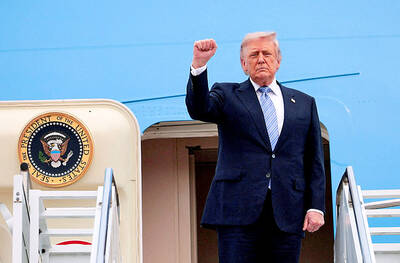
US-CHINA SUMMIT: MOFA welcomed US reassurance of no change in its Taiwan policy; Trump said he did not comment when Xi talked of opposing independence US President Donald Trump yesterday said he has not made a decision on whether to move forward with a major arms package for Taiwan after hearing concerns about it from Chinese President Xi Jinping (習近平). Trump’s comments on Taiwan came as he flew back to Washington after wrapping up critical talks in which both leaders said important progress was made in stabilizing US-China relations even as deep differences persist between the world’s two biggest powers on Iran and Taiwan. “I will make a determination,” Trump said, adding: “I’ll be making decisions. But, you know, I think the last thing we need right

TAIWAN ISSUE: US treasury secretary Scott Bessent said on the first day of meetings that ‘it wouldn’t be a US-China summit without the Taiwan issue coming up’ There were no surprises on the first day of the summit between US President Donald Trump and Chinese President Xi Jinping (習近平), the Mainland Affairs Council (MAC) said yesterday, as the government reiterated that cross-strait stability is crucial to the Asia-Pacific region, as well as the world. As the two presidents met for a highly anticipated summit yesterday, Chinese state media reported that Xi warned Trump that missteps regarding Taiwan could push their two countries into “conflict.” Trump arrived in China with accolades for his host, calling Xi a “great leader” and “friend,” and extending an invitation to visit the White House
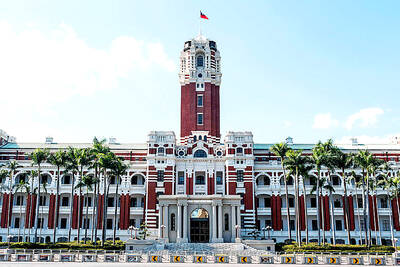
SECURITY: Taipei presses the US for arms supplies, saying the arms sales are not only a reflection of the US security commitment to Taiwan but also serve as a mutual deterrent against regional threats Taiwan is committed to preserving the cross-strait “status quo” and contributing to regional peace and stability, the Presidential Office said yesterday. “It is an undeniable fact that the Republic of China is a sovereign and independent democratic nation,” Presidential Office spokeswoman Karen Kuo (郭雅慧) reiterated, adding that Beijing has no right to claim sovereignty over Taiwan. The statements came after US President Donald Trump warned against Taiwanese independence. Trump wrapped up a state visit to Beijing on Friday, during which Chinese President Xi Jinping (習近平) had pressed him not to support Taiwan. Taiwan depends heavily on US security backing to deter China from carrying


 RSS
RSS