


BenQ Corp (明基電通), Taiwan's biggest mobile phone maker, yesterday announced that it will acquire Siemens AG's debt-ridden handset unit, aiming to bring the Taiwanese brand onto the world stage.
The deal will turn Taipei-based BenQ into one of the world's biggest cell phone vendors overnight, with annual revenues doubling to a total of US$10 billion, the head of the company said yesterday at a press conference.
"BenQ has been seeking ways to boost its economic scale and manufacturing capabilities to become a leading mobile phone player. We think Siemens is a partner that will be complementary," chairman Lee Kun-yao (
Lee said the company will acquire Siemens' entire mobile phone business, with more than 7,000 employees worldwide, and will have its headquarters in Munich.
In a joint statement issued yesterday, BenQ said it will be acquiring all of Siemens' development and manufacturing locations in Manaus, Brazil and Kamp-Lintfort in Germany. The factory in Shanghai, which is operated as a joint venture together with a Chinese partner, will also remain a development and manufacturing location, it said.
Under the terms, BenQ will also get 250 million euros in cash from the German phone giant to develop patents and market the new brand BenQ-Siemens, according to the company.
Within 5 years after the agreement takes effect in October, BenQ will be able to launch products under the co-brand BenQ-Siemens, the company said. After that, BenQ will run only its own brand, the company added.
Siemens will also spend 50 million euros to get a 2-percent stake in BenQ by purchasing the company's global depositary receipts (GDRs) by September at the earliest, BenQ said in a statement.
As Siemens, the world's No.5 cellphone vendor, will absorb all of the losses incurred before the agreement takes effect, BenQ chief financial official Eric Yu (
With the contribution from Siemens, BenQ's handset shipment will exceed 15 million units this year, up from 10 million estimated previously, Yu said. The company will hold a special shareholders' meeting on July 28 to approve the acquisition deal and the issurance of GDRs.
Vincent Chen (陳豊丰), an analyst with CLSA Ltd (里昂證券) in Taipei, is quite conservative about the acquisition, citing uncertainties.
"It will be a challenge for BenQ to reach the break-even point for the new mobile operation next year as the company hopes. It will be good enough for BenQ to shrink losses from the unit by cost savings," Chen said.
"The only positive part of the deal is BenQ will have no cash offer for Siemens' handset division, but overall, I'm still negative about the acquisition," Chen added.
But Daniel Wang (
"Siemens' offer looks quite positive to BenQ, especially for BenQ's brand business," Wang said. Besides, BenQ will have chance to take over Singapore's Flextronics to make phones in the pipeline, he added.
The key question is how much BenQ can reduce its costs to compete directly with mobile phone giants Nokia Oyj and Motorola Inc, which are slashing prices to gain market share, Wang said.
BenQ shares yesterday lost NT$0.9 to NT$32.5 yesterday on the Taiwan Stock Exchange after the purchase of Siemens' handset division was disclosed on Monday.

LEVERAGE: China did not ‘need to fire a shot’ to deny Taiwan airspace over Africa when it owns ‘half the continent’s debt,’ a US official said, calling it economic warfare The EU has raised concerns about overflight rights following the delay of President William Lai’s (賴清德) planned state visit to the Kingdom of Eswatini after three African nations denied overflight clearance for his charter at the last minute. Taiwanese allies Paraguay and Saint Kitts and Nevis, as well as several US lawmakers and the Inter-Parliamentary Alliance on China (IPAC) condemned China for allegedly pressuring the countries. Lai was scheduled to fly directly to Taiwan’s only African ally from yesterday to Sunday to celebrate the 40th anniversary of King Mswati III’s accession and his 58th birthday, but Seychelles, Mauritius and Madagascar suddenly revoked

The final batch of 28 M1A2T Abrams tanks purchased from the US arrived at Taipei Port last night and were transported to the Armor Training Command in Hsinchu County’s Hukou Township (湖口), completing the military’s multi-year procurement of 108 of the tanks. Starting at 12:10am today, reporters observed more than a dozen civilian flatbed trailers departing from Taipei Port, each carrying an M1A2T tank covered with black waterproof tarps. Escorted by military vehicles, the convoy traveled via the West Coast Expressway to the Armor Training Command, with police implementing traffic control. The army operates about 1,000 tanks, including CM-11 Brave Tiger
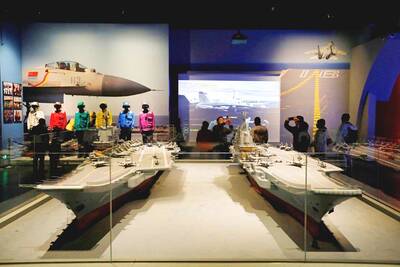
China on Wednesday teased in a video an aircraft carrier that could be its fourth, and the first using nuclear power, while making an allusion to Taiwan and vowing to further build up its islands, as it looks to boost maritime power, secure resources and bolster territorial claims. The video, issued on the eve of the 77th founding anniversary of the Chinese People’s Liberation Army Navy, featured fictional officers with names that are homophones of three commissioned aircraft carriers, the Liaoning (遼寧), Shandong (山東) and Fujian (福建). Titled Into the Deep, it showed a 19-year-old named “Hejian” (何劍) joining the group, sparking
BIG YEAR: The company said it would also release its A12 chip the same year to keep a ‘reliable stream of new silicon technologies’ flowing to its customers Taiwan Semiconductor Manufacturing Co (TSMC, 台積電) yesterday said its newest A13 chip is to enter volume production in 2029 as the chipmaker seeks to hold onto its tech leadership and demand for next-generation chips used in artificial intelligence (AI), high-performance-computing (HPC) and mobile applications. TSMC, the world’s biggest contract chipmaker, also unveiled its A12 chip at its annual technology symposium in Santa Clara, California. The A12 chip, which features TSMC’s super-power-rail technology to provide backside power delivery for AI and HPC applications, is also to enter volume production in 2029, a year after the scheduled release of the A14 chip. The technology moves


 RSS
RSS