


The push for Chinese Nationalist Party (KMT) Chairman Lien Chan (
Yesterday was a busy morning at KMT headquarters in Taipei, with both Yunlin County Council Speaker Chen Ching-hsiu (
"I have already begun a collection of signatures, and the deposit needed for registration is not a problem," Chen said, adding that he planned to register Lien as a candidate in the next couple of days.
In an embarrassing development for Ma Ying-jeou, Ma Ho-ling urged Lien to run for another term as chairman.
Ma Ho-ling said that his son "has no experience" in party operations, and that only Lien could unite the pan-blue camp.
In response, Ma Ying-jeou yesterday said that he respected his father's opinion, but planned to continue with his campaign for the party chairmanship.
Chen said he had collected between 30,000 and 50,000 signatures for Lien's bid and that the required deposit had already been dealt with. However, Lien's "agreement" to run had not yet been "settled," he said.
According to KMT regulations, party members who wish to run in the July 16 chairmanship race must deposit NT$1 million with the party and deliver a petition with the signatures of at least 3 percent of the party membership -- or a minimum of 33,000 signatures.
Chen did not say if he was optimistic about "receiving Lien's authorization" to go ahead with the registration, but he did say that he was in contact with Lien's office and that there should be "no problem."
However, he said, Lien was still standing by his previous statements that he had no intention of running.
In attempting to register Lien for the election, Chen said that he was bringing the voice of the people to the KMT headquarters.
While Lien has said on numerous occasions that he has no plans to run, supporters have argued that only Lien can unite the KMT. They contend that a contest between KMT vice chairmen Ma and Legislative Speaker Wang Jin-pyng (
Only if Lien continues as chairman, they say, will the KMT be able to win the 2008 presidential election.
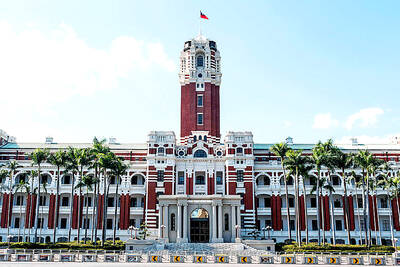
SECURITY: Taipei presses the US for arms supplies, saying the arms sales are not only a reflection of the US security commitment to Taiwan but also serve as a mutual deterrent against regional threats Taiwan is committed to preserving the cross-strait “status quo” and contributing to regional peace and stability, the Presidential Office said yesterday. “It is an undeniable fact that the Republic of China is a sovereign and independent democratic nation,” Presidential Office spokeswoman Karen Kuo (郭雅慧) reiterated, adding that Beijing has no right to claim sovereignty over Taiwan. The statements came after US President Donald Trump warned against Taiwanese independence. Trump wrapped up a state visit to Beijing on Friday, during which Chinese President Xi Jinping (習近平) had pressed him not to support Taiwan. Taiwan depends heavily on US security backing to deter China from carrying
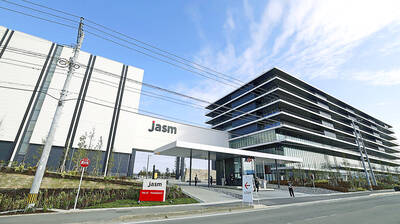
The subsidiary of Taiwan Semiconductor Manufacturing Co (TSMC, 台積電) in Kumamoto, Japan, turned a profit in the first quarter of this year, marking the first time the first fab of the unit has become profitable since mass production started at the end of 2024. According to the contract chipmaker’s financial statement released on Friday, Japan Advanced Semiconductor Manufacturing Inc (JASM), a joint venture running the fab in Kumamoto, posted NT$951 million (US$30.19 million) in profit in the January-to-March period, compared with a loss of NT$1.39 billion in the previous quarter, and a loss of NT$3.25 billion in the first quarter of
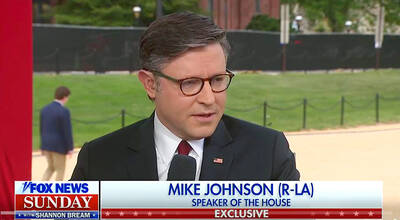
RESOLUTE BACKING: Two Republican senators are planning to introduce legislation that would impose immediate sanctions on China if it attempts to invade Taiwan US House of Representatives Speaker Mike Johnson on Sunday reaffirmed US congressional support for Taiwan, saying the US and “all freedom-loving people” have a stake in preventing China from seizing Taiwan by force. Johnson made the remarks in an interview with Fox News Sunday on US President Donald Trump’s summit with Chinese President Xi Jinping (習近平) last week. In an interview that aired on Friday on Fox News, just as Trump wrapped up a high-stakes visit to China, he said he has yet to green-light a new US$14 billion arms package to Taiwan and that it “depends on China.” “It’s a very good
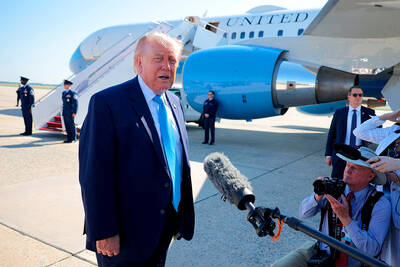
US President Donald Trump yesterday said he would speak to President William Lai (賴清德) as his administration considers whether to move ahead with a US$14 billion weapons sale to Taiwan — a potential arms deal that has drawn criticism from China. “Well, I’ll speak to him. I speak to everybody,” Trump told reporters yesterday when asked if he had any plans to call his counterpart, although he did not offer a time frame for when such a conversation could take place. Trump previously said he would speak to the person “that’s running Taiwan,” without specifying who he meant. “We have that situation very


 RSS
RSS