


President Chen Shui-bian (
Chen made the remarks yesterday while receiving US Senator John Rockefeller, a West Virginia Democrat, at the Presidential Office.
"In a bid to preserve Taiwan's economic security, stabilize its national security and uphold peace in the Asia-Pacific region, it is necessary for the US government and its Congress to support and push for the signing of an FTA between the two countries," Chen said.
"China's rise is definitely not a peaceful rise. It is an economic and military rise," the president said. "The development of China's economic power has led many countries to harbor a fantasy about it ... China is actively courting ASEAN and Latin American countries into signing FTAs, through which it will work to marginalize Taiwan from taking part in the integration of the regional economy."
China, by vigorously signing FTAs with other countries, is at the same time preventing many countries from signing FTAs with Taiwan, Chen said, adding that "the purpose of this is to demote, trim and localize Taiwan's status and thereby weaken Taiwan's self-defense capability."
Chen shared with his US visitor a new definition of a country's national security.
"The new definition of a country's national security is not limited to just military and national defense, but includes a grander strategic concept that encompasses economic security and other security issues," Chen said. "Should Taiwan be marginalized from integration into the regional economy, what follows will be the marginalization of Taiwan's economic security, which will then affect Taiwan's national security and proceed to the next step of wearing down the security of the Asia-Pacific region."
Expressing gratitude for the US Congress' long-term concern over cross-strait security issues, Chen called on the US Congress not to neglect Taiwan's economic security while placing importance on Taiwan's military security.
"Signing an FTA between the US and Taiwan could prevent the US as well as other countries from having their economies tilt toward China," Chen said, adding that the US, by signing an FTA with Taiwan, would set a model for other countries who could sign similar treaties, and thus consolidate Taiwan's economic security.
Noting that this was Rockefeller's 17th visit to Taiwan since 1985, Chen called the senator "Taiwan's best friend" and expressed gratitude for his "long-term unconditional support" for Taiwan.
Rockefeller, who has been a US senator since 1984, is a member of the Senate Finance Committee.
Prior to meeting with Chen, Rockefeller yesterday morning delivered a speech at a seminar held by the Chung-Hua Institution for Economic Research and the Cross-Strait Common Market Foundation at the Formosa Regent Hotel.
Rockefeller said he would promote cooperation between Taipei and the Bush administration to overcome difficulties in signing an FTA between the two sides.
Aside from meeting with the president, Rockefeller, who arrived in Taiwan on Saturday, also met with Premier Frank Hsieh (
He is slated to head to Japan after visiting Taiwan.
Rockefeller issues call for reform
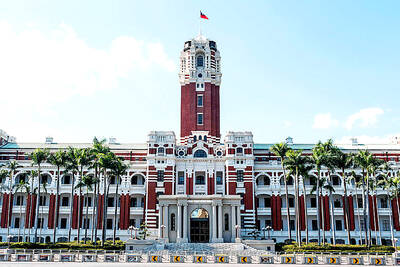
SECURITY: Taipei presses the US for arms supplies, saying the arms sales are not only a reflection of the US security commitment to Taiwan but also serve as a mutual deterrent against regional threats Taiwan is committed to preserving the cross-strait “status quo” and contributing to regional peace and stability, the Presidential Office said yesterday. “It is an undeniable fact that the Republic of China is a sovereign and independent democratic nation,” Presidential Office spokeswoman Karen Kuo (郭雅慧) reiterated, adding that Beijing has no right to claim sovereignty over Taiwan. The statements came after US President Donald Trump warned against Taiwanese independence. Trump wrapped up a state visit to Beijing on Friday, during which Chinese President Xi Jinping (習近平) had pressed him not to support Taiwan. Taiwan depends heavily on US security backing to deter China from carrying
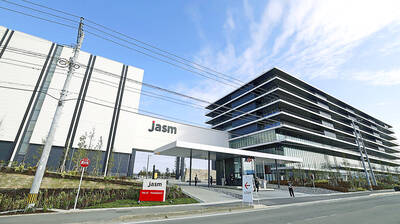
The subsidiary of Taiwan Semiconductor Manufacturing Co (TSMC, 台積電) in Kumamoto, Japan, turned a profit in the first quarter of this year, marking the first time the first fab of the unit has become profitable since mass production started at the end of 2024. According to the contract chipmaker’s financial statement released on Friday, Japan Advanced Semiconductor Manufacturing Inc (JASM), a joint venture running the fab in Kumamoto, posted NT$951 million (US$30.19 million) in profit in the January-to-March period, compared with a loss of NT$1.39 billion in the previous quarter, and a loss of NT$3.25 billion in the first quarter of
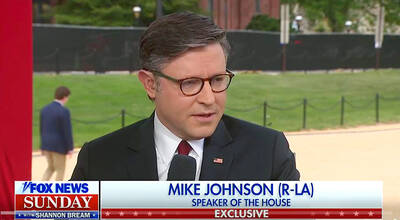
RESOLUTE BACKING: Two Republican senators are planning to introduce legislation that would impose immediate sanctions on China if it attempts to invade Taiwan US House of Representatives Speaker Mike Johnson on Sunday reaffirmed US congressional support for Taiwan, saying the US and “all freedom-loving people” have a stake in preventing China from seizing Taiwan by force. Johnson made the remarks in an interview with Fox News Sunday on US President Donald Trump’s summit with Chinese President Xi Jinping (習近平) last week. In an interview that aired on Friday on Fox News, just as Trump wrapped up a high-stakes visit to China, he said he has yet to green-light a new US$14 billion arms package to Taiwan and that it “depends on China.” “It’s a very good
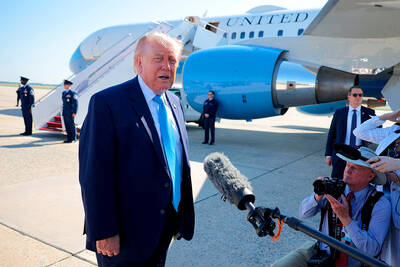
US President Donald Trump yesterday said he would speak to President William Lai (賴清德) as his administration considers whether to move ahead with a US$14 billion weapons sale to Taiwan — a potential arms deal that has drawn criticism from China. “Well, I’ll speak to him. I speak to everybody,” Trump told reporters yesterday when asked if he had any plans to call his counterpart, although he did not offer a time frame for when such a conversation could take place. Trump previously said he would speak to the person “that’s running Taiwan,” without specifying who he meant. “We have that situation very


 RSS
RSS