


The coast guard forced a Chinese research ship, the Fen Dou No.4 (
"Chinese research vessels have recently infringed on the boundaries of Taiwan's exclusive economic maritime zone under the guise of oceanic surveys, but they may be trying to acquire military intelligence," President Chen Shui-bian (
"The intrusions not only violate the law, but they also have a bad influence on cross-strait ties," Chen said.
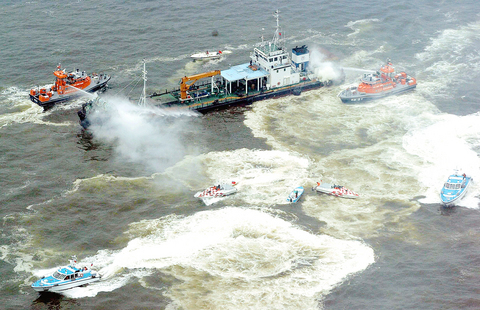
PHOTO: CHANG CHUNG-YIH, TAIPEI TIMES
Chen said he had asked the CGA to strengthen aerial and maritime patrols in Taiwan's territory.
CGA Minister Shi Hwei-yow (
He said "this is the third time this month that Chinese vessels have entered Taiwan's territory. The recent frequent intrusions of Chinese research ships were seen as unfriendly actions."
He added "the semi-official Straits Exchange Foundation (SEF) had three times requested Chinese authorities recall the Fan Dou No.4, but it still stayed and refused to leave."
The CGA discovered the Fen Dou No. 4 some 175km southwest of Kaohsiung on the morning of May 22. A CGA vessel and aircraft closed in on the ship to force its departure, but the vessel refused to move.
The CGA said another three Coast Guard vessels arrived at the spot on May 23 in an effort to force the ship to leave, and the ship stopped its operations and left on May 24.
The CGA said, however, that the vessel returned to the waters south of Taiwan on May 26 and conducted operations there.
The vessel was again forced to leave by the Coast Guard yesterday morning, Shi said.
Shi said the Chinese vessels were in violation of regulations requiring that appropriate permission be obtained before entering the economic maritime zone.
The Chinese oil exploration vessel Tan Bao (
The CGA found that a Chinese research vessel, Xiang Yang Hong No. 14 (向陽紅十四號) intruded into the waters south of Taiwan in November 2002, while two Chinese research vessels, the Huai Yang No. 4 (海洋四號) and the Bei Dou (北斗號), appeared in the northern and southern waters of Taiwan in April 2003. Also, the Xiang Yang Hong No. 6 (向陽紅六號) entered the waters north of Taiwan in August 2003.
Taiwanese military experts have said that Chinese exploration vessels frequently appear in waters south and north of Taiwan to conduct hydrographic research for submarines.

A signaling system malfunction disrupted high-speed rail (HSR) services beginning at 8am today, with trains temporarily reduced to three northbound and three southbound trains per hour as authorities conduct inspections. The malfunction occurred on a section of track in Miaoli County during pre-operation checks early this morning, forcing northbound and southbound trains to use a single track, the HSR operator said. The regular schedule has been replaced with three hourly trains offering only nonreserved seating in each direction, stopping at every station, it said, adding that business class cars would still have reserved seating. Departures from terminal stations are scheduled at the top

Taiwan is still in the process of assessing the possibility of recruiting workers from Eswatini, the Ministry of Foreign Affairs said yesterday, adding that its goal is to help Eswatini upgrade its vocational training centers. If there are plans to recruit workers from Eswatini, safeguarding national security, protecting public health and ensuring the employment rights of Taiwanese would be prerequisites, Department of West Asian and African Affairs Director-General Yen Chia-liang (顏嘉良) told a news conference. Key considerations would also include filling labor shortages in specific industries, and fostering bilateral professional and technical exchanges, he said. Yen was asked about the progress of labor

VERBOSE VESSELS: A CGA cutter and a China Coast Guard exchanged verbal barbs for more than a day in Taiwanese-controlled waters before the Chinese vessel left The Taiwanese and Chinese coast guards had a standoff near the strategically located Pratas Islands (Dongsha Islands, 東沙群島) in the north of the South China Sea, the Coast Guard Administration (CGA) said yesterday. The two sides engaged in intense radio exchanges over sovereignty claims during the 33-hour standoff. China Coast Guard vessel 3501 eventually left the restricted waters, 26.6 nautical miles (49.2km) west of the Pratas Islands, at 5pm yesterday, the CGA said. Lying approximately between southern Taiwan and Hong Kong, the Taiwan-controlled Pratas are seen by some security experts as vulnerable to Chinese attack due to their distance — more than
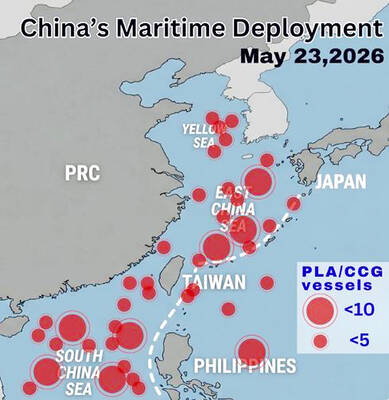
WARNING: China should stop engaging in actions that undermine regional peace and stability, as it would only build resentment among people across the Strait, the CGA said China has deployed more than 100 navy, coast guard and other vessels in waters from the Yellow Sea to the South China Sea and the western Pacific since US President Donald Trump and Chinese President Xi Jinping (習近平) met in Beijing, National Security Council Secretary-General Joseph Wu (吳釗燮) said yesterday. “In this part of the world, #China is the one & only PROBLEM wrecking the #StatusQuo & threatening regional peace & stability,” Wu wrote on X. In a separate post, he said Beijing was coercing Taiwan’s maritime domain, calling it illegal and provocative, after the Coast Guard Administration (CGA) expelled a


 RSS
RSS