


President Chen Shui-bian (
Chen's visit to Nadi was labeled a `transit' stop by officials of both countries, which do not have diplomatic relations.
Chen is the first Taiwanese president to set foot in Fiji since the country became independent from the UK in 1970.
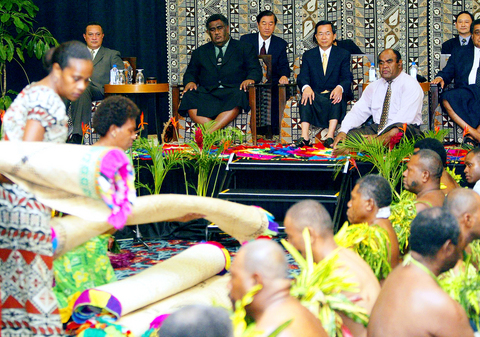
PHOTO: CNA
Chen was welcomed at the airport by overseas Taiwanese and Fijian people holding the national flags of both countries. The Fijian government provided a police and secret service escort for Chen's trip from the airport to his hotel.
According to his official schedule, Chen and his delegation were supposed to leave Tarawa, Kiribati yesterday, for an overnight transit stop in Guam.
However, late Tuesday night, officials from the Presidential Office told reporters in confidence that the delegation would be flying to Fiji, not Guam. Due to political concerns, they asked the press not to release the news until the president's aircraft had landed in Fiji.
When Chen's plane arrived at Nadi's international airport, Ratu (tribal chief) Ovini Bokini, the most respected civic leader in Fiji, was on hand to greet him.
Bokini holds the traditional title of Turaga na Tul Tavua, or the traditional head of the Vanua of Tavua. He is also the chairman of the Ba Provincial Council and chairman of the Great Council of Chiefs.
Fijian Prime Minister Laisenia Qarase later arrived at the Sheraton Hotel, where Chen and his delegation were staying, to say hello.
The Fijian government held a "almost-state-level banquet" for Chen at the Sheraton, while Bokini hosted a traditional welcoming ceremony in honor of Chen's stopover.
Neither Bokini nor Qarase made any public comments about Chen's visit.
"Fiji is the most powerful country of the Pacific islands. It really means something that our president set foot onto its soil," an anonymous source from the Presidential Office said.
Alex Tu (
"The local evening news reported that President Chen was visiting Nadi today, while Taiwanese officials were trying to keep the visit low-profile to avoid unnecessary diplomatic problems until the president's aircraft arrived," Tu said.
According to Yu, the news reports said that Chen's visit would be a challenge for Fijian diplomacy.
Tu said that Chen had planned a trip to Fiji back in January but it was called off after details of the visit were leaked and the Chinese government sent a 200-member delegation to visit the Pacific nation.
Chen has often remarked that the first character of his first name is "water" so he always brings along a lot of water wherever he goes. This was proven true yesterday as a downpour hit the Nadi area as Chen and his delegation arrived.
Ranjan Reddy, who said he was head of Fiji's "Facility Service for Taiwan VIP Delegation" told the Taipei Times that it had not rained in the region for almost a month. Reddy is actually a high-ranking law-enforcement officer, but he wished to keep his official title out of the news.
Taiwan has maintained close relations with Fiji since 1971 when it established the "Trade Mission of the Republic of China," which acts as an embassy. The mission's office in Suva is the nation's only diplomatic office in a non-diplomatic ally that uses the country 's official name. The current representative to Fiji is Kuo Shih-nan (
Fiji established diplomatic relations with China on Nov. 5, 1975.
Also see story:

‘NO SECURITY RISK’: The Railway Bureau reassured the public that the technicians’ activities were limited to technical guidance and did not involve sensitive systems The Railway Bureau yesterday said it had invited eight Chinese technicians to assist with an airport MRT construction project. The bureau issued the confirmation after an Internet user said Chinese nationals had entered the construction zone of Taiwan Taoyuan International Airport’s Terminal 3 project. They asked why “individuals from an enemy state” were allowed access to such a major national infrastructure project, which raised serious concerns over Taiwan’s industrial safety, sensitive systems and information security. The bureau’s Northern Region Engineering Branch Office said subcontractor Taiwan Handle Industrial Co (台灣手把工業) of the Taoyuan airport MRT’s “Contract No. CU05 Project A14 Station Civil, MEP &

A US uncrewed surface vessel (USV) encountered multiple Chinese warships during an autonomous transit of the Taiwan Strait, US defense company Seasats said in a statement on Wednesday. Seasats announced that a Lightfish USV had completed the first autonomous transit of the Taiwan Strait. Over five days, the USV traversed the entire length of the Strait while constantly monitoring surface vessel traffic, the company said. The Lightfish encountered multiple Chinese warships, one of which was a Chinese People’s Liberation Army Navy (PLAN) Type 056 corvette, it said. The Chinese vessels were operating “well within Taiwan’s exclusive economic zone without transmitting their identity via the
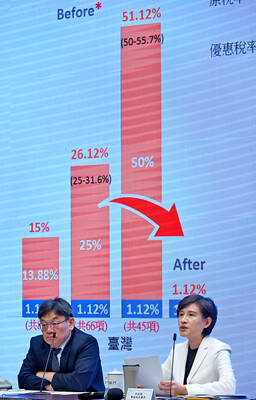
GREATER REACH? Auto parts and wood products would face tariffs of up to 15%, matching those targeting the EU, Japan and South Korea, Vice Premier said The US has announced that preferential tariff treatment for Taiwan’s non-semiconductor Section 232 goods would take effect retroactively from May 1, the Executive Yuan said yesterday. The US government yesterday posted a notice on the Federal Register’s public inspection Web site previewing tariff concessions for Taiwan under a memorandum of understanding (MOU) on Taiwan-US investment after two months of negotiations. The MOU signed on Jan. 15 stipulated three major preferential tariff arrangements: a 15 percent “reciprocal” tariff rate for Taiwan without stacking most-favored nation (MFN) rates; preferential Section 232 treatment for semiconductors and related products; and preferential Section 232 treatment for non-semiconductor

The National Chungshan Institute of Science and Technology yesterday showcased its locally developed variants of the Vision 60 robotic patrol dog, which it plans to deploy on the nation’s outlying territories in the South China Sea. The variants were produced under the Joint Lab project — created by the institute and domestic companies — and assembled with domestically produced motors, lenses and artificial intelligence (AI) systems alongside licensed tech from the US, Missile and Rocket Systems Research Division deputy director Jen Kuo-kang (任國光) told the media event at a military base in Taipei’s Dazhi (大直) area. Taiwan has built up its strengths


 RSS
RSS