


The Bush administration is becoming more assertive with China on issues ranging from trade and currency to nuclear proliferation as concerns over Iraq and terrorism begin to ease.
The change in approach comes amid mounting pressure from Congress, concerned about a swelling trade deficit with China on the back of an undervalued yuan currency, and Beijing's seeming reluctance to use its enormous clout to reign in North Korea's nuclear weapons drive.
"I see new energy and interest in addressing what the United States perceives to be its top priority in the US-China relationship -- namely rectifying trade imbalance and dealing with North Korea's nuclear proliferation," said Elizabeth Economy, an expert on US-China relations at the US Council on Foreign Relations.
The shift reflects a "return to the more traditional kind of US-China relationship rather than something very new and startling," and part of it has to do with less attention focused now on the war on terror and Iraq, she said.
Bush abandoned his aggressive China policy after the Sept. 11, 2001 terror attacks on the US.
He downplayed key bilateral differences as a tradeoff for Chinese support for Washington's war on terror and tacit backing for the US-led war on Iraq.
Nearly four years later, as Bush trumpets gains in Iraq and the war on terrorism and faces an increasingly impatient Congress over his China policy, the administration is slowly turning the screws on Beijing.
Over the last two weeks, for example, the Bush administration has stepped up pressure on China to introduce a flexible currency.
"Action is needed now. This is a coordinated effort to get the message across," a senior administration official told the Financial Times, calling on China to move immediately to revamp its policy of linking its yuan at a fixed rate to the US dollar.
The newspaper called it "a marked shift in tactics after several years of patient diplomacy" aimed at nudging China towards allowing the yuan to float.
The decision to demand prompt action by Beijing comes in the face of growing pressure from the US Congress over the whopping US trade deficit with China of US$162 billion last year.
In a surprise move, senators voted 67-33 this month to allow consideration of a bill championed by Democratic Senator Charles Schumer that will impose a 27.5 percent tariff on all Chinese imports if Beijing does not revalue in six months.
"Teddy Roosevelt once advised that the best negotiating strategy was to, `speak softly and carry a big stick,'" Schumer said.
The Bush administration's quiet encouragement to help China's leadership "see the light" has proven to be a "great failure" and "it is time to bring out the big stick and enforce US trade laws," he said.
Pressure is building up on China on the trade front too.
Rob Portman, Bush's US Trade Representative nominee, took a tough stance against China in his confirmation hearing last week, pledging a "top-to-bottom review" of trade disputes between Washington and Beijing and to use "the entire range of enforcement tools" at his disposal.
Portman said the trade deficit with China showed "the Chinese don't always play by the rules."
He said he would focus on stopping Chinese pirating of US intellectual property, rolling back China's industrial policies that exclude US products, expanding market access for US goods, and ensuring China implements its commitment to allow transparency and distribution rights for US products.
Washington is also signalling to China that despite its 20 months of chairing a six-party negotiating process to end North Korea's nuclear weapons program, there seems to be little or no progress.

ROLLER-COASTER RIDE: More than five earthquakes ranging from magnitude 4.4 to 5.5 on the Richter scale shook eastern Taiwan in rapid succession yesterday afternoon Back-to-back weather fronts are forecast to hit Taiwan this week, resulting in rain across the nation in the coming days, the Central Weather Administration said yesterday, as it also warned residents in mountainous regions to be wary of landslides and rockfalls. As the first front approached, sporadic rainfall began in central and northern parts of Taiwan yesterday, the agency said, adding that rain is forecast to intensify in those regions today, while brief showers would also affect other parts of the nation. A second weather system is forecast to arrive on Thursday, bringing additional rain to the whole nation until Sunday, it
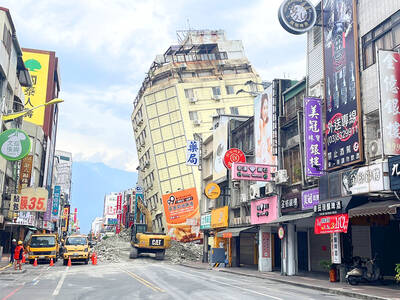
LANDSLIDES POSSIBLE: The agency advised the public to avoid visiting mountainous regions due to more expected aftershocks and rainfall from a series of weather fronts A series of earthquakes over the past few days were likely aftershocks of the April 3 earthquake in Hualien County, with further aftershocks to be expected for up to a year, the Central Weather Administration (CWA) said yesterday. Based on the nation’s experience after the quake on Sept. 21, 1999, more aftershocks are possible over the next six months to a year, the agency said. A total of 103 earthquakes of magnitude 4 on the local magnitude scale or higher hit Hualien County from 5:08pm on Monday to 10:27am yesterday, with 27 of them exceeding magnitude 5. They included two, of magnitude

CONDITIONAL: The PRC imposes secret requirements that the funding it provides cannot be spent in states with diplomatic relations with Taiwan, Emma Reilly said China has been bribing UN officials to obtain “special benefits” and to block funding from countries that have diplomatic ties with Taiwan, a former UN employee told the British House of Commons on Tuesday. At a House of Commons Foreign Affairs Committee hearing into “international relations within the multilateral system,” former Office of the UN High Commissioner for Human Rights (OHCHR) employee Emma Reilly said in a written statement that “Beijing paid bribes to the two successive Presidents of the [UN] General Assembly” during the two-year negotiation of the Sustainable Development Goals. Another way China exercises influence within the UN Secretariat is

Taiwan’s first drag queen to compete on the internationally acclaimed RuPaul’s Drag Race, Nymphia Wind (妮妃雅), was on Friday crowned the “Next Drag Superstar.” Dressed in a sparkling banana dress, Nymphia Wind swept onto the stage for the final, and stole the show. “Taiwan this is for you,” she said right after show host RuPaul announced her as the winner. “To those who feel like they don’t belong, just remember to live fearlessly and to live their truth,” she said on stage. One of the frontrunners for the past 15 episodes, the 28-year-old breezed through to the final after weeks of showcasing her unique


 RSS
RSS