


The US feels that visits to Beijing by Chinese Nationalist Party (KMT) Chairman Lien Chan (連戰) and People First Party (PFP) Chairman James Soong (宋楚瑜) will be productive only if they lead to dialogue between the Chinese leaders and the Democratic Progressive Party (DPP) government, the US State Department's leading specialist on cross-strait issues said.
Randall Schriver, the deputy assistant secretary of state in charge of China and Taiwan issues, told Taiwanese reporters on Tuesday that "ultimately, for this to be productive for all parties, the leaders in Beijing will ultimately have to talk to the elected leaders in Taiwan and the government that is in power."
Schriver's remarks indicated that Washington is reserving judgment on the pan-blue efforts to meet with Chinese officials, but is not ready to criticize the efforts.
He did have some positive words to say about the KMT and PFP trips to China, repeating what he had said earlier.
"Our view is that on the margins, dialogue is better than no dialogue at all," he said.
However, how Washington views the trips will hinge on "will it eventually contribute to dialogue that's broader across the political spectrum in Taiwan, or will it be limited to reaching out to just the opposition and potentially be eventually divisive in Taiwan," he said.
"We do not know yet," Schriver said. "We're watching this carefully."
He declined comment on whether the government should prosecute KMT Vice Chairman Chiang Pin-kun (
"That's internal Taiwan politics and legal matters," he said.
On overall relations, Schriver said the Bush administration "feels pretty good about things right now," after a rough patch during the run-up to last year's presidential and legislative elections when relations were severely strained over President Chen Shui-bian's (
Noting areas Washington and Taipei are working on cooperatively, including economic issues and counter-terrorism, Schriver said, "we have a very full agenda and we feel pretty good about it."
Trying to minimize the earlier frictions, which saw Bush publicly chastising Chen after a meeting with Chinese Premier Wen Jiabao (溫家寶), Schriver said, "even friends can't agree on everything all the time. So there are some areas where we need very close consultation."
On Taiwan's international status, Schriver evaded a question about whether he had earlier conceded that Taiwan enjoys a de facto independent status.
"I think what I said is that there is a de facto status in that the people of Taiwan can be very proud of a lot of that they have accomplished," he said. "We're equally proud of what they have accomplished" in political reform and economic successes.
"We're very proud to be Taiwan's champion on those issues in the international community," he said.
On Taiwan's quest for observer status in the World Health Association and its annual World Health Assembly in Geneva each May, Schriver indicated that Washington is working with "countries we regard as friends and like-minded countries on this issue" to try to secure observer status for Taiwan.
But if that cannot be achieved right away, Schriver said, Washington is discussing a range of interim options that would give Taiwan the ability to work with the WHO and "contribute in ways without any obstacles from Beijing to direct participation."
He made those comments as reports from Europe indicate that the EU countries might be willing to support Taiwan's case for observership at next month's WHA meeting, unlike their opposition in the past.
Ultimately, Schriver added, the US seeks "meaningful participation" in the WHO for Taiwan.
He made his comments at a going-away luncheon hosted by the Taiwanese press corps in Washington. He will leave his State Department post at the end of the month to join his mentor, former deputy secretary of state Richard Armitage in a consulting firm in Washington.
Due to a spat with the Taipei Times, Schriver barred the newspaper from joining the luncheon, but it obtained a tape of his on-the-record remarks.
also see stories:
KMT unveils details of Lien Chan's trip
DPP issues English version of policy on visits
Cross-strait dialogue is long-term goal, MAC says

NATIONAL SECURITY THREAT: An official said that Guan Guan’s comments had gone beyond the threshold of free speech, as she advocated for the destruction of the ROC China-born media influencer Guan Guan’s (關關) residency permit has been revoked for repeatedly posting pro-China content that threatens national security, the National Immigration Agency said yesterday. Guan Guan has said many controversial things in her videos posted to Douyin (抖音), including “the red flag will soon be painted all over Taiwan” and “Taiwan is an inseparable part of China,” while expressing hope for expedited “reunification.” The agency received multiple reports alleging that Guan Guan had advocated for armed reunification last year. After investigating, the agency last month issued a notice requiring her to appear and account for her actions. Guan Guan appeared as required,
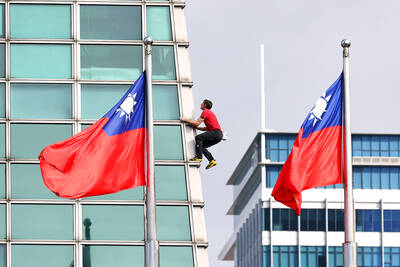
DAREDEVIL: Honnold said it had always been a dream of his to climb Taipei 101, while a Netflix producer said the skyscraper was ‘a real icon of this country’ US climber Alex Honnold yesterday took on Taiwan’s tallest building, becoming the first person to scale Taipei 101 without a rope, harness or safety net. Hundreds of spectators gathered at the base of the 101-story skyscraper to watch Honnold, 40, embark on his daredevil feat, which was also broadcast live on Netflix. Dressed in a red T-shirt and yellow custom-made climbing shoes, Honnold swiftly moved up the southeast face of the glass and steel building. At one point, he stepped onto a platform midway up to wave down at fans and onlookers who were taking photos. People watching from inside
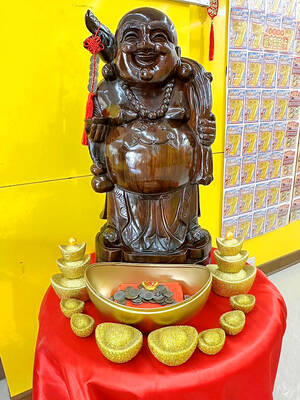
A Vietnamese migrant worker yesterday won NT$12 million (US$379,627) on a Lunar New Year scratch card in Kaohsiung as part of Taiwan Lottery Co’s (台灣彩券) “NT$12 Million Grand Fortune” (1200萬大吉利) game. The man was the first top-prize winner of the new game launched on Jan. 6 to mark the Lunar New Year. Three Vietnamese migrant workers visited a Taiwan Lottery shop on Xinyue Street in Kaohsiung’s Gangshan District (崗山), a store representative said. The player bought multiple tickets and, after winning nothing, held the final lottery ticket in one hand and rubbed the store’s statue of the Maitreya Buddha’s belly with the other,
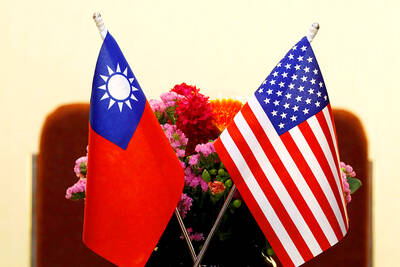
‘NATO-PLUS’: ‘Our strategic partners in the Indo-Pacific are facing increasing aggression by the Chinese Communist Party,’ US Representative Rob Wittman said The US House of Representatives on Monday released its version of the Consolidated Appropriations Act, which includes US$1.15 billion to support security cooperation with Taiwan. The omnibus act, covering US$1.2 trillion of spending, allocates US$1 billion for the Taiwan Security Cooperation Initiative, as well as US$150 million for the replacement of defense articles and reimbursement of defense services provided to Taiwan. The fund allocations were based on the US National Defense Authorization Act for fiscal 2026 that was passed by the US Congress last month and authorized up to US$1 billion to the US Defense Security Cooperation Agency in support of the


 RSS
RSS