


Cross-strait exchanges should abide by the law, which states that no political parties, groups or individuals have the right to represent the Taiwanese people or replace the government's authority, the Presidential Office said.
This was one issue in a seven-point conclusion announced by the Presidential Office late on Tuesday night, after a meeting convened by President Chen Shui-bian (陳水扁) with high-ranking officials from the Executive Yuan, the Democratic Progressive Party (DPP) and the DPP caucus.
Presidential Office Secretary-General Yu Shyi-kun said the meeting concluded that as cross-strait affairs are related to national sovereignty and the exercise of the government's authority, anyone who reaches an agreement with foreign governments, the other side of the Taiwan Strait, or the envoys they dispatch, will be dealt with according to the law.
"No political parties, groups or individuals have the right to represent the Taiwanese people or replace the government's authority," Yu said, adding that, "Cross-strait exchanges should abide by the law."
The seven-point conclusion comes in the wake of a visit to China by the opposition Chinese Nationalist Party (KMT). During the visit a 10-point agreement was established between the KMT and the Chinese Communist Party (CCP) regarding trade, agriculture, tourism and the protection of China-based Taiwanese businessmen.
Tuesday night's meeting also concluded that the overall interests of the nation and the well-being of the people come above the interests of political parties, especially regarding cross-strait contacts, dialogue and consultation, which should require a consensus to be reached among the political parties and the general public to best protect the nation's interests.
"President Chen is willing to meet with leaders from the governing and opposition parties so as to prevent a craze of China fever from undermining Taiwan's dignity and interests," Yu said.
Reiterating Chen's earlier comments that "the biggest difference between the two sides of the Strait is not the separate governments, but democracy vs. authoritarianism," the conclusion stated that "if Beijing really wants to close the gap between the peoples on both sides, it should not try to lure Taiwan with small favors under its undemocratic system."
Only the 23 million people of Taiwan have the right to decide the fate of the nation and the Beijing authorities should address and respect the will of the majority of people on Taiwan, the agreement said.
Additionally, cross-strait differences should be resolved peacefully through dialogue and that the choice and free will of the Taiwanese people should be respected, the conclusion said, adding that the government will base cross-strait relations on the principle of "reconciliation without flinching and steadfastness instead of confrontation."
The conclusion also stressed that the government should not ignore "effective management" and said the national security and administrative agencies should adjust related trade policy.
On issues related to cross-strait agriculture and the service sectors, the government should conduct consultations under the framework of the WTO, the conclusion said.
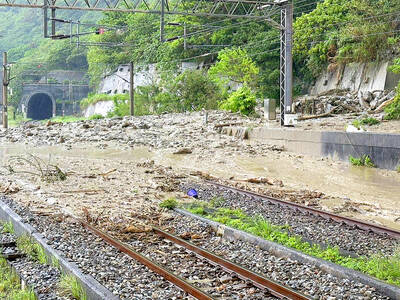
ROLLER-COASTER RIDE: More than five earthquakes ranging from magnitude 4.4 to 5.5 on the Richter scale shook eastern Taiwan in rapid succession yesterday afternoon Back-to-back weather fronts are forecast to hit Taiwan this week, resulting in rain across the nation in the coming days, the Central Weather Administration said yesterday, as it also warned residents in mountainous regions to be wary of landslides and rockfalls. As the first front approached, sporadic rainfall began in central and northern parts of Taiwan yesterday, the agency said, adding that rain is forecast to intensify in those regions today, while brief showers would also affect other parts of the nation. A second weather system is forecast to arrive on Thursday, bringing additional rain to the whole nation until Sunday, it

LANDSLIDES POSSIBLE: The agency advised the public to avoid visiting mountainous regions due to more expected aftershocks and rainfall from a series of weather fronts A series of earthquakes over the past few days were likely aftershocks of the April 3 earthquake in Hualien County, with further aftershocks to be expected for up to a year, the Central Weather Administration (CWA) said yesterday. Based on the nation’s experience after the quake on Sept. 21, 1999, more aftershocks are possible over the next six months to a year, the agency said. A total of 103 earthquakes of magnitude 4 on the local magnitude scale or higher hit Hualien County from 5:08pm on Monday to 10:27am yesterday, with 27 of them exceeding magnitude 5. They included two, of magnitude

CONDITIONAL: The PRC imposes secret requirements that the funding it provides cannot be spent in states with diplomatic relations with Taiwan, Emma Reilly said China has been bribing UN officials to obtain “special benefits” and to block funding from countries that have diplomatic ties with Taiwan, a former UN employee told the British House of Commons on Tuesday. At a House of Commons Foreign Affairs Committee hearing into “international relations within the multilateral system,” former Office of the UN High Commissioner for Human Rights (OHCHR) employee Emma Reilly said in a written statement that “Beijing paid bribes to the two successive Presidents of the [UN] General Assembly” during the two-year negotiation of the Sustainable Development Goals. Another way China exercises influence within the UN Secretariat is

Taiwan’s first drag queen to compete on the internationally acclaimed RuPaul’s Drag Race, Nymphia Wind (妮妃雅), was on Friday crowned the “Next Drag Superstar.” Dressed in a sparkling banana dress, Nymphia Wind swept onto the stage for the final, and stole the show. “Taiwan this is for you,” she said right after show host RuPaul announced her as the winner. “To those who feel like they don’t belong, just remember to live fearlessly and to live their truth,” she said on stage. One of the frontrunners for the past 15 episodes, the 28-year-old breezed through to the final after weeks of showcasing her unique


 RSS
RSS