


Iraqi lawmakers elected Industry Minister Hajim al-Hassani, a Sunni Arab, as parliament speaker yesterday, ending days of deadlock and moving forward on forming a new government two months after the country's historic elections.
The decision was a step toward repairing the tattered image of the newly elected National Assembly, which had bickered for days over who would take the speaker post. A session last Tuesday to choose a parliament speaker disintegrated into shouts and accusations.
"It's time for the patient, Iraqi people to be treated with the dignity that God has given them," al-Hassani said, accepting his new post.
In western Baghdad, officials were investigating an attack by dozens of insurgents who blew up car bombs and fired rocket propelled grenades late on Saturday outside the Abu Ghraib prison.
A statement purportedly made by al-Qaida's wing in Iraq claimed responsibility for the attack, which injured 44 U.S. servicemen and 12 prisoners.
The group, led by Jordanian militant Abu Musab al-Zarqawi, has said many of its latest killings were in revenge for Iraqi women being held by coalition authorities.
The U.S. military denies it is holding any Iraqi women.
Abu Ghraib was at the center of a prisoner abuse scandal that broke out last year when pictures showing soldiers piling naked inmates in a pyramid and humiliating them sexually became public.
Al-Hassani meanwhile urged his fellow lawmakers to work together, adding that "if we neglect our duties and fail, then we will hurt ourselves and the people will replace us with others."
Former nuclear scientist Hussain al-Shahristani, a Shiite, and Kurdish official Aref Taifour were elected as al-Hassani's deputies.
The three were chosen by secret ballot, with lawmakers allowed to write the names of no more than three of five possible candidates on pieces of paper that were dropped into a box. The votes were then read out loud and marked down, one-by-one, on a large, white board. Two ballots were left blank.
The three top candidates -- Al-Hassani with 215 votes, al-Shahristani with 157, and Taifour with 96 -- were elected.
Al-Hassani urged legislators to pledge their "allegiance to the country and the people, not to the party or the sect or the ethnicity." His statement was greeted by applause.
Lawmakers had focused on picking a Sunni Arab as speaker in an effort to reach out to the minority dominant under ousted dictator Saddam Hussein. Sunni Arabs, believed to make up the backbone of the insurgency, have a disproportionately small number of seats in parliament because many boycotted the election or stayed home because they feared attacks at the polls.
also see story:
Iraqis growing tired of violent insurgency
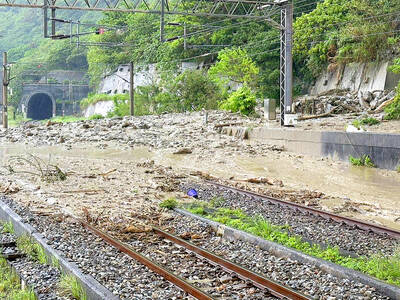
ROLLER-COASTER RIDE: More than five earthquakes ranging from magnitude 4.4 to 5.5 on the Richter scale shook eastern Taiwan in rapid succession yesterday afternoon Back-to-back weather fronts are forecast to hit Taiwan this week, resulting in rain across the nation in the coming days, the Central Weather Administration said yesterday, as it also warned residents in mountainous regions to be wary of landslides and rockfalls. As the first front approached, sporadic rainfall began in central and northern parts of Taiwan yesterday, the agency said, adding that rain is forecast to intensify in those regions today, while brief showers would also affect other parts of the nation. A second weather system is forecast to arrive on Thursday, bringing additional rain to the whole nation until Sunday, it
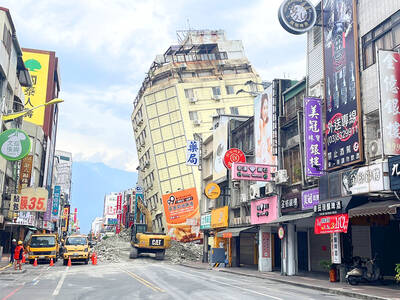
LANDSLIDES POSSIBLE: The agency advised the public to avoid visiting mountainous regions due to more expected aftershocks and rainfall from a series of weather fronts A series of earthquakes over the past few days were likely aftershocks of the April 3 earthquake in Hualien County, with further aftershocks to be expected for up to a year, the Central Weather Administration (CWA) said yesterday. Based on the nation’s experience after the quake on Sept. 21, 1999, more aftershocks are possible over the next six months to a year, the agency said. A total of 103 earthquakes of magnitude 4 on the local magnitude scale or higher hit Hualien County from 5:08pm on Monday to 10:27am yesterday, with 27 of them exceeding magnitude 5. They included two, of magnitude
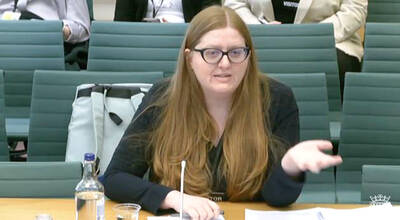
CONDITIONAL: The PRC imposes secret requirements that the funding it provides cannot be spent in states with diplomatic relations with Taiwan, Emma Reilly said China has been bribing UN officials to obtain “special benefits” and to block funding from countries that have diplomatic ties with Taiwan, a former UN employee told the British House of Commons on Tuesday. At a House of Commons Foreign Affairs Committee hearing into “international relations within the multilateral system,” former Office of the UN High Commissioner for Human Rights (OHCHR) employee Emma Reilly said in a written statement that “Beijing paid bribes to the two successive Presidents of the [UN] General Assembly” during the two-year negotiation of the Sustainable Development Goals. Another way China exercises influence within the UN Secretariat is

Taiwan’s first drag queen to compete on the internationally acclaimed RuPaul’s Drag Race, Nymphia Wind (妮妃雅), was on Friday crowned the “Next Drag Superstar.” Dressed in a sparkling banana dress, Nymphia Wind swept onto the stage for the final, and stole the show. “Taiwan this is for you,” she said right after show host RuPaul announced her as the winner. “To those who feel like they don’t belong, just remember to live fearlessly and to live their truth,” she said on stage. One of the frontrunners for the past 15 episodes, the 28-year-old breezed through to the final after weeks of showcasing her unique


 RSS
RSS