


In the weeks after Baghdad fell in April 2003, looters systematically dismantled and removed tons of machinery from Saddam Hussein's most important weapons installations, including some with high-precision equipment capable of making parts for nuclear weapons, a senior Iraqi official said last week in the government's first extensive comments on the looting.
The Iraqi official, Sami al-Araji, the deputy minister of industry, said it appeared that a highly organized operation had pinpointed specific plants looking for valuable equipment, some of which could be used for both military and civilian applications, and carted the machinery away Araji said his account was based largely on observations by government employees and officials who either worked at the sites or lived near them.
"They came in with the cranes and the lorries, and they depleted the whole sites," Araji said. "They knew what they were doing; they knew what they wanted. This was sophisticated looting."

PHOTO: AP
These types of facilities were cited by the Bush administration as a reason for invading Iraq, but they were left largely unguarded by coalition forces in the chaotic months after the invasion Araji's statements came just a week after a UN agency revealed that approximately 90 key sites in Iraq had been looted or razed after the US-led invasion. Satellite imagery analyzed by two UN groups -- the International Atomic Energy Agency and the Monitoring, Verification and Inspection Commission, or UNMOVIC -- confirm that some of the sites identified by Araji appear to be totally or partly stripped, according to officials at those agencies.
Araji said equipment capable of making parts for missiles as well as chemical, biological and nuclear arms was missing from eight or 10 sites that were the heart of Iraq's dormant program on unconventional weapons.
That program was the rationale for the US-led invasion, but occupation forces found no unconventional arms and CIA inspectors concluded that the effort had been largely abandoned after the 1991 Persian Gulf war.
Araji said he had no evidence where the equipment had gone. But his account raises the possibility that the specialized machinery from the arms establishment that the war was aimed at neutralizing had made its way to the black market or was in the hands of foreign governments.
Araji said he believed that the looters themselves were more interested in making money than making weapons.
Araji said that if the equipment had left Iraq, its most likely destination was a neighboring state.
also see story:
Analysts see low spirits aplenty from online holy warriors
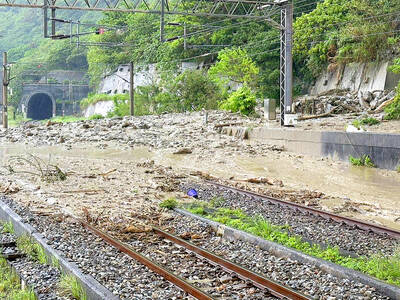
ROLLER-COASTER RIDE: More than five earthquakes ranging from magnitude 4.4 to 5.5 on the Richter scale shook eastern Taiwan in rapid succession yesterday afternoon Back-to-back weather fronts are forecast to hit Taiwan this week, resulting in rain across the nation in the coming days, the Central Weather Administration said yesterday, as it also warned residents in mountainous regions to be wary of landslides and rockfalls. As the first front approached, sporadic rainfall began in central and northern parts of Taiwan yesterday, the agency said, adding that rain is forecast to intensify in those regions today, while brief showers would also affect other parts of the nation. A second weather system is forecast to arrive on Thursday, bringing additional rain to the whole nation until Sunday, it
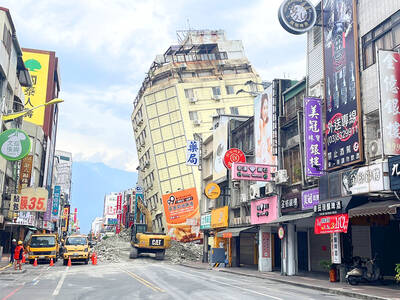
LANDSLIDES POSSIBLE: The agency advised the public to avoid visiting mountainous regions due to more expected aftershocks and rainfall from a series of weather fronts A series of earthquakes over the past few days were likely aftershocks of the April 3 earthquake in Hualien County, with further aftershocks to be expected for up to a year, the Central Weather Administration (CWA) said yesterday. Based on the nation’s experience after the quake on Sept. 21, 1999, more aftershocks are possible over the next six months to a year, the agency said. A total of 103 earthquakes of magnitude 4 on the local magnitude scale or higher hit Hualien County from 5:08pm on Monday to 10:27am yesterday, with 27 of them exceeding magnitude 5. They included two, of magnitude
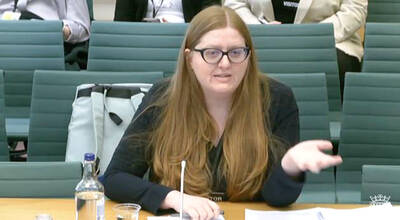
CONDITIONAL: The PRC imposes secret requirements that the funding it provides cannot be spent in states with diplomatic relations with Taiwan, Emma Reilly said China has been bribing UN officials to obtain “special benefits” and to block funding from countries that have diplomatic ties with Taiwan, a former UN employee told the British House of Commons on Tuesday. At a House of Commons Foreign Affairs Committee hearing into “international relations within the multilateral system,” former Office of the UN High Commissioner for Human Rights (OHCHR) employee Emma Reilly said in a written statement that “Beijing paid bribes to the two successive Presidents of the [UN] General Assembly” during the two-year negotiation of the Sustainable Development Goals. Another way China exercises influence within the UN Secretariat is

Taiwan’s first drag queen to compete on the internationally acclaimed RuPaul’s Drag Race, Nymphia Wind (妮妃雅), was on Friday crowned the “Next Drag Superstar.” Dressed in a sparkling banana dress, Nymphia Wind swept onto the stage for the final, and stole the show. “Taiwan this is for you,” she said right after show host RuPaul announced her as the winner. “To those who feel like they don’t belong, just remember to live fearlessly and to live their truth,” she said on stage. One of the frontrunners for the past 15 episodes, the 28-year-old breezed through to the final after weeks of showcasing her unique


 RSS
RSS