


Flooded with mounting complaints of corruption and official abuses, China's top judge and prosecutor promised yesterday to improve professional standards in the country's courts and listen more closely to the public.
In annual reports to the National People's Congress, they also promised to "refine" its controversial death penalty review process, but gave no explanation.
China imposes the death penalty for offenses ranging from murder to nonviolent crimes such as tax evasion, and is believed to account for most of the world's executions.
China's courts are often criticized for their frequent use of capital punishment, low professional standards and interference by Communist Party officials in rulings.
The judicial system is "trying its best to raise the quality of trials so as to reduce repeated complaints" from the same person about the same case, said the report by Xiao Yang (
He called on Chinese court officials to handle complaints more swiftly, while protecting petitioners from retaliation in cases where judges themselves are the target of grievances.
Courts nationwide handled more than 4 million complaints from the general public last year, while the number filed with the Supreme Court jumped 24 percent to 147,665, he said.
Xiao didn't detail those complaints, but many involve the seizure of land by local officials, unpaid wages, embezzlement of public money and other abuses.
Courts are also concerned about repeat complainers who gather collectively to voice grievances, Xiao said. He didn't elaborate, but the government worries that rising discontent about corruption and judicial abuses could threaten communist rule.
Xiao promised more training for judges and more openness at trials.
"By raising the political, professional and moral quality of judges and their staff ... we will raise the quality of trials," he said in his report.
Jia Chunwang (賈春旺), China's top prosecutor, also promised to improve training for local prosecutors and stepped up efforts to combat corruption and official abuses.
In an apparent effort to show that courts are giving a full airing to cases, Xiao said rulings in some 17,000 were overturned last year, though that accounted for only 0.34 percent of the total.
China will send some judges for training to Hong Kong and Macau, two former European colonies that have retained Western-style court systems since their return to Chinese rule, according to Xiao.
China will also do more to punish crooked judges and "deepen the struggle against corruption," he said.
But China's frequent use of the death penalty barely received mention in yesterday's judicial reports.
Xiao didn't give a total figure for the number of executions carried out last year, though he said appeal courts upheld 400 death sentences for economic offenses such as smuggling, tax fraud, counterfeiting and bribery.
The Rome-based group Hands Off Cain said China executed at least 5,000 people in 2003. Amnesty International put the figure at 726, but said that was based on incomplete information and the true number was believed to be much higher.
Meanwhile, China arrested over 800,000 people last year for a variety of crimes including endangering state security and being involved in separatist and terrorist activities, Jia said yesterday.
In total, 811,102 people were held, an 8.3 percent increase from 2003.
Jia said last year authorities were actively involved in anti-drug campaigns, crackdowns on pornographic web sites and other Internet crimes.
"[We were] resolute in smashing crimes which endanger state security and those criminal activities carried out by separatists, religious extremists and violent terrorists," Jia told lawmakers.
Endangering state security is a term China's communist leaders routinely use to detain people who oppose its rule.
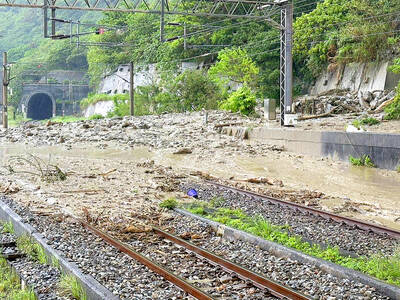
ROLLER-COASTER RIDE: More than five earthquakes ranging from magnitude 4.4 to 5.5 on the Richter scale shook eastern Taiwan in rapid succession yesterday afternoon Back-to-back weather fronts are forecast to hit Taiwan this week, resulting in rain across the nation in the coming days, the Central Weather Administration said yesterday, as it also warned residents in mountainous regions to be wary of landslides and rockfalls. As the first front approached, sporadic rainfall began in central and northern parts of Taiwan yesterday, the agency said, adding that rain is forecast to intensify in those regions today, while brief showers would also affect other parts of the nation. A second weather system is forecast to arrive on Thursday, bringing additional rain to the whole nation until Sunday, it

LANDSLIDES POSSIBLE: The agency advised the public to avoid visiting mountainous regions due to more expected aftershocks and rainfall from a series of weather fronts A series of earthquakes over the past few days were likely aftershocks of the April 3 earthquake in Hualien County, with further aftershocks to be expected for up to a year, the Central Weather Administration (CWA) said yesterday. Based on the nation’s experience after the quake on Sept. 21, 1999, more aftershocks are possible over the next six months to a year, the agency said. A total of 103 earthquakes of magnitude 4 on the local magnitude scale or higher hit Hualien County from 5:08pm on Monday to 10:27am yesterday, with 27 of them exceeding magnitude 5. They included two, of magnitude

CONDITIONAL: The PRC imposes secret requirements that the funding it provides cannot be spent in states with diplomatic relations with Taiwan, Emma Reilly said China has been bribing UN officials to obtain “special benefits” and to block funding from countries that have diplomatic ties with Taiwan, a former UN employee told the British House of Commons on Tuesday. At a House of Commons Foreign Affairs Committee hearing into “international relations within the multilateral system,” former Office of the UN High Commissioner for Human Rights (OHCHR) employee Emma Reilly said in a written statement that “Beijing paid bribes to the two successive Presidents of the [UN] General Assembly” during the two-year negotiation of the Sustainable Development Goals. Another way China exercises influence within the UN Secretariat is

Taiwan’s first drag queen to compete on the internationally acclaimed RuPaul’s Drag Race, Nymphia Wind (妮妃雅), was on Friday crowned the “Next Drag Superstar.” Dressed in a sparkling banana dress, Nymphia Wind swept onto the stage for the final, and stole the show. “Taiwan this is for you,” she said right after show host RuPaul announced her as the winner. “To those who feel like they don’t belong, just remember to live fearlessly and to live their truth,” she said on stage. One of the frontrunners for the past 15 episodes, the 28-year-old breezed through to the final after weeks of showcasing her unique


 RSS
RSS