


The release of a three-point outline for China's proposed anti-secession bill is not expected to impact Taiwan's economy, foreign investors and local academics said yesterday, while international rating agency Standard & Poor's said it has no plan to change its ratings on Taiwan in the near future.
The impending bill is also not likely to rock the nation's stock markets as no drastic measures were revealed by Beijing, they added.
China yesterday said it would allow the use of "non-peaceful means" to prevent independence by Taiwan in the event that efforts to secure peaceful unification are unsuccessful.
Against this backdrop, the benchmark TAIEX declined 0.8 percent to 6,173.34, while the NT dollar fell NT$0.004 to close at NT$30.875 against its US counterpart.
"I did not see any new ideas in the bill, which is pretty much the same as China's claims in the past," said Kung Ming-hsin (龔明鑫), an economist at the Taiwan Institute of Economic Research (TIER, 台經院).
The extent of any negative effect will depend on further details of the bill -- due to come out in the next few days -- and China's stated bottom line for "non-peaceful" action, Kung said.
Kung's view was echoed by other analysts, who said they did not expect a profound impact on Taiwan's stock markets.
"Investors had factored in the political concerns before the meeting of the congress. With the unveiling of the draft, the uncertainty hanging over the local stock markets should be lifted now," said George Wu (
Overseas fund managers have long seen cross-strait relations as one of the biggest risks for investing in Taiwan's stock markets. Investors tend to stay on the sidelines when cross-strait tension ratchet up, as they did last year during the presidential elections. Escalated tensions between Taipei and Beijing tend to put investors on the sidelines at the time.
Peter Sutton, head of a research team with CLSA Ltd in Taipei, said "There's nothing new at all."
With the improvement in cross-strait relations and a possible end to gridlock in the Legislative Yuan after the meeting between President Chen Shui-bian (
Direct links refers to direct trade, postal and transport links.
Another investor said the bill raises no significant concerns.
"China revealed no aggressive moves to curb Taiwan from secession, which means no imminent threat of war across the Taiwan Strait," said Wu Pei-wei (吳佩偉), a fund manager with ABN AMRO Asset Management in Taipei.
In addition, China did not set a timetable for unification with Taiwan, or for taking aggressive military actions to thwart the "renegade province" from independence, which means long-term foreign direct investment in Taiwan should not be affected, said Wu Chung-shu (
Standard & Poors (S&P) on Nov. 30 last year gave Taiwan a "AA-" foreign currency debt rating and a "negative" sovereign outlook, citing political tensions with China and a deteriorating fiscal situation.
But the rating agency believes that there is room to interpret China's bill in two ways, a credit analyst at S&P told the Taipei Times yesterday.
"On the one hand China reiterated its position that it is willing to use non-peaceful means to prevent Taiwanese independence. On the other hand it promised to explore all diplomatic means available to resolve the dispute," Philippe Sachs said in a telephone interview from Singapore.
Although S&P believes rising Chinese nationalism and moves by Taiwan away from unification could lead to heightened tensions, the passage of the bill will not necessarily result in a worsening of relations in the near term, Sachs said.
"We have to wait and see how Taiwan reacts to the passage of the law ... Will Taiwan react positively to the tempered language in the proposed law or will they react negatively, thus reversing some warming in relations in recent weeks. Regardless, at this point we have no plan to change our ratings on Taiwan in the near future," Sachs said.
The bill's passage is not expected to deter Taiwanese businesspeople from investing in China, Academia Sinica's Wu said.
"The substantial economic and trade exchanges across the Taiwan Strait will never stop in spite of sporadic conflicts in the political arena," Wu said.
As a result, any short-term impact would be from strong emotional reactions from some local groups, which could cause foreign investors to put a hold on investment in Taiwan, he added.
Looking ahead, ABN AMRO's Wu said he expects the TAIEX to climb another 15 percent to 7,000 points by mid-year, boosted by purchases by foreign investors.
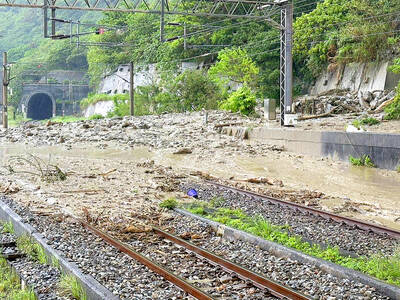
ROLLER-COASTER RIDE: More than five earthquakes ranging from magnitude 4.4 to 5.5 on the Richter scale shook eastern Taiwan in rapid succession yesterday afternoon Back-to-back weather fronts are forecast to hit Taiwan this week, resulting in rain across the nation in the coming days, the Central Weather Administration said yesterday, as it also warned residents in mountainous regions to be wary of landslides and rockfalls. As the first front approached, sporadic rainfall began in central and northern parts of Taiwan yesterday, the agency said, adding that rain is forecast to intensify in those regions today, while brief showers would also affect other parts of the nation. A second weather system is forecast to arrive on Thursday, bringing additional rain to the whole nation until Sunday, it

LANDSLIDES POSSIBLE: The agency advised the public to avoid visiting mountainous regions due to more expected aftershocks and rainfall from a series of weather fronts A series of earthquakes over the past few days were likely aftershocks of the April 3 earthquake in Hualien County, with further aftershocks to be expected for up to a year, the Central Weather Administration (CWA) said yesterday. Based on the nation’s experience after the quake on Sept. 21, 1999, more aftershocks are possible over the next six months to a year, the agency said. A total of 103 earthquakes of magnitude 4 on the local magnitude scale or higher hit Hualien County from 5:08pm on Monday to 10:27am yesterday, with 27 of them exceeding magnitude 5. They included two, of magnitude

CONDITIONAL: The PRC imposes secret requirements that the funding it provides cannot be spent in states with diplomatic relations with Taiwan, Emma Reilly said China has been bribing UN officials to obtain “special benefits” and to block funding from countries that have diplomatic ties with Taiwan, a former UN employee told the British House of Commons on Tuesday. At a House of Commons Foreign Affairs Committee hearing into “international relations within the multilateral system,” former Office of the UN High Commissioner for Human Rights (OHCHR) employee Emma Reilly said in a written statement that “Beijing paid bribes to the two successive Presidents of the [UN] General Assembly” during the two-year negotiation of the Sustainable Development Goals. Another way China exercises influence within the UN Secretariat is

Taiwan’s first drag queen to compete on the internationally acclaimed RuPaul’s Drag Race, Nymphia Wind (妮妃雅), was on Friday crowned the “Next Drag Superstar.” Dressed in a sparkling banana dress, Nymphia Wind swept onto the stage for the final, and stole the show. “Taiwan this is for you,” she said right after show host RuPaul announced her as the winner. “To those who feel like they don’t belong, just remember to live fearlessly and to live their truth,” she said on stage. One of the frontrunners for the past 15 episodes, the 28-year-old breezed through to the final after weeks of showcasing her unique


 RSS
RSS